



Arab American attorney Shereef Akeel does not hide his enthusiasm for adding a new chapter to his distinguished career defending civil rights, the law and the Constitution — this time by running for a seat on the Board of Governors at Wayne State University in Detroit.
Akeel is competing for the Democratic Party nomination at its state convention on April 19, ahead of the general election in November for two open seats on the university’s Board of Governors. Founded in 1868, Wayne State University is now the third-largest university in Michigan, with more than 24,000 students.
Belief in America
Akeel began his conversation with The Arab American News with a sentence that seemed like a cornerstone before any discussion of elections or positions: “I am the son of immigrants.” He did not present it as a slogan or an emotional appeal, but rather as an intellectual reference point.
According to the Egyptian-born attorney, the phrase is not decorative or campaign rhetoric — it is the foundation through which he views America, the Constitution and the meaning of public responsibility.
Akeel emphasized that speaking about immigration is not merely recounting personal history, but rather a way to understand authority and public policy.
“Immigrants come here… and they add,” he said. “They are not a burden. They are the story of America.
“My parents came to the United States from Egypt because they believed in opportunity, equality under the law and the idea that education and hard work could build a meaningful life. I was born in California, and later we moved to Michigan. Michigan became home.
“Growing up, I watched my father — an engineer in robotics — build things that mattered. He invented a robot. He contributed to American innovation. Like so many immigrants, he didn’t come here to take; he came here to build. That shaped me permanently. When I see fear directed at immigrants — especially educated immigrants — I don’t see a political talking point. I see my father.”
Education first
Akeel said that in the home where he grew up, “education was not optional.” He graduated from Stevenson High School in Sterling Heights before attending the University of Michigan, where he earned a bachelor’s degree in accounting because, as he explained, he wanted to understand systems — how institutions function and how decisions at the top affect ordinary people.
He later enrolled at Wayne State University, earning a Master of Business Administration (MBA), then became a certified public accountant before graduating from the Detroit College of Law (now affiliated with Michigan State University) and becoming an attorney in 1996.
He worked in accounting and insurance before entering the courtroom, which gave him practical insight into “reading reality.”
“When they talk about budgets or deficits or negotiations… I understand what the numbers mean and how they turn into decisions,” he said.
He studied law at night while working during the day to support his family.
“I studied at night… I had a family… yes, it was a heavy burden… but I kept going.
“I am married to Dalia and we have five children,” he said with a laugh. “I tried to have a daughter… but that didn’t happen.”
He noted that his family constantly reminds him that “behind every legal case is a full life” and that “rights” are not abstract concepts but realities that affect people’s lives.
Among the influential figures in his life, Akeel mentions his father and his uncle, constitutional thinker Ahmed Kamal Aboul Magd. Watching his uncle defend civil rights and women’s rights in Egypt showed him how politics can pressure the law.
Comparing Egypt and the United States shaped his professional outlook. In Egypt, he saw political power override the law. In America, he saw the strength of the Constitution, the Bill of Rights, the First Amendment and due process protections.
“The Constitution here is strong… but not because it’s written,” he said. “It’s strong because there are lawyers willing to defend it.”

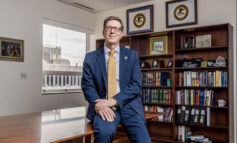
Attorney Shereef Akeel at his office. – File photo.
Civil rights battles
Akeel began his legal career as a personal injury attorney, but the September 11 attacks changed his professional direction. Fear, he recalls, was moving faster than the law.
He remembers how Arab American and Muslim organizations became targets of suspicion, and how assets and bank accounts were frozen without clear charges. That pushed him to shift his focus to civil rights litigation.
“We began filing lawsuits… we began suing banks,” he said.
He recounts the first case that marked a turning point: a Yemeni American man who had worked for nearly 15 years in Dearborn and was told after 9/11, “Go home. Tell your leader we don’t want your kind here.”
“I took the case… it was my first civil rights lawsuit… and that’s what put me on this path,” he said, explaining that it was not merely professional, but deeply human. When years of work and integration collapse under a wave of fear, a lawyer’s task becomes restoring balance.
He filed lawsuits against major financial institutions, including Bank of America, over freezing accounts without due process.
“We sued the banks… and then we began suing the government, too.”
Akeel also handled numerous civil rights cases involving discrimination at border crossings.
“They would ask: ‘Do you practice your religion? How many times do you pray? Do you pray at dawn?’”
He described such questioning as unconstitutional and filed lawsuits against U.S. Customs and Border Protection and the Department of Homeland Security over what he called “religious tests.”
He challenged secret procedures used to place individuals on no-fly or travel ban lists.
“How do you ban someone and not tell them why?” He asked, adding, “We sued… and we won.”
Akeel also pursued accountability for atrocities committed at Abu Ghraib prison in Iraq, securing $42 million in compensation for victims in a complex class-action lawsuit that lasted nearly 20 years. After photos aired on 60 Minutes, a former detainee came to his Dearborn office seeking help. The case evolved into litigation against military contractors who oversaw operations at the prison, including CACI International and Blackwater.
“We sued them for torture and crimes against humanity — and we won,” he said.
He personally traveled to Iraq in 2004 to obtain authorizations from victims. He grew a beard and wore local clothing because, as he explained, “people there didn’t like Americans.
“They didn’t speak English… and it was a very dangerous period,” he added. “But justice requires that you show up — that you meet people — that you listen.”
The case lasted 20 years. In November 2024, a final ruling in Virginia affirmed that crimes committed abroad are not beyond accountability.
Akeel’s platform
After major victories in civil rights cases involving travel bans and religious discrimination, Akeel turned his focus toward universities — particularly foreign students affected by President Trump’s policies.
“I am very concerned about foreign students,” he said. “If they become afraid and leave for Germany or Japan or elsewhere, we will lose minds, we will lose innovation, we will lose research.”
He stressed the importance of protecting international students, especially at Wayne State, which he described as “the anchor of Detroit and a hub for first-generation students.” He emphasized the need to improve the university’s four-year graduation rate, which stands at 36 percent — far below the national average of 70 percent.
“Why aren’t first-generation students getting the support they need to graduate on time?” he asked.
Akeel also advocates updating university facilities, noting student complaints about parking costs and malfunctioning elevators as signs of misplaced priorities.
His campaign platform includes expanding scholarships and financial aid to ease student debt, increasing enrollment by making tuition affordable for working-class and first-generation students, protecting students’ and faculty members’ rights to expression and organization and ensuring a safe and inclusive campus environment.
He also supports collective bargaining and expanding union job opportunities.
“Without professors and staff, there is no university,” he said.
Drawing on his background as a CPA, Akeel calls for “open and accountable management” of university resources. He pledges to involve students, faculty and unions in Board decisions, ensure transparency in budgeting and long-term planning and prioritize recruiting and retaining high-quality educators, while strengthening diversity, equity and inclusion as core governance principles.
The road ahead
In recent weeks, Akeel has been traveling across Michigan building support ahead of the Democratic Party convention at Huntington Place in downtown Detroit on April 19, where thousands of delegates will select nominees for several races, including the two Wayne State Board seats.
The attorney — who says he “never planned to be a politician” — explained that his decision to run came at the urging of students and alumni who contacted him.
“They told me, Uncle Shereef… we want you to run on our behalf.”
Those words, he said, made his candidacy “a duty, not a political experiment.”
Since then, Akeel has visited Kalamazoo, Marquette, Grand Rapids, Warren, Sterling Heights, Detroit, Dearborn, Bloomfield Hills and other communities “to listen and to explain.
“When Wayne State is strong, Detroit is strong… and when Detroit is strong, Michigan is strong,” he emphasized.


Leave a Reply