


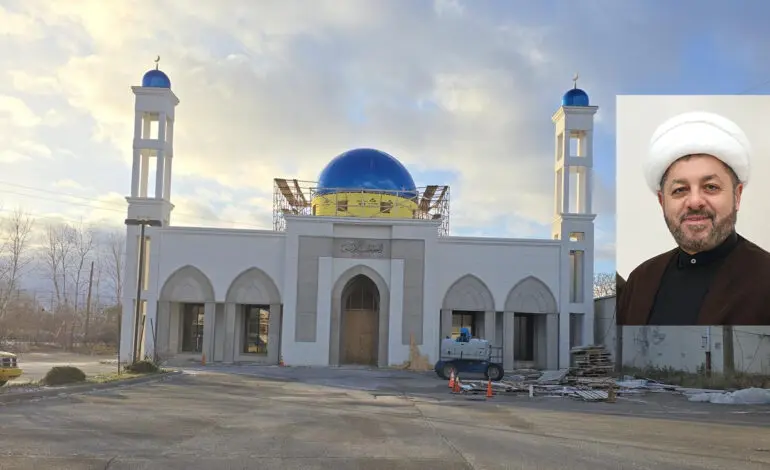

The story behind the construction of Mosque of the Prophet, affiliated with the Islamic Institute of Knowledge, is not merely another success story about building a beautiful and distinctive architectural landmark in Dearborn. Rather, it reflects a layered experience that mirrors how institutions are formed in the diaspora — how a daily need becomes a decision, a decision becomes a project and a project becomes a reality that asserts itself.
Between these stages, small details intersect with major transformations to ultimately produce the story of a mosque built not only with stone, but with determination, seriousness and a trust that accumulated step by step over decades.
Opened during Ramadan
On the first night of its opening during the past month of Ramadan, as the call to Maghrib prayer signaled the beginning of the communal iftar, the scene quickly took shape in a way that left no room for interpretation: a continuous flow of people, rows forming and filling rapidly, constant movement and a space that filled all at once.
Sheikh Dr. Baqir Berry, imam of the Islamic Institute of Knowledge, summarized that moment.
“From the very first night… the mosque was completely full,” he said.

Sheikh Dr. Baqir Berry, imam of the Islamic Institute of Knowledge and Mosque of the Prophet on Schaefer Road in Dearborn.
It was not gradual. It was a revealing moment in which all concerns and hesitations collapsed. The question of whether a new mosque was necessary shifted from a debatable idea to an obvious need that could no longer be postponed.
Day after day, that reality became even clearer. Despite its size, the new mosque struggled to accommodate the large numbers of worshipers, especially during evening and voluntary prayers in Ramadan. The Nights of Qadr marked the peak, with attendance exceeding expectations and forcing some worshipers to pray outside.
The first Friday prayer delivered the final verdict on any previous doubt. The question once posed to Sheikh Berry — “Do we really need this space?” — was answered by the people and the crowd.
When the mosque overflows
In a broader reflection, Berry explained that the issue was not a sudden moment, but rather the result of prolonged daily pressure experienced by the community.
Overcrowding was not the exception — it had become the norm, creating what he described as an “adaptation to tightness”, until that condition itself led to the conviction that continuing this way was no longer possible.
For years, the prayer space at the Islamic Institute of Knowledge had been unable to accommodate the numbers, particularly on Fridays and during Ramadan. Hallways turned into prayer rows, and corridors became extensions of the congregation. Women, in particular, faced even greater difficulty finding adequate space.
“The institute was performing a role far greater than its capacity… and that was not something we could continue,” Berry told The Arab American News.
The problem was not only limited space, but the gap between the role the institute played and the resources available.
The hardest step
Berry explained that the most difficult part of the project was not construction itself, but making the decision.
Large projects are not measured solely by their size, but by the ability to sustain them. The central question was not desire — it was capability.
He noted that this type of “conscious hesitation” was necessary, as it prevents entering into poorly calculated projects and leads to more mature and responsible decisions.
Despite the clear need for more space, the decision to build was not easy. Initial estimates placed the cost between $4 million and $5 million, with long-term commitments extending for years, if not decades.
“The question was not ‘Should we build?’ but ‘Can we continue?’” Berry said, emphasizing that this hesitation reflected a deep awareness of the financial challenges and the need to assess the project’s sustainability.
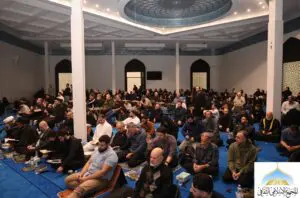
Worshipers inside the Mosque of the Prophet during Ramadan. – Photos by the Islamic Institute of Knowledge
The moment that changed everything
Amid this hesitation, an unexpected opportunity emerged: the chance to purchase the building adjacent to the Islamic Institute of Knowledge on Schaefer Road in Dearborn.
The property had not been part of expansion plans, but it appeared to be the answer.
“We were not planning for this… but when it was presented to us, it felt like more than a coincidence,” Berry said.
The purchase was not just an expansion — it became a turning point that reshaped the entire project, linking old and new into a unified vision.
In a telling detail, Berry pointed to a corner of the old building that had once seemed insignificant.
“We used to say we didn’t need it,” he said.
It later became the main passage connecting the new mosque to the original complex, which opened in 1998.
“What seems marginal at the beginning became essential in the end,” he said.
Numbers that reflect transformation
Today, the new mosque — with its blue domes — accommodates approximately 600 worshipers, with capacity reaching 700 during peak times.
The prayer hall measures about 6,600 square feet, while the total mosque area is 11,400 square feet.
Berry noted that the layout of the carpeting improved efficiency and organization of prayer rows, reflecting the importance of thoughtful design.
The mosque was not designed as a purely aesthetic space, but as a fully functional system: an open hall, clear sound, balanced lighting and carefully planned movement pathways.
Engineer Alain Abbas oversaw the architectural design, achieving a balance between Islamic identity and American environmental requirements. Calligrapher Harout Bastajian, designed the Quranic inscriptions inside the mosque, alongside other Lebanese calligraphers.
Project management included a team alongside Sheikh Berry and Sharif Makki: Engineer Alain Abbas, Hajj Akram Bazzi, Dr. Ali Berry, Hajj Ali Khalaf, Hajj Fouad Berry, engineer Mohammad Jouni and Hajj Ali Moukalled — a collective model aimed at ensuring continuity.
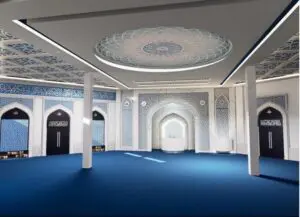
Inside the Mosque of the Prophet adjacent to the Islamic Institute of Knowledge on Schaefer Road in Dearborn.
Funding
Sheikh Berry emphasized that the project’s success was not only tied to the amount of donations, but their nature.
The goal was not simply fundraising, but building a relationship between people and the project — where every donor, even with a small amount, felt part of the construction.
This model provided real stability, as funding was continuous and rooted within the community.
The project cost approximately $5 million. Notably, it did not rely on a single funding source, but on the community as a whole — through donation drives, social events, individual contributions and long-term monthly commitments.
Berry described the monthly contribution system as the “real secret” behind the project’s success.
He recalled a woman who said she could not afford a large donation. The alternative: she could contribute monthly.
That monthly contribution became an option or rather a model.
Over four years, many committed to monthly contributions, each according to their ability.
One of the most moving stories involved a woman who sent a $1,000 check. When asked why, she said she had a dream in which she and her children were in distress and found safety leaning against a mosque wall.
“I felt this mosque would be a refuge for others,” she said. She later donated a larger amount.
Berry also noted that funding was not limited to one group — members of the community from different backgrounds contributed, including Sunnis and Palestinians, giving the project a unifying character reflected inside the mosque itself.
A broader social role
Berry revealed that one of the project’s key transformations is redefining the role of the mosque beyond its traditional framework.
The mosque is no longer just a place of worship, but a meeting point for individuals facing psychological struggles, social pressures or addiction-related issues.
Such individuals find in the mosque an environment of support rather than judgment.
“These cases don’t just need advice,” he said. “They need guidance, compassion, understanding and reintegration into society.”
Support for the poor remains central, but now extends beyond financial aid to building a real support network.
“The mosque should be a place that helps people stand again and prosper… not just a place for prayer,” Berry added.
A vision rooted in the 1980s
Berry emphasized that today’s achievement is an extension of the vision of his father, Imam Abdul Latif Berry, who founded the institute in the 1983 on the principle that the mosque is a center for shaping people’s lives — not just a place of worship.
This idea remained present throughout all stages since inception — from hesitation to decision, through execution and ultimately the opening, which from the very first night demonstrated that the mosque was not merely a spatial need, but a full community necessity.
Despite the achievement, work is not yet complete. External facilities — including parking, landscaping and services — still require development.
But as the experience proved, a project built on community commitment is likely to be completed in the same way: Step by step and in the same spirit of cooperation.
It is worth noting that the Islamic Institute of Knowledge was established in 1983 under the leadership of Imam Abdul Latif Berry. Its first location was on Warren Avenue in Dearborn before moving in 1998 to its current location at 6345 Schaefer Road.
In 2001, the American Islamic Academy — a comprehensive school from kindergarten through 12th grade — was added. The institute later expanded again with the opening of the Mosque of the Prophet during Ramadan this year.
Leave a Reply