



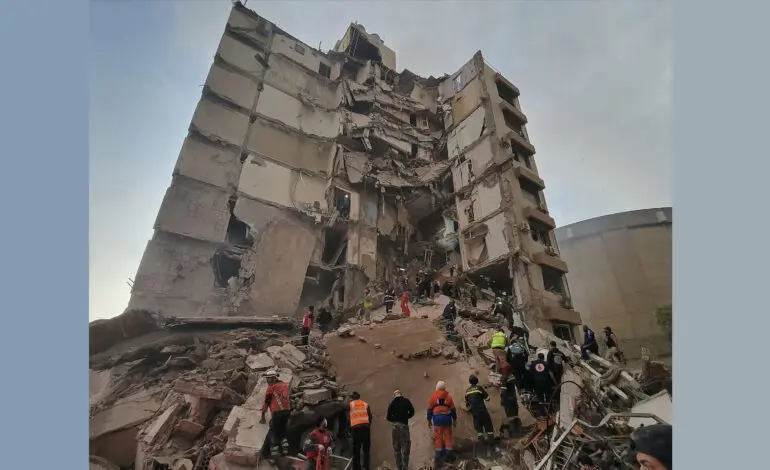

BEIRUT – In one of the deadliest episodes in Lebanon since the end of the civil war in 1990, Israeli airstrikes killed more than 300 people and wounded more than 1,100 in a matter of minutes, according to Lebanese officials, leaving entire neighborhoods in ruins and overwhelming hospitals across Beirut.
The strikes, which hit more than 100 locations across the country in roughly 10 minutes on Wednesday, marked a sharp escalation in Israel’s ongoing military campaign and drew accusations from Lebanese officials that civilians were deliberately targeted.
A neighborhood turned war zone
In the Barbour neighborhood of central Beirut, residents described scenes of chaos and destruction following the strikes.
Omar Rakha, a 38-year-old supermarket owner, told the Guardian he heard warplanes overhead but did not immediately register the explosions. He later regained consciousness face down in the street, bleeding, after a nearby building was leveled.
“I really didn’t think something like this would happen here,” Rakha told the Guardian, noting that the area had previously been considered relatively safe. “Nothing like this happened in the last war, and because of that all of the refugees came here for safety.”
Nearby, 24-year-old trainer Shaden Fakih rushed toward the impact site, searching for his friend Mahmoud, who had been inside the building. He was unable to get close as the structure had collapsed into burning rubble.
“There’s no Hezbollah here,” Fakih told the Guardian. “Just stop bombing us… If you want to target Hezbollah, do it, but don’t kill civilians.”
Hospitals overwhelmed
Doctors described a flood of casualties arriving within minutes, overwhelming medical facilities.
Dr. Ghassan Abu-Sittah, a surgeon at the American University of Beirut Medical Center, said many of the wounded were children pulled from under rubble, some arriving alone and unidentified.
“The youngest was an 11-month-old,” he told the Guardian. “I had to operate on him just to relieve pressure in the head.”
Dr. Firass Abiad, Lebanon’s former health minister, said dozens of critically injured patients arrived simultaneously, including elderly victims and those suffering severe crush injuries.
“These are civilians who, without any warning, their entire apartment building was flattened,” Abiad told the Guardian. “There was nothing we could do.”
Civilians or targets?
The Israeli occupation forces said the strikes targeted Hezbollah “command and control centers” in what it called “Operation Eternal Darkness.”
However, Lebanese officials rejected that claim.
Prime Minister Nawaf Salam accused Israel of striking “densely populated residential neighborhoods” and killing civilians in violation of international law.
Medical officials and residents also questioned the use of 1,000-pound bombs in crowded urban areas, suggesting the scale and timing of the strikes were designed to overwhelm emergency response systems.
Abu-Sittah said the surge of casualties appeared intentional.
“This was meant to flood the health system,” he told the Guardian, comparing the aftermath to mass casualty events he witnessed in Gaza.
Expanding targets
Barbour, like many of the areas hit, had not previously been considered part of Israel’s battlefield in Lebanon.
But Israeli military spokesperson Avichay Adraee claimed without any evidence that Hezbollah fighters had moved into mixed neighborhoods in Beirut, signaling a broader targeting strategy.
The strikes also shattered hopes that a ceasefire between Israel and Iran might ease tensions in Lebanon.
Since fighting escalated in early March, more than 1,800 people have been killed and nearly 6,000 wounded in Lebanon.
Desperation and loss
As rescue crews searched through rubble, scenes of grief and confusion unfolded across the city.
Emergency responders worked through debris, pulling bodies and injured survivors from collapsed buildings. In some cases, only remains were recovered.
Families searched desperately for loved ones, sharing images across social media.
One widely circulated photo showed an elderly couple, Mohammed and Khatoun Karshat, who were later confirmed dead after being found beneath the rubble.
A turning point
Residents warned that the strikes could have long-term consequences.
“These attacks are creating anger,” Fakih said. “People will be pushed toward Hezbollah just to defend themselves.”
As night fell, Beirut residents struggled to process the scale of the devastation.
“It’s been the worst day since the war started,” Fakih said. “And what I’m most sad about is that my beautiful Lebanon… it’s being destroyed.”


Leave a Reply