



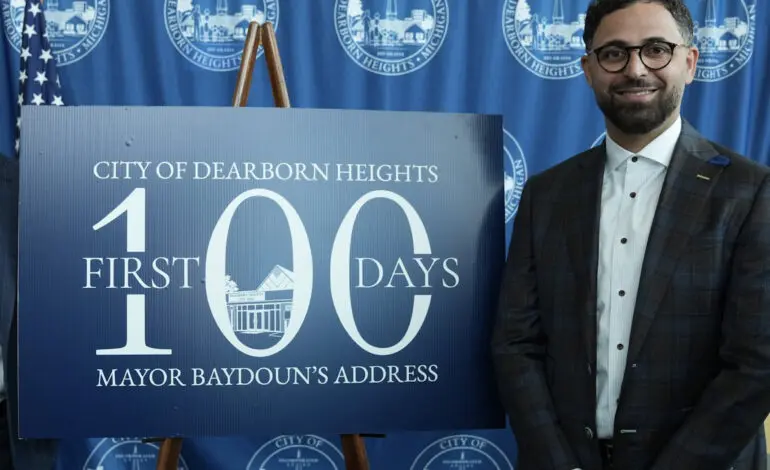

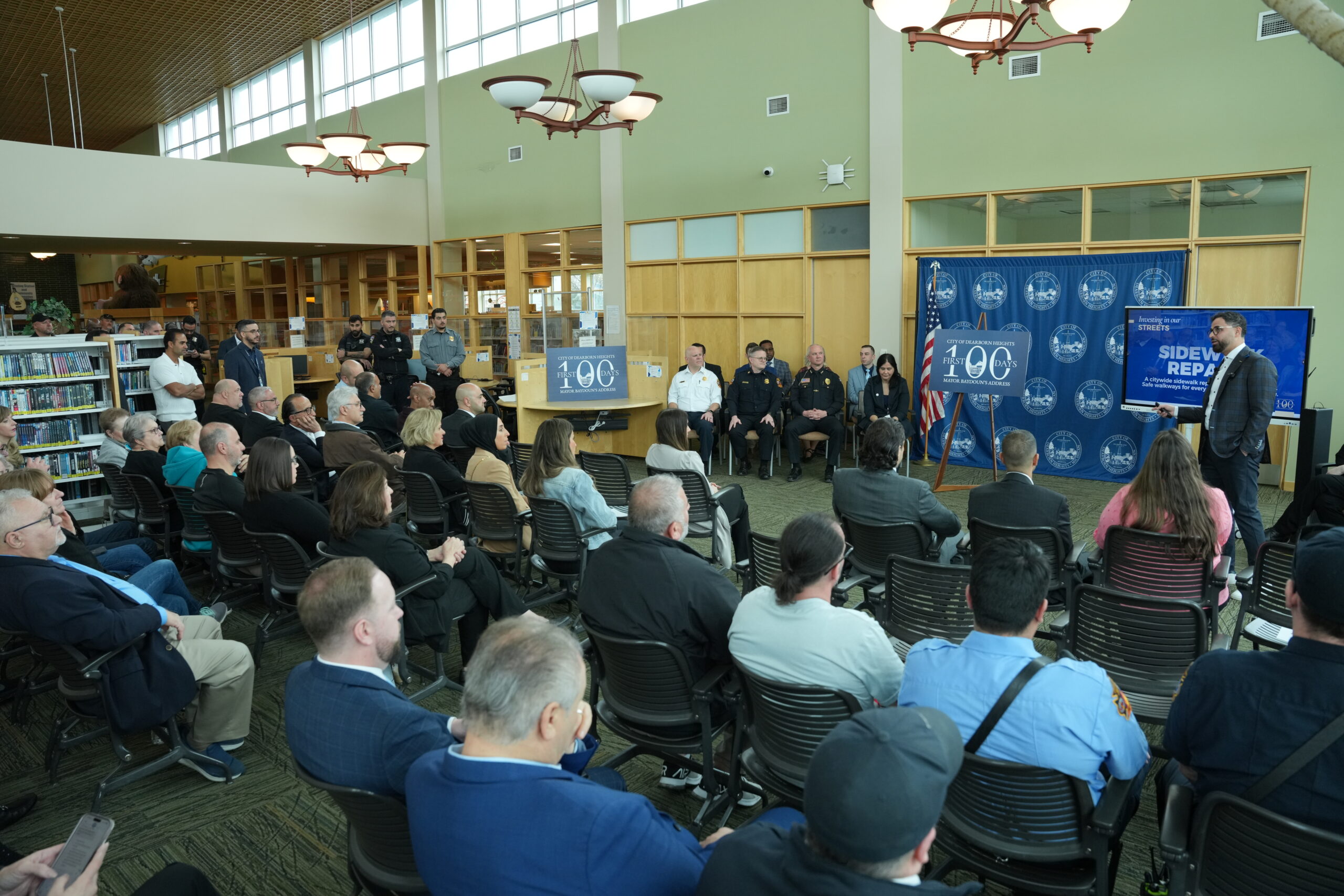
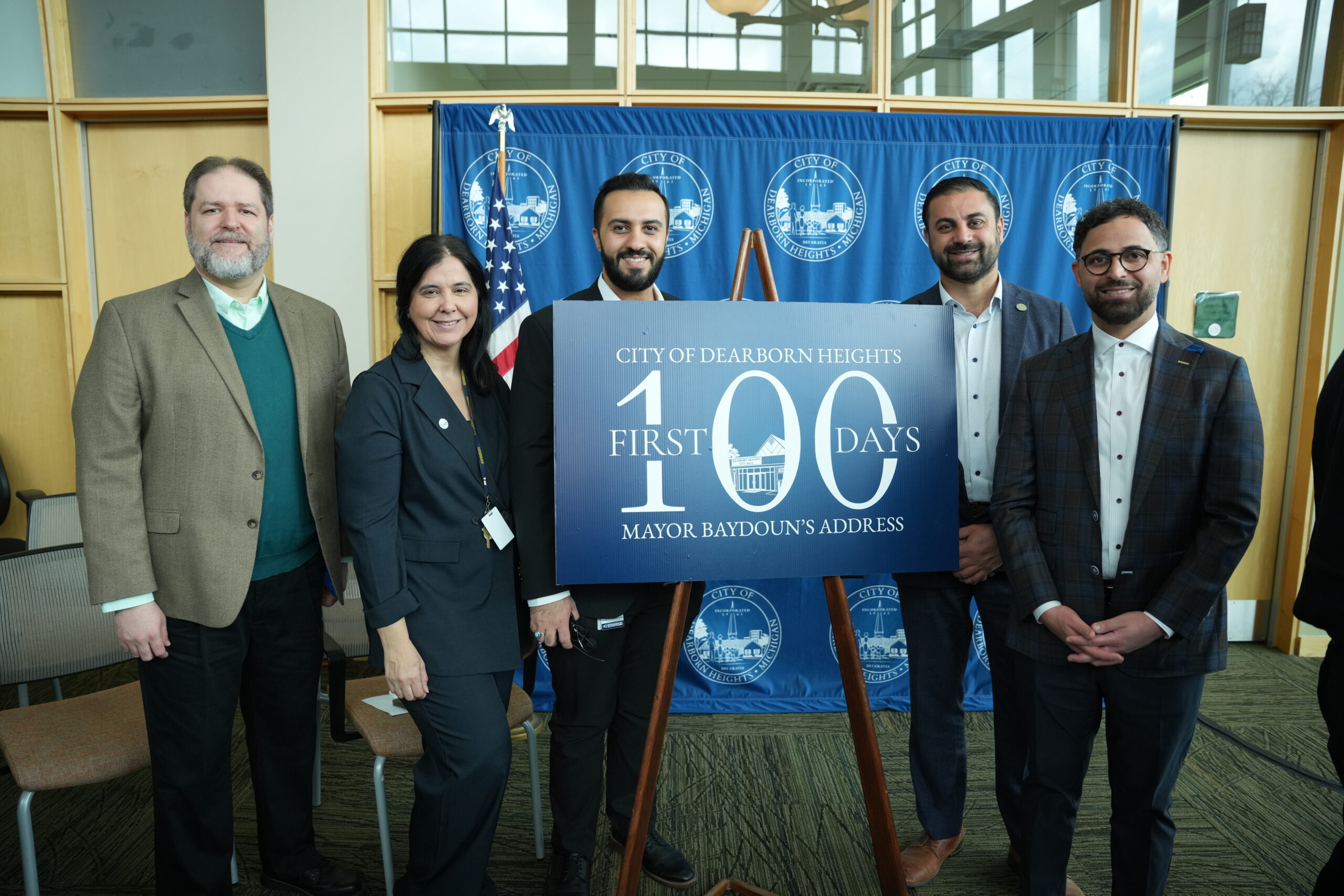
DEARBORN HEIGHTS — On Monday, during a town hall meeting with residents under the theme “Results, Not Promises”, Mayor Mo Baydoun presented a comprehensive overview of his administration’s first 100 days, highlighting significant progress across public safety, infrastructure, economic development, technology modernization and expanded city services.
The event, held at the Caroline Kennedy Library and attended by local officials and dozens of residents, detailed a broad reform agenda that included restructuring the city’s budget, establishing a new grants department and fully staffing the fire department for the first time in a decade.
Baydoun said his administration eliminated $500,000 in unnecessary spending from a city budget that had exceeded projections by approximately $11.6 million over the previous four years under former Mayor Bill Bazzi.
Public safety improvements
Public safety has been a central focus during Baydoun’s first 100 days.
Police increased patrols across major roads and residential neighborhoods, issuing more than 6,200 traffic citations aimed at curbing reckless driving.
Baydoun praised Police Chief Michael Guzowski for reducing officer overtime by more than 50 percent through improved scheduling, without cutting services. The department also introduced body cameras equipped with real-time translation capabilities to improve communication with residents from diverse backgrounds, and added a new police K-9 unit to enhance detection and enforcement capabilities.
In a major milestone, Baydoun confirmed that all vacancies in the Dearborn Heights Fire Department have been filled for the first time in 10 years.
Plans are also underway to build a new modern fire station named after former Fire Chief David Brogan, supported by government grants secured with the help of U.S. Rep. Rashida Tlaib, State Representatives Alabas Farhat and Erin Byrnes and Wayne County Executive Warren C. Evans.
Baydoun added that his administration has already begun upgrading emergency services with the acquisition of two new ambulances.
Infrastructure and public works
The city’s Department of Public Works invested approximately $1.3 million in new trucks and equipment to improve operational efficiency.
The Department of Community and Economic Development relaunched a citywide sidewalk repair program and installed new stop signs and speed humps at dangerous intersections and near schools and parks.
Baydoun said the city is planning to install a new traffic signal near Crestwood High School on Beech Daly Road to improve traffic flow and safety.
Construction work along Ann Arbor Trail, between Parkland and Outer Drive, is scheduled to begin later in this month.
The administration is also continuing flood mitigation efforts by purchasing and demolishing flood-prone homes near the Ecorse Creek and converting them into green spaces to absorb stormwater, funded through a renewed grant from the Federal Emergency Management Agency (FEMA).
City officials are also working with the Michigan Department of Environment, Great Lakes and Energy (EGLE) to address ongoing environmental challenges.




Economic development and city revenue
On the economic front, Dearborn Heights established a new Municipal Grants Department for the first time in its history, which has already received applications exceeding $100 million in funding requests.
The city has also begun recovering unpaid business licensing fees, while offering vacant city-owned properties and surplus land for sale to generate revenue and encourage investment.
In addition, Baydoun’s administration launched a streamlined business engagement office to improve communication with local businesses and has intensified enforcement against non-compliant commercial operations.
He also emphasized the city’s commitment to protecting tenant rights and ensuring property owners comply with municipal regulations.
Water bills and smart meters
Addressing longstanding concerns over high water bills, Baydoun said the city has taken decisive steps to correct billing issues.
Crews have begun installing smart water meters, while high bills are being reviewed and corrected to ensure fairness.
Residents will soon be able to monitor their water usage in real time through a mobile app or online portal, giving them greater control over consumption and billing accuracy.
Modernizing city services and governance
Baydoun announced that the city is transitioning all financial and administrative systems to the BS&A Cloud-Based ERP system, expected to launch in August.
Customer service, he said, has become a top priority for the first time, with comprehensive staff training, resident feedback platforms and a new employee handbook emphasizing professionalism and respect.
The city’s Building Department has transitioned to digital operations, while the Business Resource Center is being developed into a one-stop hub for permits and licensing.
The Planning Commission and Zoning Board of Appeals have been consolidated under the Department of Community and Economic Development, and new digital tools are being developed to streamline processes and increase transparency for developers and residents.
Baydoun also announced that the city will conduct its first charter review in more than 60 years to ensure local governance reflects current community needs.
A new Communications and Media Department has also been established to oversee public messaging and manage the city’s digital presence, which has already generated more than 2 million online views, according to Baydoun.
Alleys, parks and neighborhood stability
The city has begun developing an alley improvement plan that includes returning unused rights-of-way to adjacent property owners, alongside launching an “Alley Mural” initiative to transform neglected spaces into community art.
Officials are also working on a broader resiliency plan to prepare for future infrastructure and climate challenges.
Investment in public parks is being expanded with support from the Tax Increment Finance Authority (TIFA) and Wayne County, with new parks designed to be fully inclusive, including accessibility for children with disabilities.
To preserve neighborhood stability, the city has banned short-term rentals through platforms such as Airbnb. Baydoun said 15 investigations have been opened, resulting in eight violations and fines totaling nearly $28,000.
Libraries and community engagement
Dearborn Heights also saw growth in literacy and community engagement.
More than 4,000 books were distributed to more than 600 students in the Great Start Readiness Program (GSRP), funded through federal support.
Public libraries recorded strong participation, with 17,000 visitors attending 320 programs, along with increases of 1,200 additional book checkouts and 5,000 additional computer logins compared to the same period last year.
“This is just the beginning”
Concluding his remarks, Baydoun said the progress made so far is only the start.
“This is just the beginning,” he said. “We have made real progress, and we will continue building on it to make Dearborn Heights a better city for all its residents.”



Leave a Reply