



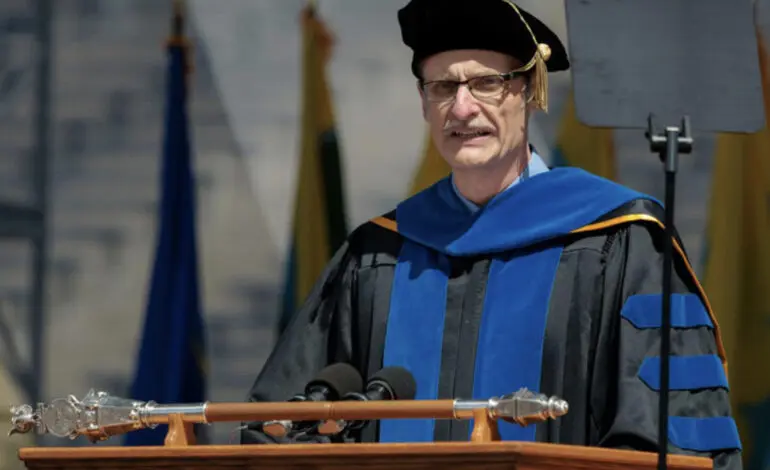

ANN ARBOR — The administration of the University of Michigan needed only a few hours to demonstrate what critics described as complete deference to pro-Israel pressure at the expense of free speech, after the university president swiftly condemned remarks delivered by a faculty speaker during last Saturday’s spring commencement ceremony for praising students who opposed Israel’s war on Gaza.
While delivering his speech at the commencement ceremony, history professor Derek Peterson, outgoing chair of the university’s Faculty Senate and Senate Advisory Committee on University Affairs, told graduates to remember pro-Palestine student activists when singing the University’s fight song.
“Sing for the pro-Palestinian student activists, who have over these past two years opened our hearts to the injustice and inhumanity of Israel’s war in Gaza,” Peterson said.
Peterson also told graduates to remember historical activists and social movements. These included Sarah Burger, a suffragette who campaigned for the university to accept women in 1858; Moritz Levi, who fought against anti-Semitism as one of the university’s first Jewish faculty members in 1896 and the Black Action Movement of the 1970s and 80s, which fought for the rights of students of color on campus.
“The greatness of this institution does not only rest on the shoulders and on the accomplishments of our student athletes, who deserve all the congratulations we can offer them,” Peterson said. “The greatness of this university rests also on the courage and the conviction of student activists who have pushed this university down the path towards justice.”
Even though a large crowd cheered Peterson’s statements at the ceremony, his comments quickly angered pro-Israel members of the university’s Board of Regents as well as some local community members, many of whom expressed outrage online and accused Peterson of anti-Semitism.
In an emergency statement issued later that same evening, U of M President Domenico Grasso described Peterson’s remarks as “hurtful and insensitive to many members of our community.”
He added that the administration would review future commencement programming.
“We regret the pain these remarks caused on a day dedicated to celebrating achievement and excellence,” Grasso said. “For that reason, the university apologizes.”
Peterson’s speech came amid ongoing fallout from student protests against the Israeli occupation of Palestinians and the genocidal war in Gaza that swept the university between late 2023 and early 2025.
Several student and community activists involved in those demonstrations later faced criminal charges related to trespassing and resisting police. Some charges were brought by Michigan Attorney General Dana Nessel after protests targeted the homes and offices of university leaders, including former University President Santa Ono and members of the Board of Regents.
Additionally, at the start of his second term, President Trump placed U of M among a list of universities facing investigation over allegations that they allowed anti-Semitism to spread on campus.
Grasso’s statement firmly distanced the university from Peterson’s remarks, describing them as “inappropriate” and not reflective of the institution’s officially neutral stance. The university president stressed that Peterson had deviated from the version of the speech previously shared with administrators before commencement.
No retreat
Responding to Grasso’s statement and criticism from some regents and board candidates, Peterson told local media Monday that his speech was never intended to provoke division or controversy. Instead, he said, he hoped to celebrate the university’s long tradition of student activism, including students who called for ending the war in Gaza and for the university to divest from Israel and weapons manufacturers.
In an email to the Michigan Daily, Peterson wrote that he believes his statements have received an excessive amount of controversy online.
“It should not be controversial to have one’s ‘heart opened to the inhumanity and injustice of Israel’s war in Gaza’, which is what I credited activists with doing,” he wrote in an email to the Michigan Daily. “Having an open heart to other people’s suffering is a fundamental human virtue, and it is a quality that I hope we teach our students, whatever their political posture might be.”
Peterson, a professor of history and African studies, said that “on a day honoring graduates, I wanted to honor student activists and highlight the role they played in shaping this university into what it is today.”
That included students opposed to the Gaza war.
He also expressed surprise at Grasso’s response, saying he had hoped the university president would demonstrate greater commitment to protecting faculty viewpoints, particularly those that were not “unreasonable.”
“I crafted my remarks in a way intended to make them as uncontroversial as possible,” Peterson said. “If I had the chance to do it again, I would also express sympathy for the victims of October 7, 2023, as well as for the students who sought to honor their memory.”
He insisted that, “nothing I said was anti-Semitic.”
Peterson added that his speech underwent full university review beforehand. According to him, the university advised against referring to the war as a “genocide” or naming specific student groups, recommendations he said he followed, in order to avoid causing “unnecessary offense.”
Short clips of the speech circulated widely on social media, while Peterson later uploaded a longer version to YouTube. In it, he discussed the history of student activism at the university, beginning with women fighting for admission rights, continuing through Black student movements and concluding with pro-Palestinian student activism.
Peterson later emphasized that his speech, delivered on behalf of the faculty, was meant to celebrate activism across the university community generally. He highlighted historical struggles against the status quo, including women’s campaigns for admission and the university’s acceptance of Jewish students and faculty at a time when other institutions excluded them because of their religious beliefs. He also praised Black student activism that pushed for curricula better reflecting Black experiences and identity.
“The greatness of this institution rests not only on the shoulders and achievements of our student athletes, who deserve all our congratulations; the greatness of this university also rests upon the courage and conviction of student activists who pushed this university further down the road toward justice,” Peterson said at the commencement ceremony.
“It should not be controversial to express compassion for the inhumanity and injustice of Israel’s war in Gaza,” he said later when defending his remarks.
He added that the University of Michigan is not merely an institution for academic training but also one that teaches students how to confront disagreement courageously.
Peterson stressed that compassion for oppressed people is a fundamental human virtue students should learn regardless of political beliefs, adding that student activism has always been part of the university’s history.
“Students do not need excessive emotional coddling,” he said, “they need encouragement to confront a world full of flaws and injustice.”
Fierce backlash
For her part, U of M Regent Sarah Hubbard, a Republican, described Peterson’s remarks as “deeply troubling and disappointing”, while suggesting disciplinary action could be considered.
“It is very difficult to execute meaningful consequences on tenured faculty, but as a leader I can help set the tone and expectations for their conduct,” Hubbard wrote in a post on X.
“His conduct was unbecoming for a leader of the greatest university in the world,” she added.
Hubbard further stated that the Board of Regents now has an opportunity to make “lasting changes” that could change what she described as this kind of conduct.
“I look forward to discussing this matter with my fellow regents and university administration,” she wrote.
Michael Schostak and Lena Epstein, Republican candidates for the Board of Regents, also sharply criticized the administration for allowing Peterson to speak at commencement despite what they described as his “divisive record.”
In a joint statement issued after the ceremony, Schostak and Epstein said they were disappointed by Peterson’s decision to deliver what they called an “anti-Israel speech before our graduates, their families and the world watching us.”
Schostak argued the university should have anticipated such comments because of Peterson’s history of supporting resolutions calling on the university to divest from Israel and end research partnerships with Israeli institutions.
“The bottom line is that it should have been made crystal clear that he should not address such an emotionally charged issue for the university,” Schostak said.
He added that commencement ceremonies “are supposed to be about the students, not about something happening 6,000 miles away.” Still, he added, “I absolutely believe in free speech. However, there is a time, place and proper manner for such comments, and this ceremony was not it.
“When I’m regent this type of divisive and disrespectful behavior will not go without consequence.”
Makled defends Peterson
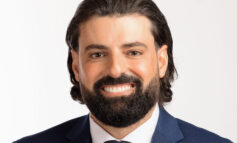
Democratic Board of Regents candidate Amir Makled defended Peterson’s right to speak freely, stating that the University of Michigan, “has a long tradition of students and faculty raising their voices on the defining issues of their time, from teach-ins during the Vietnam War to movements for civil rights, labor rights and human rights.”
Makled, an Arab American attorney who has volunteered to represent several pro-Palestinian student activists in court, said Peterson’s speech reflected the university’s true traditions by acknowledging “student voices and the university’s role in fostering open dialogue and constructive critical engagement.”
Makled added that he opposes all forms of hatred, including anti-Semitism, Islamophobia and anti-Black racism. However, he stressed that “protecting students from hate should not come at the expense of suppressing peaceful and legitimate expression or avoiding difficult conversations.”
Makled is running this November for one of two open seats on the U of M Board of Regents after receiving the Democratic Party’s nomination alongside incumbent Democratic regent Paul Brown. They will face Republican candidates Schostak and Epstein in the general election.
The university’s eight-member Board of Regents is currently controlled by Democrats, who hold six seats, including pro-Israel regent Jordan Acker, whom the state Democratic convention on April 19 declined to renominate in favor of Makled.


Leave a Reply