



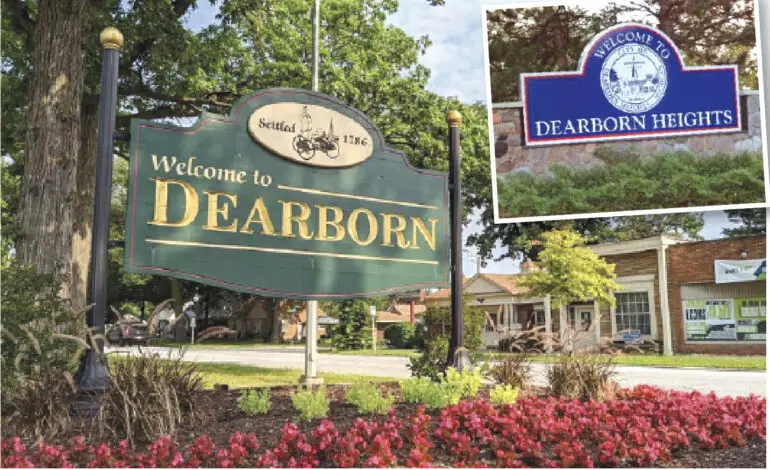

DEARBORN / DEARBORN HEIGHTS — If official figures are accurate, Dearborn and Dearborn Heights have collectively lost more than 6,700 residents over the past five years. But for officials in the neighboring cities — home to the largest concentration of Arab Americans in the country — those numbers appear far removed from reality.
Local leaders expressed skepticism about the accuracy of population estimates released by the U.S. Census Bureau and said steps may be necessary to challenge or correct them.
While population decline is often viewed as a clear sign of a city’s deterioration and loss of attractiveness, officials say conditions on the ground in Dearborn and Dearborn Heights tell a very different story. Both cities continue to experience housing shortages, crowded neighborhoods and strong demand for homes and rental properties, alongside high birth rates and other indicators typically associated with population growth rather than decline.
Record birth rates and rising housing demand , so how are we losing thousands of residents?
The issue carries implications far beyond civic pride. Population figures play a central role in determining how billions of dollars in federal and state funding are distributed each year. Census counts influence allocations for infrastructure, education, housing, health care and social programs, as well as political representation and electoral district boundaries.
In practical terms, every resident who is not counted can mean fewer resources and services for the community.
As concerns grow, officials in both cities are discussing whether corrective legal action may eventually be necessary, similar to the lawsuit filed by Detroit against the U.S. Census Bureau alleging that approximately 25,000 residents were omitted from official population estimates.
Although neither Dearborn nor Dearborn Heights have not taken that step, officials in both cities are raising many of the same questions after recent Census Bureau estimates suggested the two Arab American-majority communities experienced the largest population losses of any municipalities in Michigan during 2025.
Why the numbers matter
According to recent U.S. Census Bureau estimates, Dearborn lost 405 residents during the past year, while Dearborn Heights lost 428 residents, for a combined decline of 833 people in a single year.
The significance extends beyond the size of the two cities. According to the Center for Arab Narratives (CAN), an institution of ACCESS, the largest Arab American community nonprofit organization in the United States, Dearborn became the first city in the nation with a majority population of Middle Eastern and North African (MENA) descent following the 2020 Census. Census data showed that approximately 54.5 percent of Dearborn residents identified as having Arab ancestry — roughly 60,000 people out of a population of about 110,000 at the time.
Yet official estimates now place Dearborn’s population at only 105,611 residents in 2025 despite substantial development and housing activity over the past several years.
In Dearborn Heights, demographic studies and estimates have suggested that residents of Middle Eastern and North African descent account for between one-quarter and nearly 39 percent of the city’s population.
Because the two communities together represent the largest concentration of Arab Americans in both Michigan and the nation, any significant undercount raises broader questions about whether the Census Bureau is accurately measuring populations that include large numbers of immigrants, multilingual households and multigenerational families — groups that have historically proven more difficult to count.
The official figures
According to the latest Census Bureau estimates, Dearborn’s population declined from 109,557 in 2020 to 105,611 in 2025.
That represents a loss of 3,946 residents, or approximately 3.6 percent of the city’s population.
Dearborn Heights reportedly declined from 63,292 residents in 2020 to 60,536 residents in 2025, a reduction of 2,756 people.
Combined, the two cities are estimated to have lost 6,702 residents since 2020.
However, local officials say the realities they observe every day do not align with those figures.
Dearborn officials: The city is growing
In an extended interview, Dearborn Senior Press Secretary’s Hassan Abbas rejected the notion that the city is experiencing a genuine population decline.
He said virtually every indicator available to the city points in the opposite direction.
Dearborn currently records one of the highest birth rates in Michigan, Abbas said, while the city’s housing vacancy rate remains below 2 percent.
He also cited an independent housing study concluding that Dearborn needs at least 1,500 additional housing units to meet existing demand.
Abbas emphasized that city officials are not basing their concerns on impressions alone but on what he described as strong indicators suggesting that Dearborn’s population continues to grow.
“We are confident that Dearborn’s population is increasing,” Abbas said. “We expect the next national census in 2030 to provide a more accurate picture and show substantial population growth.”
Housing market tells a different story
Abbas said anyone working in the local real estate sector can attest to the strong demand for housing throughout the city.
“If you ask anyone in the local real estate industry, they will tell you that demand for housing in Dearborn remains extremely high,” he said.
He added that the city’s bustling downtown, crowded schools and parks, active community gathering spaces and continuing residential development projects are not characteristics typically associated with a shrinking city.
Census Bureau has been wrong before
Abbas noted that Dearborn’s skepticism is rooted not only in current observations but also in past experience.
According to the city, Census Bureau estimates during the decade between 2010 and 2020 were at times off by as much as 20 percent.
“During that period, the Census Bureau estimated that Dearborn had lost between 8 and 9 percent of its population,” Abbas said. “But the 2020 Census later showed the exact opposite.”
Instead of declining, Dearborn actually recorded approximately 12 percent population growth during that decade, making it one of Michigan’s fastest-growing cities.
Abbas also pointed out that multilingual communities, immigrant populations and multigenerational households have historically been more vulnerable to census undercounts.
He said city officials are currently reviewing the latest estimates, the methodology used to produce them and local housing and demographic data to better understand the discrepancy.
Mayor Mo Baydoun: “We have real concerns”
In Dearborn Heights, concerns are even more pronounced.
Mayor Mo Baydoun told The Arab American News that city officials have “real concerns” about whether current estimates accurately reflect the city’s actual population.
He noted that Dearborn Heights meets many of the characteristics the Census Bureau has traditionally identified as difficult to count, including large numbers of young children, immigrants, non-English speakers, multigenerational households and residents living in rental or multi-family housing.
“We have real concerns about whether the current estimates accurately reflect Dearborn Heights,” Baydoun said.
He added that what city officials observe on the ground does not resemble a community experiencing population decline.
“We see growth through our building department data,” he said. “Certificates of occupancy continue to be issued, homes are being occupied and new businesses continue to open throughout the city.”
Baydoun stressed that these conclusions are based on measurable data rather than anecdotal impressions.
“The activity we see on the ground tells a completely different story than the one reflected in the estimates,” he said.
Every uncounted resident means less funding
Baydoun argued that the issue extends far beyond statistics.
“Every person who is not counted is someone for whom the city does not receive the funding necessary to provide services,” he said. “As a city, we pay the price for that.”
He explained that any undercount directly affects funding levels for roads, schools, housing and public services.
Meanwhile, Mohamed Qasim, communications director for Dearborn Heights, said municipal officials are reviewing the latest estimates and exploring available tools to evaluate how the figures were calculated and whether they accurately reflect local realities.
Qasim noted that the Census Bureau itself acknowledged in April 2024 that children ages 0 to 4 were undercounted nationwide during the 2020 Census. He said that admission raises legitimate questions about the accuracy of population estimates in communities such as Dearborn Heights.
Baydoun also pointed to misinformation campaigns during the 2020 Census that discouraged participation among vulnerable communities.
“There were coordinated misinformation campaigns targeting vulnerable populations,” he said.
According to Baydoun, some Arab American residents were falsely told that participating in the census could result in deportation or loss of government benefits, while some African American residents received misinformation claiming their data would be shared with government agencies.
“Those claims were false, but they worked,” Baydoun said. “People stayed away from participating, and our communities paid the price through lost funding and diminished representation.”
He said city leaders do not believe Dearborn Heights is experiencing an actual population decline but rather that the census system continues to struggle with accurately counting communities characterized by language barriers, multigenerational households and lingering distrust fueled by misinformation.
A question that could shape the future of our communities
The Census Bureau’s estimates may ultimately prove accurate. Or Detroit, Dearborn and Dearborn Heights may be justified in their concerns.
What is clear, however, is that the gap between official numbers and local observations has become too large to ignore.
While census estimates point to the loss of thousands of residents, local officials point to some of the state’s highest birth rates, housing shortages, strong real estate demand, fully occupied neighborhoods, expanding businesses and community institutions filled with activity.
For that reason, the debate is no longer simply about 25,000 residents in Detroit or 6,702 residents in Dearborn and Dearborn Heights.
It is about a larger question:
Does the federal government truly see our communities as they are, or are thousands of residents still invisible in the official count?



Leave a Reply