



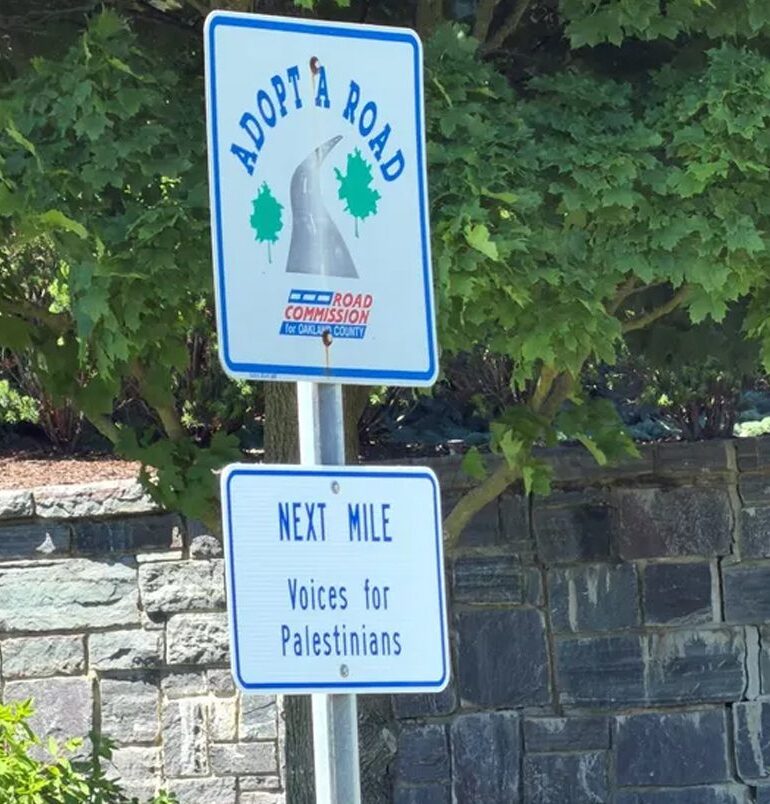
WEST BLOOMFIELD — Less than a week after two “Voices for Palestinians” signs were installed along Orchard Lake Road in West Bloomfield Township, the Oakland County Road Commission removed the official signs on Sunday in response to pressure from members of the local Jewish American community, citing their proximity to Temple Israel, which was the target of a retaliatory attack in March.
County officials cite proximity to Temple Israel; critics call the decision discriminatory and a blow to free speech
The signs had been erected by the grassroots group Voices for Palestinians through Oakland County’s Adopt-A-Road program, a community service initiative that encourages volunteers to clean designated roadways twice a year.
Although the group’s application to participate in the program dates back to September 2025 — months before the attack on Temple Israel, which resulted in the death of the assailant and injuries to one security guard — Oakland County officials, led by County Executive Dave Coulter, argued that the signs were insensitive to the local Jewish community because of their location near the synagogue. In reality, Temple Israel is located approximately three miles from where the signs were installed.
Shahaboddin Owlia, founder of Voices for Palestinians and a West Bloomfield resident, received approval from the three-member Road Commission at the end of October 2025. Owlia fulfilled the program’s requirements by organizing a cleanup of Orchard Lake Road between Walnut Lake and Maple roads in April, prior to the installation of the signs earlier this month.
Nevertheless, at Coulter’s request, the Road Commission voted to remove the signs, which read, “Next Mile: Voices for Palestinians”, prompting sharply divided reactions.
The decision followed a public statement by Coulter, who described the placement of the signs as “deeply troubling.”
“Placing a message like this in that location appears insensitive to the impact it may have and risks being perceived as provocative,” Coulter said, referring to a community with a significant Jewish population.
Coulter added that he had asked the Road Commission to review the matter, arguing that placing the signs in the heart of Oakland County’s Jewish community and near Temple Israel “raises deep concerns and causes understandable pain for many of our Jewish neighbors.”
“While the First Amendment protects a wide range of speech — including speech that many may find offensive or disagreeable — courts have long recognized that reasonable, content-neutral restrictions may apply based on time, place and manner to protect the rights and safety of others,” Coulter said.
Michigan is home to approximately 90,000 Jewish residents, the majority of whom live in Oakland County.
On Sunday, the Road Commission removed the signs, a move welcomed by some residents but criticized by others who argued that the signs represented a legitimate exercise of free expression and should not have been removed.
Craig Bryson, spokesperson for the Oakland County Road Commission, confirmed the action.
“We reviewed the signs and removed them,” Bryson said. “There are, of course, widely differing opinions about what constitutes hate speech, but given the recent attack on the synagogue, we certainly understand why some people were concerned.”
Members of the local Jewish community also exchanged comments on Facebook over the weekend, arguing that placing the signs near Temple Israel demonstrated a lack of sensitivity toward Jewish residents.
Owlia, however, told Deadline Detroit that he was “saddened and shocked” by the decision.
“I never expected something like this to happen,” he said.
The engineer, who works for a major automotive manufacturer, explained that the signs were intended to amplify the voices of Palestinians suffering under occupation and blockade. He noted that he has consistently supported the right of Jewish community members to display signs and materials highlighting the Israeli hostages taken by Hamas on October 7, 2023.
“With the genocide in Gaza continuing, I felt compelled to give voice to the other side, to Palestinians and Palestinian children,” Owlia said. “That is the real reason behind the name Voices for Palestinians.”
Owlia added that he has not yet decided whether he will challenge the removal of the signs.
According to Bryson, the Adopt-A-Road signs carry no cost to participants, and the county generally welcomes anyone interested in joining the program, which does not impose specific content requirements on applicants.
“Honestly, in my 29 years with the Road Commission, we’ve never encountered a situation like this,” Bryson said. “We install signs for every approved applicant.”
He noted that the program currently includes 388 sponsors, most of them community groups, memorial dedications or political figures.
Bryson added that, in light of the controversy, the commission plans to review its approval standards moving forward while remaining mindful of legal protections and constitutional rights.
Organizations participating in the Adopt-A-Road program are required to clean their assigned roadway segments twice annually on dates designated by the Road Commission.
Critics accuse Oakland County of favoritism
Responding to the removal of the signs, Fabrice Smieliauskas of the Michigan Progressive Democrats, a pro-Palestinian organization that includes Jewish members, posted a statement on Facebook accusing Oakland County officials of bending over backward to accommodate the sensitivities of the Jewish community while disregarding other voices.
“A sign encouraging all of us to respect human rights and basic moral principles by listening to “Voices for Palestinians” should be welcomed anywhere in Michigan,” Smieliauskas wrote. “Its purpose is to raise awareness among a public that is often indifferent, self-absorbed and largely disconnected from international affairs.”
He argued that treating such a sign as problematic merely because it appears in a predominantly Jewish area effectively elevates the preferences of a small — albeit vocal — minority above those of the broader public.
Smieliauskas further described portions of the local Jewish community as preferring to live within “carefully curated information bubbles” and “safe spaces.”
He also rejected attempts to justify the removal based on the March attack on Temple Israel.
“Using a horrific attack on a synagogue, which was motivated by the conflict in Lebanon, not Palestine, as justification for these sensitivities is an overreach that cannot supersede our fundamental right to free expression,” he said.
Smieliauskas argued that the removal reflects a broader pattern among Oakland County officials of accommodating pro-Israel interests while marginalizing opposing viewpoints. He pointed to the Oakland County Board of Commissioners’ 18-month delay before eventually adopting a symbolic resolution supporting a ceasefire in Gaza.
Emily Weiner, another activist, wrote on Facebook that “the people who feel threatened by this sign are threatened by the mere existence of Palestinians.”
Dawud Walid, executive director of the Michigan chapter of the Council on American-Islamic Relations (CAIR-Michigan), told Deadline Detroit that the removal of the signs was discriminatory and deeply troubling.
“It is shameful that the group of residents who were seeking to do community service and who are speaking up about crimes and human rights violations are being silenced.”
“There appears to be an ethnic preference of one group of people in Oakland County over another group.”
Not everyone agreed.
One critic of the signs wrote on Facebook, “Can you imagine a sign reading ‘Voices for Israel’ being displayed in Dearborn?”
Another Jewish person, who asked that their name not be used in this article, posted on Facebook, “Great that they got taken down! Not sure how someone couldn’t understand the problem (or pointed harassment) with the placement of those signs. Hope the decision-makers tighten up their decision-making.”


Leave a Reply