



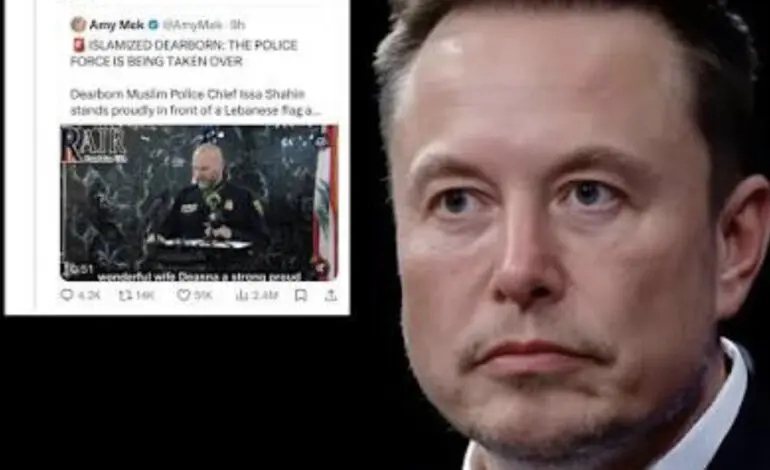

A single social media post, amplified by the world’s richest man, can in a matter of hours transform a dedicated public servant into a traitor in the court of public opinion, without a single shred of evidence to support the accusation. The recent comments by Elon Musk regarding Dearborn Police Chief Issa Shahin serve as a potent case study in this phenomenon. By selectively editing facts and weaponizing identity, these posts construct a narrative of a “clash of civilizations.” Yet, when held against the light of the United States Constitution, this narrative collapses under its own weight, revealing itself not as a patriotic defense of American values, but as a dangerous attack on the very principles of liberty and pluralism that define the nation, a tactic emblematic of the erosion of democratic norms in an age of kleptocracy.
Adel AlAdlani
At the heart of this controversy lies a fundamental misunderstanding of the First Amendment and the constitutional principle of religious neutrality. The viral post hysterically decries the supposed “Islamization of American law enforcement”, pointing to Chief Shahin’s faith, his heritage and the increasing diversity of the Dearborn Police Department as evidence of a nefarious plot. However, the Constitution explicitly prohibits religious tests for public office, ensuring that “no religious test shall ever be required as a qualification to any office or public trust under the United States.” This clause is a foundational pillar of American governance, born from the Founders’ firsthand experience with religious persecution. To suggest that Shahin’s Muslim faith is a disqualifier for his role is to advocate for a religious test, a concept the Founders abhorred. As George Washington wrote to a Jewish congregation in 1790, the government of the United States “gives to bigotry no sanction, to persecution no assistance.” The act of a public official ending a speech with “Hamdullah” is not an unconstitutional act; it is the free exercise of religion, a right protected so that citizens of all faiths, or none, may participate fully in public life.
To suggest that Chief Shahin’s Muslim faith disqualifies him from public service is to embrace the very religious test the Constitution explicitly forbids.
The narrative that Chief Shahin’s recruitment efforts constitute a form of “demographic replacement” or an attempt to impose “Sharia law” is a perversion of community policing and a fundamental misreading of the Establishment Clause. The Establishment Clause prevents the government from endorsing or favoring one religion over another, but it does not mandate a secular, religion-free public square. In fact, the Supreme Court has long recognized a need for “benevolent neutrality which will permit religious exercise to exist without sponsorship and without interference.”
Chief Shahin, a lifelong American who has served the Dearborn Police Department for nearly three decades, has consistently advocated for hiring qualified officers who reflect the diverse community they are sworn to protect. His efforts are a strategic necessity. Dearborn is home to one of the nation’s largest Arab American populations, and the department has expanded its outreach to attract applicants from a variety of backgrounds, not to impose a foreign ideology, but to build trust, enhance communication and ensure that law enforcement understands the structure of the neighborhoods it patrols. The fact that the department has made accommodations for religious practices, such as respecting the wearing of hijabs, is not evidence of creeping Islamism, but rather a sign of a mature society accommodating its citizens’ constitutional rights. This is a departure from the Founders’ vision of a nation where one’s faith is a private matter and not a barrier to public service. Crucially, the viral allegations offer not a shred of evidence that the Dearborn Police Department has enforced anything other than Michigan and U.S. law. The entire accusation rests on innuendo and cultural anxiety, not on fact.
Perhaps the most inflammatory accusation in this controversy is Elon Musk’s labeling of Chief Shahin’s actions as “treason”, citing the presence of a flag of a foreign state. This grave accusation trivializes a capital offense and weaponizes patriotism to attack an individual for his heritage or the community’s heritage being served. The mere display of a foreign national flag, a common expression of cultural pride for millions of Arab Americans who have fled conflict or simply wish to honor their roots, does not equate to a violation of one’s oath of allegiance. The United States is a nation built almost entirely of immigrants; to criminalize cultural expression based on ancestry would be to criminalize the American story. Furthermore, Musk’s statement itself demonstrates a willful ignorance of American history. The Founders understood that the great promise of the United States was that citizenship could transcend ancestry or religion. As John Adams stated, the government “has in itself no character or enmity against the laws, religion or tranquility of [Muslims].” The flag of a nation’s heritage is not a standard of loyalty; it is a thread in the tapestry of a diverse nation. The First Amendment protects freedom of speech, which must include the freedom to express one’s cultural identity.
The accusations against the Dearborn Police Department rest on innuendo and cultural anxiety — not a single piece of evidence that anything other than Michigan and U.S. law is being enforced.
The irony in this debate is stark. It is not Chief Shahin who is undermining American values, but those who, with immense power and reach, spread divisive, false narratives to fracture the nation. The Constitution does not guarantee freedom from offense; it guarantees the free exercise of religion and equal protection under the law for all citizens, regardless of their faith or heritage. The attack on Shahin is an attack on the idea of a pluralistic, democratic society.
Elon Musk’s role in this controversy is particularly troubling, as he has recently been anointed the world’s first trillionaire and is a prominent figure in the current political landscape. His recent financial ascendancy, achieved in part through lucrative government contracts and a tax structure that has allowed his companies to pay near-zero federal tax while accumulating massive profits, embodies a new and dangerous power dynamic. This is the core of a modern kleptocracy, a system where immense private wealth is used to capture public institutions and shape public discourse for personal and political gain. By wielding his social media platform, X, as a weapon to amplify a fringe, xenophobic narrative, Musk is demonstrating how concentrated wealth can corrupt the democratic process. This is not just a billionaire expressing an opinion; it is an oligarch using his financial and media power to target a public servant, leveraging a platform acquired with those vast, concentrated resources. The influence of such wealth threatens to substitute the rule of law with the rule of the powerful, where truth is dictated by the loudest voice and loyalty is measured by a single, mandated standard. This is a far greater threat to American democracy than a police chief’s efforts to build a more representative police force.
The attack on Chief Issa Shahin is ultimately an attack on the American promise that citizenship, not religion or ancestry, determines who belongs.
Ultimately, the controversy over Chief Issa Shahin is a manufactured spectacle. It is a deliberate attempt to stoke fear and division by exploiting religious and cultural differences for political gain. The true mark of a patriot is not the public airing of a single national flag, but a commitment to the Constitution and the principles of equality, liberty and justice for all. In the words of James Madison, the true test of a free society is its capacity to ensure that all citizens retain an “equal title to the free exercise of religion according to the dictates of conscience.” The attacks on Chief Shahin are an affront to that sacred principle, and they represent a more insidious form of un-American activity than any he has been accused of. They are the poison of the kleptocrat, a tool to disenfranchise the many to serve the narratives of the few.
– Adel AlAdlani has a PhD in public administration from Western Michigan University.



Leave a Reply