




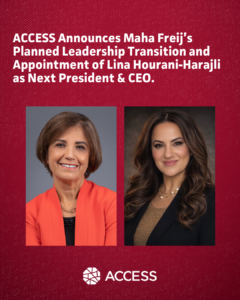
DEARBORN — ACCESS President and CEO Maha Freij will retire this fall after more than 35 years of service to the nation’s largest Arab American nonprofit organization, marking the end of an era that helped transform ACCESS into a nationally recognized institution.
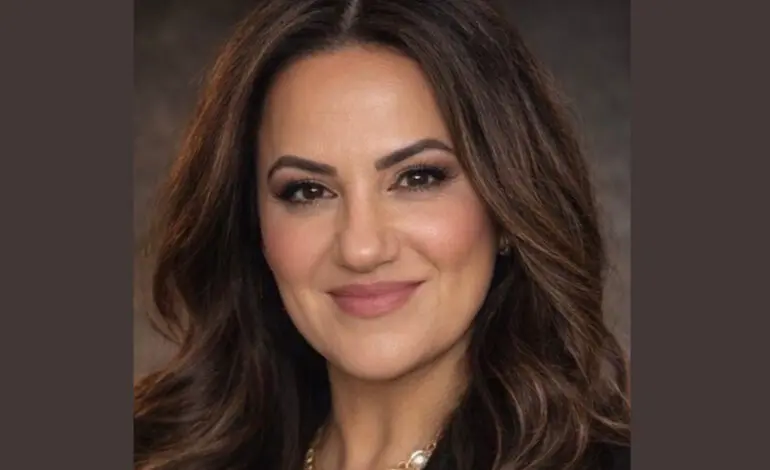
The ACCESS Board of Directors announced that it has unanimously appointed Chief Operating Officer Lina Hourani-Harajli as the organization’s next president and CEO. She will officially assume the role on October 1, following a planned leadership transition.
Freij will remain president and CEO until then and will continue serving ACCESS as a strategic advisor to help ensure a smooth transition.
Three decades of transformative leadership
Freij joined ACCESS in 1991 and has spent more than three decades helping expand the organization’s services, financial strength and national presence.
During her tenure, ACCESS launched several landmark initiatives, including the capital campaign that established the Arab American National Museum, founded the Center for Arab American Philanthropy (CAAP), expanded its national institutions and strengthened the organization’s long-term financial sustainability through the growth of reserves and endowment funds.
As president and CEO, she also oversaw the creation of the Center for Arab Narratives (CAN) and led the fundraising campaign for the new ACCESS Recovery Center, scheduled to open later this year.
“Maha’s contributions to ACCESS and the broader community are immeasurable,” said ACCESS Board Chair Hussien Shousher. “For more than three decades, her vision has helped transform ACCESS into a national institution while remaining deeply grounded in the needs of the communities we serve.”
Shousher also credited Freij with building a culture of leadership development that prepared the organization for a seamless succession.
Together, we have built something larger than ourselves — an institution rooted in community, guided by purpose and prepared to serve future generations.
Hourani-Harajli to lead the next chapter
Hourani-Harajli joined ACCESS in 2000 and has served as chief operating officer for more than a decade.
She has overseen the organization’s business operations, human resources, information technology, marketing and communications while helping modernize ACCESS’ infrastructure and operations.
She also played a leading role in implementing ACCESS’ “whole-family” approach, an integrated model designed to help families achieve long-term economic stability by addressing education, employment, health and social services throughout every stage of life.
“I am honored by the trust the Board has placed in me and grateful to Maha for her decades of leadership and mentorship,” Hourani-Harajli said. “ACCESS has always been guided by a strong commitment to organizational and operational excellence, and that legacy of service and innovation will continue as we embark on this next chapter in ACCESS’ 55-year history.”
Legacy of community service
Reflecting on her retirement, Freij said ACCESS’ greatest accomplishment has been building institutions capable of serving future generations.
“I have always believed that our responsibility is not simply to build organizations, but to build institutions that can serve communities for generations,” Freij said. “Together, we have built something larger than ourselves — an institution rooted in community, guided by purpose and prepared to serve future generations.”
Founded in Dearborn in 1971, ACCESS has grown into the nation’s largest and most comprehensive Arab American nonprofit organization, serving millions of people through health, education, economic development and social service programs.
In addition to ACCESS itself, the organization oversees several nationally recognized institutions, including the Arab American National Museum (AANM), the Center for Arab American Philanthropy (CAAP), the Center for Arab Narratives (CAN) and the National Network for Arab American Communities (NNAAC).
With the leadership transition now underway, ACCESS officials said the organization remains committed to advancing the health, economic, social and cultural well-being of the diverse communities it serves across Michigan and throughout the United States.


Leave a Reply