



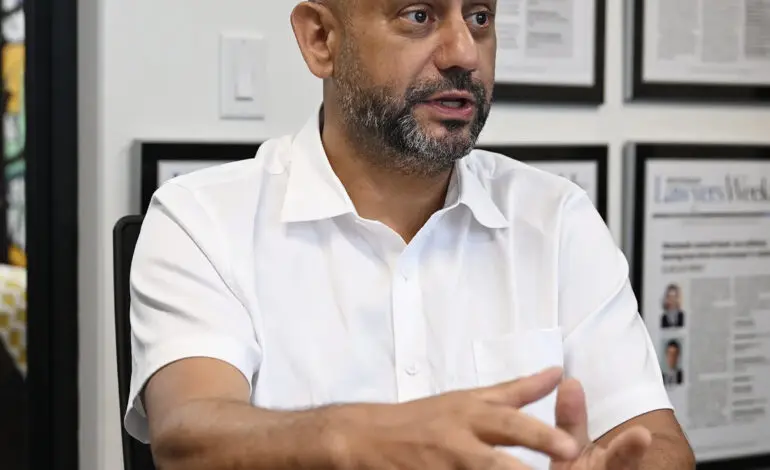

DEARBORN HEIGHTS — Former Dearborn Heights Police Chief Ahmed Haidar has filed a lawsuit against the city and Mayor Mo Baydoun, alleging that he was wrongfully terminated in retaliation for actions he took while leading the department.
According to the lawsuit, filed in Wayne County Circuit Court in July, Haidar was removed from his position several weeks after Baydoun became acting mayor, succeeding former Mayor Bill Bazzi. Bazzi had selected Haidar to lead the Dearborn Heights Police Department in early 2025.
Haidar’s dismissal came only three months after he signed an amended five-year employment contract with the Bazzi administration. Bazzi was still serving as mayor at the time but resigned in October 2025 to become the U.S. ambassador to Tunisia.
Under the Dearborn Heights City Charter, the mayor’s office automatically passed to Baydoun, who was then City Council chairman. According to the lawsuit, a campaign of retaliation against Haidar began almost immediately afterward.
Tensions emerge
In comments to the Detroit News, Haidar said he initially experienced no problems and was pleased to lead the Police Department in the city where he grew up. However, his relationship with Baydoun reportedly began deteriorating during the summer of 2025, when Baydoun was still City Council chairman.
The tensions stemmed from a criminal investigation involving one of Baydoun’s relatives in neighboring Dearborn.
Baydoun himself had an extremely strained relationship with then-Mayor Bazzi. Haidar told the newspaper that he became involved because he received several calls from community members concerning Baydoun’s relative, who worked at a Dearborn Heights school.
Haidar said he requested the police report regarding the incident and contacted the school district superintendent to ensure that district officials were aware of the matter.
“I felt that if I didn’t do anything about it… and this person went back into our schools and committed a crime here, everybody would be up in arms saying, ‘Wait a minute, the Dearborn Heights police chief knew about this and didn’t do anything about it,’” Haidar said.
According to the lawsuit, Baydoun called Haidar and expressed displeasure that the police chief had used official channels instead of speaking with him directly about the investigation. Baydoun reportedly described Haidar’s action as a “slap in the face.”
“From then on, there was tension between us, more so coming from him,” said Haidar, who has 26 years of law enforcement experience. “We would have staff meetings and things like that, and I would get kind of the cold shoulder. I would walk into a room and there would be no hello, no handshake… Some of the things he did were kind of childish, but we kept working, developing the department and doing our jobs.”
Other disputes
According to the lawsuit, additional problems arose after Haidar reassigned Police Department vehicles but did not allocate one to the police union president, who supported Baydoun’s mayoral campaign.
The lawsuit also states that Haidar declined to pose for a photograph with Baydoun during the campaign that culminated in Baydoun’s November election victory, further complicating Haidar’s working conditions.
Even before then, in October 2025, Haidar and another Dearborn Heights police investigator sought to hold a news conference regarding threats allegedly made by a White man against a local mosque. Baydoun, however, refused to allow the news conference, citing concerns about how it would appear publicly because both officers were Muslim, according to the lawsuit.
The complaint alleges that Baydoun’s intervention was motivated by religious bias and discrimination. It further claims the mayor’s position conveyed a troubling message that Muslim officers should be “kept out of the spotlight because of their faith.”
Haidar said what disturbed him most, however, was Baydoun’s refusal to accept a $1.5 million grant that would have allowed the understaffed Police Department to hire nine additional officers.
Haidar said the city would have been required to contribute $250,000 annually to secure the grant, an amount roughly equivalent to the cost of two officers. According to the lawsuit, Baydoun refused to accept the grant because it carried Haidar’s name and that of the former mayor.
“It was a great deal, but he refused to approve it just because it had my name and the previous administration’s name on it,” Haidar said. “He let the Police Department and the community down because of his ego.”
Lawsuit’s demands
Nicole Omilian, Haidar’s attorney, said the lawsuit contains two principal claims. The first seeks a finding that the city breached her client’s contract and demands payment of the compensation owed under the full five-year agreement. The second seeks a finding that Haidar was subjected to discrimination.
Although Haidar told the Detroit News that he would like to return to his former position, he acknowledged that doing so may no longer be realistic because of what he described as a hostile work environment.
“I love this job, I love this position and I love the police officers,” Haidar said. “I hated leaving, but I was forced out because I did the right thing.”
Baydoun did not respond to requests for comment regarding the pending litigation.
“There are a lot of allegations in the lawsuit, and the court will decide them,” Dearborn Heights Communications Director Mohamed Qasim said.
The city is already defending another federal lawsuit filed in Detroit in 2024 by three former Dearborn Heights police officials, including another former chief, over their treatment by city officials.



Leave a Reply