



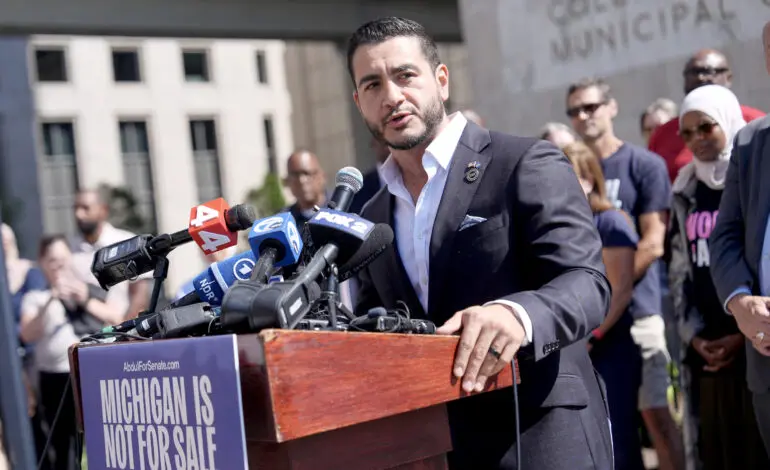

Progressive Arab American candidate Abdul El-Sayed pulled off a remarkable electoral upset Tuesday, scoring a historic victory in Michigan’s Democratic primary for the U.S. Senate after defeating establishment-backed U.S. Rep. Haley Stevens, whose campaign benefited from unprecedented spending by pro-Israel groups.
Following the fiercely contested Democratic primary, in a result described as a political earthquake, El-Sayed quickly turned his attention to Republican nominee Mike Rogers, whom he will face in the Nov. 3 general election. President Trump, meanwhile, attacked El-Sayed and accused him of hating Jewish people in an apparent attempt to deepen divisions among Democrats and incite hate against El-Sayed.
The nationally watched primary, which highlighted the struggle between competing wings of the Democratic Party, ended with El-Sayed defeating Stevens by approximately one percentage point. Stevens has represented Michigan’s 11th Congressional District in Oakland County since 2019.
Beyond the historic possibility that he could become the first Muslim elected to the U.S. Senate, El-Sayed’s victory stunned political observers in Michigan and across the country because of the symbolism surrounding the enormously expensive contest.
The result represented a major victory for the Democratic Party’s progressive wing at a time when the party continues to struggle with weak leadership and the absence of a unified electoral agenda following its defeat in the 2024 elections. The upset came less than three months before a general election that will determine control of the U.S. House and Senate during the final two years of Trump’s second term.
According to the reported statewide results, El-Sayed received 743,441 votes, or 48.5 percent, compared with 727,747 votes, or 47.5 percent, for Stevens. Stevens had received the support of Gov. Whitmer, former Governors Granholm and Blanchard, former U.S. Senator Debbie Stabenow and retiring U.S. Sen. Gary Peters. Peters’ seat will be filled by either El-Sayed or Rogers beginning in January.
El-Sayed’s accomplishments extend far beyond securing the Democratic nomination. The 41-year-old physician defeated the party’s traditional establishment and a flood of outside money spent by pro-Israel organizations and other political action committees to support Stevens and attack him.
Stevens and the outside organizations supporting her reportedly spent more than $60 million during the primary, while the American Israel Public Affairs Committee’s super PAC alone spent nearly $32 million opposing El-Sayed.
The Stevens campaign and its allies outspent El-Sayed and his supporters by nearly nine to one. El-Sayed campaigned on removing big money from politics, establishing universal health care and improving public education.
Victory speech
Because of the closeness of the contest and the sensitivity surrounding the Democratic battle, El-Sayed stopped short of declaring victory Tuesday night, despite maintaining a clear lead as ballots were counted.
The following morning, El-Sayed delivered his victory speech near the Spirit of Detroit statue in downtown Detroit, surrounded by supporters and dozens of local and national journalists.
He focused on the broader political significance of his victory, denounced the influence of corporations and outside political spending and criticized Rogers, who has Trump’s endorsement.
El-Sayed began by expressing gratitude for the opportunity to participate in the democratic process as the son of Egyptian immigrants. He emphasized that such an opportunity should not be taken for granted.
His family, he said, came from a place where the political system lacked democracy and where people could not simply run for office or freely express their views. The ability to choose one’s leaders, he added, is a gift whose value is too often overlooked.
El-Sayed unites Democrats after stunning primary win, turns focus to his Republican opponent, Mike Rogers
A central theme of his speech was the struggle against corporate money and outside pressure groups. El-Sayed said his campaign had defeated a political machine that spent an extraordinary amount of money trying to overcome the strength of the grassroots movement behind him.
“You’re not supposed to be able to beat $70 million of outside spending,” El-Sayed said. “What we showed today is that the power of our voices is greater than the power of their money.”
He added that when the nation’s largest pharmaceutical, technology, energy and insurance companies come knocking and declare that they can buy American democracy, the public can stand up and tell them otherwise.
“This is the people’s democracy,” he said. “And we will always own it.”
El-Sayed also reflected on his background as a physician and how it shaped his approach to politics and his interactions with voters.
He said one of the most important moments in medicine occurs when a patient shares their pain with a doctor because they trust that the doctor can help provide treatment. El-Sayed said he seeks to apply that same principle to public service by treating the everyday struggles of ordinary people with seriousness and responsibility.
El-Sayed directly addressed Michigan’s Jewish community, recalling memorable encounters during the campaign, from sharing a Passover meal and attending religious services at synagogues to standing in solidarity with Jewish residents during difficult moments.
He thanked the Jewish voters who supported him and said AIPAC does not represent them.
El-Sayed said the right of one people to self-determination must not come at the expense of destroying another people or denying them that same right. No community can be fully free, he added, until everyone is free, an apparent reference to his support for Palestinian rights.
He also expressed a deep commitment to protecting the safety of Jewish residents and people of all religious backgrounds. He said his commitment to their security was as firm as his commitment to protecting the safety and well-being of his two daughters.
Political observers viewed El-Sayed’s outreach to Jewish voters as part of an effort to unite the Democratic electorate before his November contest against Rogers.
The former director of the Detroit Health Department and Wayne County’s Department of Health, Human and Veterans Services then launched a direct attack on his Republican opponent.
El-Sayed described Rogers as a “corporate sellout” who pursued his personal interests at the expense of Michigan residents. He accused Rogers of using his 14 years in Congress to profit from his relationships with pharmaceutical, insurance and energy companies before moving to Florida to escape Michigan’s harsh winters.
El-Sayed also criticized Rogers’ political shifts, accusing him of combining the worst elements of neoconservatism and the MAGA movement. He described Rogers as a Trump “bootlicker.”
El-Sayed challenged Rogers to participate in five public debates before Michigan voters, predicting that the Republican nominee would reject the offer because he is “a coward.”
“Hey, Mike, if you want to be a Florida man, you can be a Florida man,” El-Sayed said. “Either way, I promise you we’re sending you back to Florida in November.”
El-Sayed concluded by emphasizing the importance of building an inclusive political movement that protects everyone’s rights and provides opportunities for all children, regardless of their backgrounds.
He said a meaningful political philosophy should be guided by one central question: What could society build and provide if every child were treated as if they belonged to everyone?
Democratic unity
Stevens conceded Wednesday morning, saying in a post on X that she had called El-Sayed to offer him her “full support.”
In a separate statement, she congratulated her Democratic colleague and urged him to work toward unifying the party.
“We need to win this Senate seat because Elissa Slotkin deserves a partner like Abdul,” said Stevens, referring to Michigan’s Democratic junior U.S. senator.
Stevens pledged to devote her energy during the remaining months before the November election to helping Democrats win races across the ballot.
She said Democrats must be able to stand up to Trump, stop his health care cuts, address the affordability crisis and ensure that manufacturing workers have a voice in the halls of power.
Republicans currently hold 53 seats in the U.S. Senate. Democrats are seeking gains in several Republican-leaning states and need a net pickup of four seats to reclaim the majority. At the same time, they must defend seats in competitive states, including Georgia and Michigan.
Reinforcing the party’s unity message, Michigan State Sen. Mallory McMorrow, who previously competed against El-Sayed and Stevens, endorsed El-Sayed following his victory.
“I am proud to offer my endorsement and full support to Abdul as we head toward November together as a unified party,” McMorrow said in a statement. “Take it from me: This was a tough primary. But whatever differences existed among the candidates in this race, they pale in comparison with the differences we face in November.”
McMorrow said Trump and Rogers were counting on Democrats being too bruised, proud and resentful to reunite and defeat them.
“Let’s prove them wrong,” she said.
Although McMorrow suspended her campaign about a month before Election Day, her name remained on the ballot. She received 61,344 votes, or 4 percent, according to the final reported results.
El-Sayed responded positively to calls from Stevens and McMorrow to close the party’s wounds after the bitter primary campaign.
In several media interviews, he said his immediate focus was on bringing together all elements of the Democratic coalition to defeat Rogers. He emphasized that his political movement has room for everyone and that he intends to build a united front capable of winning in November.
Battle for November
On the Republican side, Rogers advanced automatically to the November election after running unopposed in the primary, with Trump’s backing helping clear the field of serious challengers.
Political observers expect the contest between Rogers and El-Sayed to become one of the most closely watched U.S. Senate races in the country. Democrats must retain Peters’ seat if they hope to preserve a realistic path toward winning a Senate majority.
While El-Sayed faces the task of unifying Democrats, Republicans are confronting a historic challenge of their own: Winning a Michigan U.S. Senate seat for the first time in the 21st century.
Spencer Abraham, first elected in 1994, was the last Republican to represent Michigan in the U.S. Senate.
Rogers, who resides in Oakland County, attempted to end that losing streak in 2024 but narrowly lost to Sen. Slotkin by fewer than 20,000 votes. Slotkin succeeded retiring Democratic Sen. Debbie Stabenow.
Trump, who helped clear the Republican field for Rogers and carried Michigan in the 2016 and 2024 presidential elections, quickly expressed his support for him in the November contest.
Trump warned Tuesday about the rise of “Democratic socialists”, claiming that they would “destroy our country.”
“When you go to these cities run by socialists and communists, they’re always dirty and filthy,” Trump said during an interview with Fox News. “They’re disgusting.”
He added that such cities had crime, few jobs, no money and lacked cleanliness.
Trump said he believed Rogers would perform “much better against Abdul” than he did against Slotkin because of El-Sayed’s progressive positions.
Rogers and national Republican organizations had previously suggested that they viewed El-Sayed as an easier opponent than Stevens.
The National Republican Senatorial Committee even produced a digital advertisement highlighting El-Sayed’s progressive positions and the endorsement he received from progressive U.S. Sen. Bernie Sanders (I-VT). Conservative observers interpreted the move as an attempt to improve El-Sayed’s chances against Stevens and help him reach the general election.
Stevens relied on a similar argument during the Democratic primary, repeatedly claiming that El-Sayed would be the easier opponent for Rogers to defeat. But her argument proved her wrong.
Trump attacks El-Sayed using crude language
Trump launched a sharp personal attack against El-Sayed following the primary, accusing him of hating Jewish people, calling him a “communist” and describing him as “full of shit.”
Speaking at an event in Las Vegas, Trump said El-Sayed “doesn’t like everybody” and claimed voters would discover what he really believed if he were elected.
“He doesn’t like Israel,” Trump said. “He doesn’t like the Jewish people. He hates them. He hates them with a passion in his heart, and there’s nothing he can do about it.”
Trump also attacked the rise of socialism within the Democratic Party, describing it as virtually indistinguishable from communism.
El-Sayed responded during an interview with CNN, accusing Trump of devoting more attention to Michigan’s Senate race than to the affordability crisis affecting an entire generation of Americans.
“People are paying nearly $5 a gallon for gas because of a war he started,” El-Sayed said. “And half the time, if he’s not talking about me, he’s talking about the drapes in his ballroom.”
The Democratic nominee said Trump’s remarks fueled Islamophobia and vowed to confront such rhetoric while advancing an inclusive political approach.
“Whether you are Jewish or Muslim or Christian or Hindu or Sikh, or even if you don’t practice any religion at all, you deserve to feel safe in this country,” El-Sayed said. “You deserve to feel safe in the Democratic Party. And I am absolutely committed to that.”

Leave a Reply