



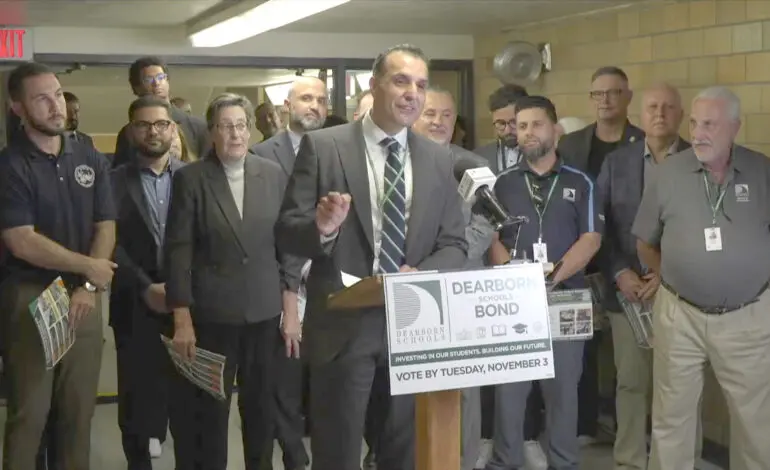

DEARBORN — About three months before voters decide its fate in the November election, Dearborn Public Schools launched an informational campaign promoting a “transformational” $1.51 billion bond proposal that would construct new schools and modernize every building in the district, which serves all of Dearborn and a portion of Dearborn Heights.
The campaign was formally launched during an August 6 press conference at Lowrey School, one of the district’s oldest buildings.
Constructed in 1927, Lowrey is among several aging schools that would be replaced by six new preschool-through-eighth-grade buildings across Dearborn. The proposed project would be carried out in four phases over 20 years and would extensively renovate the district’s remaining schools.
Dearborn Public Schools operates 36 schools, including its three traditional high schools: Dearborn High, Fordson and Edsel Ford. All three high schools would be preserved and modernized under the proposed plan.
The press conference brought together new Dearborn Public Schools Superintendent Mike Esseily, members of the Dearborn Board of Education, Dearborn Federation of Teachers President Kathi Martin, Dearborn Mayor Abdullah Hammoud and Dearborn Heights Mayor Mo Baydoun. Both mayors announced their support for the proposal.
Before the press conference, attendees toured Lowrey School and viewed some of the building’s infrastructure problems, including a roughly 50-year-old boiler, deterioration in the foundation and the absence of air conditioning.
Dearborn voters to decide in November on $1.51 billion school transformation plan
Lowrey would be replaced during the first phase of construction if voters approve the $1.51 billion bond proposal on November 3.
Esseily described the proposal as “transformational.”
“This is a big ask, but small investments produce small results, and Dearborn’s kids deserve more than a Band-Aid on a system that needs to be rebuilt,” he said.
“Over the next 20 years, every single school and building in this district will either be replaced or extensively remodeled.”
Esseily said the district developed the transformation plan after years of detailed studies and community discussions. The process was also intended to avoid the shortcomings of a previous bond proposal rejected by voters in 2019.
The district will return to the community for additional input before beginning each subsequent phase of the four-stage project, he said.
If approved, the proposal would provide air conditioning in every school, repair or replace aging roofs and boilers and renovate restrooms, cafeterias and playgrounds. It would also improve security and safety systems and expand spaces for special education, science, technology, engineering, arts and mathematics programs and career and technical education.
No net tax-rate increase for Dearborn homeowners
The ballot proposal asks voters to authorize a 3.14-mill property tax levy to repay bonds over 30 years. One mill equals $1 for every $1,000 of a property’s taxable value.
The district says the proposal would not increase the overall property tax rate for Dearborn homeowners because the new levy would be fully offset by other reductions.
The city of Dearborn is phasing out a combined sewer overflow bond millage, reducing the tax rate by 0.94 mills compared with 2025. Dearborn Public Schools would also waive its 2.18-mill operating levy if the bond passes.
Dearborn officials rally behind “transformational” school bond
Together, the two reductions total 3.12 mills, effectively offsetting the proposed 3.14-mill bond levy, according to district officials.
Homeowners in the portion of Dearborn Heights served by Dearborn Public Schools would experience a slight tax increase because they do not pay Dearborn’s sewer bond millage.
Hammoud described the modernization of the schools as an investment in Dearborn’s future and its coming generations, saying the city’s educational environment must keep pace with the community’s growth and transformation.
He said the proposal was coordinated between the city and school district to avoid increasing the overall property tax rate for Dearborn homeowners.
Hammoud also noted that his administration had reduced Dearborn’s overall property tax rate by approximately 17 percent over the past five years, from about 61 mills to roughly 51 mills.
Although Dearborn voters approved millage proposals supporting SMART public transportation and the city’s libraries during the August 4 primary election, Hammoud emphasized that both were renewals of existing taxes and would not create additional tax burdens for property owners.
Baydoun also endorsed the school bond proposal, stressing that “every child matters, regardless of where they live.”
Pointing to the high temperatures and lack of air conditioning inside Lowrey School, Baydoun questioned how students could spend seven or eight hours a day in such conditions while remaining focused and ready to learn.
Aging buildings affect students and staff
Martin highlighted the direct effects aging buildings have on students and school employees.
She recalled the experience of a fifth grade student who uses a wheelchair and had to transfer to another school because the elevator in the student’s building remained out of service for nearly a year.
Martin also cited recurring pest problems and outdated ventilation systems that worsen asthma among some students and employees.
“These are not just maintenance issues,” Martin said. “They affect the health, safety and daily experiences of the people inside our schools.”
“Investing in our facilities is investing in student success,” she added. “This is not about luxury. It is about necessity.”
$1.51 billion proposal promises sweeping overhaul of Dearborn schools
Speaking on behalf of the Dearborn Board of Education, Trustee Mary Petlichkoff said the proposed plan combines the findings of two comprehensive district studies.
The Fielding International study focused on the district’s future educational and spatial needs, while the Quinn Evans study evaluated the condition of its older buildings and the feasibility of preserving them.
“We believe we have found the right formula,” Petlichkoff said. “We can do this with the least impact to our taxes and still generate the funds needed to build the quality of schools our students deserve now and into the future.”
If voters approve the proposal, construction would proceed in four phases over two decades. Six new preschool-through-eighth-grade schools would be constructed, while all other district buildings would receive extensive renovations and modernization.
The district says the plan would allow students to remain in their existing neighborhoods while gaining access to modern learning spaces, upgraded technology, expanded laboratories and improved career education facilities.



Leave a Reply