


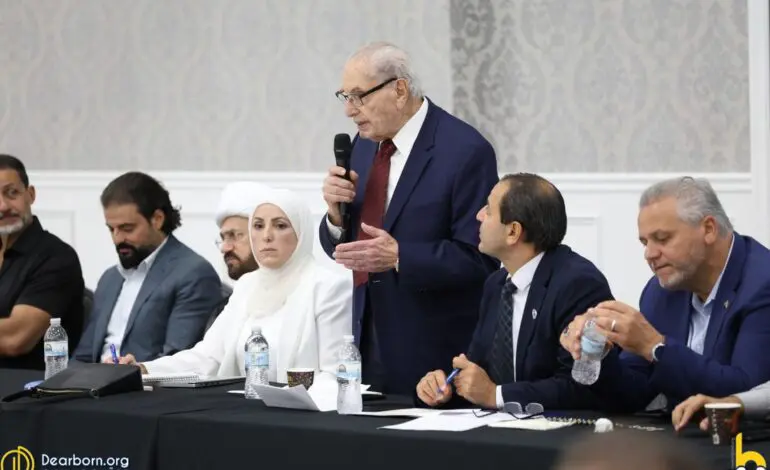

DEARBORN — Dozens of leaders and representatives from Arab American associations, clubs and organizations across Metro Detroit, along with community figures, business leaders and elected officials, accepted an invitation Monday from Dr. Nassib Fawaz, president of the Lebanese International Business Council, to form an umbrella organization that would coordinate their efforts and unite their objectives.
The proposed organization, called the Michigan Community Organizations Council (MCOC), would bring participating institutions under one umbrella to protect the rights of Arab and Muslim Americans in the United States and advocate for people in their countries of origin.
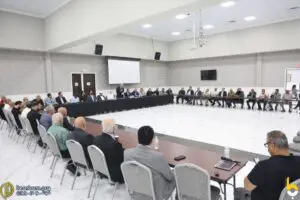
Approximately 65 political, religious and professional leaders joined the council’s organizing committee for a roundtable discussion at the Bint Jebail Cultural Center in Dearborn on Monday, August 24.
Participants discussed the council’s proposed organizational and structural framework, mechanisms for coordinating community action and future plans to represent Arab American institutions and strengthen their collective role and presence.
The meeting was held under the slogan “One community, one voice, one future.”
At the beginning of the nearly two-hour meeting, participants voted unanimously on the need to develop a shared vision that would unify the work of Arab American institutions and advance community organizing across Michigan in response to the growing challenges facing Arab and Muslim American communities.
Following a period of discussion and an exchange of ideas, Fawaz called for a formal motion to establish the Michigan Community Organizations Council.
Bint Jbeil Benevolent Association President Hajj Samih Baydoun introduced the motion, which was seconded by Father Halim Chaker, pastor of Our Lady of Redemption Melkite Catholic Church in Livonia.
The proposal received approval by a majority vote. Four participants abstained and requested additional clarification and logistical details intended to help ensure the council’s success, particularly in light of previous umbrella organizations that later dissolved or became inactive.
Dr. Nassib Fawaz speaks during the founding meeting of the Michigan Community Organizations Council in Dearborn Monday evening. – Photo by Dearborn.org
Fawaz, chairman of the council’s organizing committee, then joined committee members Dr. Ibrahim Duhaini and Dr. Lina Saad in presenting a detailed overview of the preliminary bylaws and organizational plan.
The presentation addressed the council’s proposed vision, mission and strategic objectives, as well as its organizational structure and governance rules intended to promote transparency and sound performance.
The organizing committee also discussed membership requirements, mechanisms for ensuring equitable representation among participating organizations and the proposed distribution of specialized committees and working groups. It outlined procedures for coordination, decision-making and the policies needed to operate the council efficiently and effectively.
The committee plans to continue inviting community organizations from across Metro Detroit to join the Michigan Community Organizations Council.
Leaders and representatives attending Monday’s organizing meeting came from numerous religious institutions, civil rights organizations, clubs and associations. They included representatives from the Michigan Muslim Imams Council, the Islamic Cultural Association, the Islamic Council of America, the Islamic House of Wisdom, the Islamic Center of Detroit, Al-Baqaa Mosque, the Arab American Civil Rights League, the American Human Rights Council, the Jordanian American Heritage Organization, the Yemeni American Heritage Club, the Barachit Social Club and Our Lady of Redemption Melkite Catholic Church in Livonia, among others.
Attendees also included attorneys, physicians and business leaders, along with elected officials such as Wayne County Commissioners Sam Baydoun and Hassan Ahmad, Dearborn City Council President Pro Tem Kamal Alsawafy and Dearborn Heights City Council President Pro Tem Hassan Saab.
As part of the organizing process, participants approved a second initiative to establish an official delegation representing the proposed council. The delegation would meet with elected officials and policymakers in Lansing and Washington, D.C.
The meetings would highlight growing community concerns about current developments and rapidly unfolding events across the Middle East, particularly in Palestine, Lebanon, Iraq and Syria.
Participants also approved the formation of an interim committee responsible for developing an implementation plan, establishing logistical and communication procedures and building the advocacy effort to help it achieve its intended objectives.
Fawaz said the proposed council is intended to protect the community from mounting challenges and continuously strengthen its institutional capacity.
“Ask not what my community can do for me, but what I can do for my community,” he said, adapting President John F. Kennedy’s well-known call to public service.
In an interview with The Arab American News, Fawaz said the council’s responsibilities would include protecting the rights of Arab and Muslim Americans in the United States, strengthening their public presence and supporting their prosperity.
He added that the council would also work to defend people in their countries of origin who continue to face Israeli attacks in Palestine, Lebanon and Syria, as well as communities enduring the consequences of armed conflict elsewhere in the Middle East.
Leave a Reply