



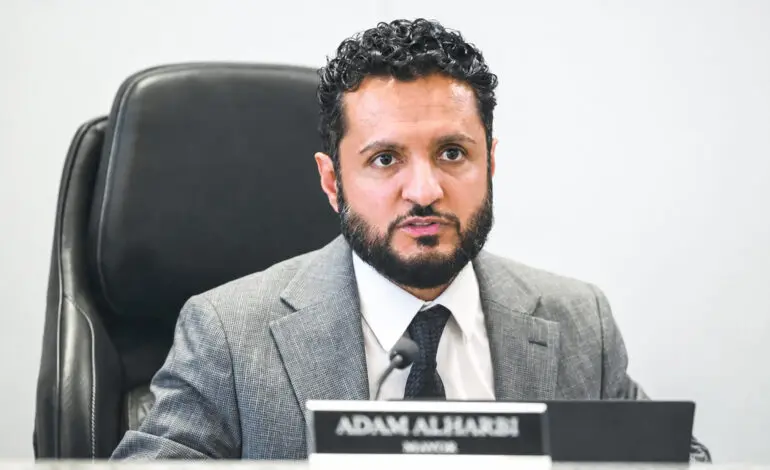

HAMTRAMCK — Despite the complex and continuing legal process surrounding the November 2025 Hamtramck mayoral election — and the political disputes and community divisions it has produced — Mayor Adam Alharbi says he remains focused on improving one of Michigan’s most ethnically diverse cities.
Alharbi described himself to The Arab American News as an independent public official who is aligned with neither the Republican nor Democratic Party and is not concerned with the partisan battles dominating Michigan’s current election season.
The 45-year-old mayor said the daily challenges facing Hamtramck’s approximately 28,000 residents — from improving infrastructure and lowering utility bills to strengthening public services — do not distinguish between political affiliations.
Since taking office at the beginning of the year, Alharbi said, his administration has launched several initiatives and structural improvements intended to enhance the quality of life in a city that regularly attracts local and national attention because of its cultural, ethnic and religious diversity. Hamtramck is the only U.S. city governed entirely by Muslim elected officials.
The latest development in the election dispute came in mid-August, when the Michigan Supreme Court declined to hear an appeal challenging a Court of Appeals decision ordering the review and counting of 37 absentee ballots that had been excluded from the November election.
The ballots were discovered in the City Clerk’s Office after the election. Their exclusion left Alharbi with an 11-vote lead over his opponent, then-City Council member Muhith Mahmood.
Mahmood, who is of Bangladeshi descent, continued challenging the result. The Wayne County Board of Canvassers initially declined to count the ballots because of concerns that the chain of custody of the ballots had been broken.
Mahmood subsequently filed a lawsuit in Wayne County Circuit Court, which upheld the board’s decision after Alharbi’s legal team argued that the chain of custody had been compromised.
The case then proceeded to the Michigan Court of Appeals, which reversed the Circuit Court ruling and ordered the ballots to be reviewed and included. The appellate court concluded that procedural and administrative errors by the City Clerk’s Office should not disenfranchise voters who had lawfully cast ballots.
That ruling remained in place after the Michigan Supreme Court declined to hear Alharbi’s appeal. Responsibility now rests with the Wayne County Board of Canvassers to review the ballots and determine their validity.
The four-member board is evenly divided between two Democrats and two Republicans. During its initial consideration of the disputed ballots, the board deadlocked 2–2, with its Democratic members supporting their inclusion and its Republican members opposing it. The tie resulted in the ballots being excluded from the certified results.
The partisan split prompted some news organizations and political observers to characterize the dispute as a battle between Republicans aligned with Alharbi and Democrats aligned with Mahmood.
Alharbi firmly rejected that portrayal. He said he did not run for mayor under any party banner and argued that news coverage had unfairly linked him to Republicans because former Mayor Amer Ghalib — one of his most prominent supporters — endorsed Donald Trump in the 2024 presidential election following disagreements with Democrats over several issues, including LGBTQ policies and the war in Gaza.
Ghalib supported Alharbi’s campaign to succeed him in 2025. The former mayor decided not to seek reelection after Trump nominated him to serve as U.S. ambassador to Kuwait. The nomination later stalled in the U.S. Senate.
The absentee ballot dispute
Alharbi said his opposition to including the disputed ballots was not based solely on whether they would benefit him or Mahmood. He said his position concerns enforcement of Michigan election law and protection of the integrity of Hamtramck’s democratic process.
He noted that the previous City Council adopted a resolution late last year supporting both the Wayne County Board of Canvassers’ decision and the Circuit Court ruling against counting the 37 ballots. That action occurred before Alharbi formally took office.
Alharbi said it is important to distinguish between the appellate court’s order requiring the ballots to be reviewed and whether each ballot will ultimately be deemed valid under Michigan election law.
He maintained that the Wayne County Board of Canvassers is responsible for determining the validity of the ballots and whether they are eligible to be counted.
The Yemeni American telecommunications engineer said his concerns about the ballots have not changed. He alleged that they were found in opened envelopes inside the clerk’s office after unauthorized individuals had entered the area.
Alharbi said the Clerk’s Office failed to maintain an adequate chain of custody, raising what he described as legitimate questions about whether the ballots could have been tampered with.
He said those concerns were intensified by news reports and video footage allegedly showing individuals depositing large numbers of ballots into an election drop box. Alharbi characterized the practice as unlawful “ballot harvesting.”
He also said an additional ballot was discovered in the clerk’s office approximately a month ago, bringing the total number of uncounted ballots to 38.
Alharbi further alleged that approximately 100 ballots examined during the November 2025 canvass appeared to have had his name erased and replaced with his opponent’s name.
He praised the Wayne County Board of Canvassers for sending a letter concerning the matter to the Wayne County Prosecutor’s Office for investigation.
Given the circumstances in which the disputed ballots were found and the absence of what he considers a reliable chain of custody, Alharbi said he believes the 37 ballots may have been tampered with and may not satisfy Michigan election law requirements.
He expressed confidence that the Board of Canvassers would fulfill its responsibilities under the law.
An independent mayor
Alharbi emphasized that he is “neither a Democrat nor a Republican” and has never belonged to a political party or participated in partisan political activities.
He also said he has never publicly endorsed a presidential candidate or a candidate for any other public office in Michigan or elsewhere.
Rather than dwelling on partisan politics, Alharbi spoke at length about his plans to improve the quality of life in Hamtramck despite the local controversies and the continuing uncertainty surrounding the mayoral election.
He insisted that he is an independent mayor serving residents from a wide range of backgrounds and political perspectives, including people with no party affiliation.
His principal political concern, he said, is protecting the integrity of Hamtramck elections and ensuring that they are conducted in accordance with the law.
“Residents must have confidence in the election process,” he said.
Hamtramck’s problems do not distinguish between Democrats and Republicans, Alharbi added. Potholes, high water bills and residents’ everyday concerns affect everyone regardless of political affiliation.
“All the people here want is for their city to operate properly,” he said. “That is what matters to me as well.”
Accomplishments and plans
Alharbi also highlighted what he described as his administration’s accomplishments since he took office at the beginning of the year.
He said the city has taken decisive steps to strengthen election security and integrity, including adopting two resolutions. One calls for strict enforcement of the City Charter’s residency requirement for candidates, while the other strengthens the chain of custody during elections by installing a secure door and surveillance cameras in the City Clerk’s Office.
Several City Council members, including Mahmood, have faced allegations that they violated Hamtramck’s candidate residency rules, which require candidates for municipal office to have lived in the city for at least one year.
Mahmood continues to face a separate legal challenge that could prevent him from assuming the mayor’s office even if the disputed ballots are counted and ultimately give him a majority.
Alharbi said his administration also created a position to manage the city’s social media accounts, which publish news and information about improvements in Hamtramck through videos and other reports.
The city has also begun redesigning its public identity and developing a new logo intended to make Hamtramck more attractive to investors and visitors.
Alharbi said his administration helped Hamtramck qualify as a Select Level community in the Michigan Main Street program, making it one of a limited number of municipalities participating at that level.
The state program provides technical assistance and investment support to revitalize downtowns and older commercial districts and strengthen local economic activity.
He also pointed to efforts to support the Hamtramck Fire Department and provide the Police Department with drones, additional cameras and artificial-intelligence technology to improve public safety.
His administration is working to upgrade the city’s website and make it available in multiple languages, making information more accessible to residents. A new online system is also being developed to make it easier for residents to report problems.
Alharbi said he worked with Hamtramck’s representative in the State House of Representatives to help secure additional funding for the city.
He also established a Unity Commission intended to reflect Hamtramck’s diversity and foster what he called “the community unity we desperately need.”
Other projects under consideration include working with relevant agencies to establish a new Wayne County Community College District location in Hamtramck.
Alharbi said the city has also worked with Wayne County officials for several months to restore funding intended to reopen the county jail facility in Hamtramck.
His administration is considering hiring an outside firm to assist with the search for a new city manager. It is also working with Hamtramck’s finance officials to identify innovative ways of lowering residents’ water bills.
He acknowledged that much remains to be done and said he wants to continue those efforts regardless of the outcome of the ballot review.
“My commitment to Hamtramck will not change,” he said. “For me, it has never been about a position or a single election. It has always been about Hamtramck and the lives of its residents.”
Ordinary disagreements
Alharbi downplayed political disagreements within the city government, describing them as part of the normal course of American political life.
He said heated discussions among City Council members are normal and are sometimes portrayed negatively by sections of the media. Council members should be expected to hold differing opinions on public issues, he added.
He said divisions within the Hamtramck City Council were considerably more severe decades ago. He recalled accounts of disputes that escalated into physical confrontations between Council members and even damage to their vehicles.
“Compared with that era, I cannot describe the current City Council as deeply divided,” he said.
Alharbi acknowledged that there remains room to improve communication and cooperation, but said most City Council meetings are calm and productive.

Leave a Reply