



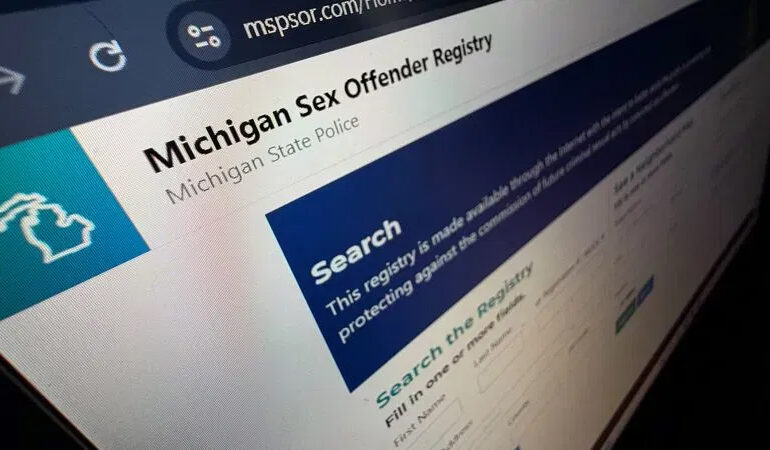

LANSING — Until recently, any Michigan resident could determine whether a person convicted of a sex offense lived near their home or within their neighborhood by visiting the state’s online Public Sex Offender Registry. The registry contained approximately 43,000 people before it was reduced by nearly half under a landmark Michigan Supreme Court ruling issued earlier this September.
A majority of the Michigan Supreme Court justices found that the 2021 amendments to the Sex Offenders Registration Act should not be applied to people whose relevant offenses occurred before July 1, 2011. The court found that the Michigan Constitution prohibits the state from retroactively extending or increasing a person’s punishment after the crime was committed or a sentence was imposed.
Under the Supreme Court’s September 9 decision, the Michigan State Police removed the names and photographs of more than 20,000 people from the registry last week because their relevant offenses occurred before July 1, 2011.
People who committed qualifying offenses on or after that date remain subject to the stricter registration rules adopted 15 years ago. Those rules include stringent address reporting requirements and, in some cases, lifetime registration.
After removing more than 20,000 names from the registry, the Michigan State Police said the number could continue to change as its review proceeds.
Despite concerns that the ruling will make it more difficult to monitor people with older sex offense convictions, Miriam Aukerman, director of strategic litigation at the ACLU of Michigan, welcomed the Supreme Court’s decision, saying it reduces the reach of what she described as the state’s failed registry system.
Aukerman explained that the Michigan Legislature substantially revised the law in 2011, effectively and retroactively imposing what could be described as a strict lifetime surveillance system.
“The legislature changed the rules of the game, but the court’s decision makes clear that it cannot do that,” she said, describing the practice as “a violation of a fundamental constitutional principle.”
Aukerman emphasized that the Supreme Court made clear that the state cannot increase a person’s punishment after the original sentence has been imposed.
She said the decision would affect people whose sex offenses occurred before 2011, meaning their convictions date back at least 15 years and, in many cases, several decades.
Aukerman and the ACLU of Michigan have spent more than a decade fighting to reform the state’s sex offender registration system.
She said Michigan’s sex offender registry is particularly problematic because of its enormous size, describing it as one of the largest registries of its kind in the country.
“It is a massive registry, and it is among the largest in the entire country,” she said. “It does not consider the individual circumstances of any person when placing them on the registry.”
Aukerman added that the registry is “not only ineffective but counterproductive because it makes it more difficult for people to find employment or housing.”
The Michigan State Police, meanwhile, emphasized that it played no role in changing the registry’s rules and was merely implementing the court’s order.
“The MSP did not make this change to the law,” said Col. James F. Grady II, director of the Michigan State Police. “However, the department maintains the database, is required to comply with the Court’s order and is taking the necessary steps to implement the ruling.”
“Any concerns about or efforts to change the law should be directed to the state legislature,” Grady added.
Critics say the removal of thousands of names from the registry raises serious public-safety concerns, particularly for parents who depend on it to identify people with sex-offense convictions living near their children.
It is important to note, however, that the ruling does not overturn anyone’s conviction. Its effect is limited to determining who remains legally required to appear on the public registry.
Michigan’s Public Sex Offender Registry, including listed residential addresses across the state, is available at mspsor.com.



Leave a Reply