



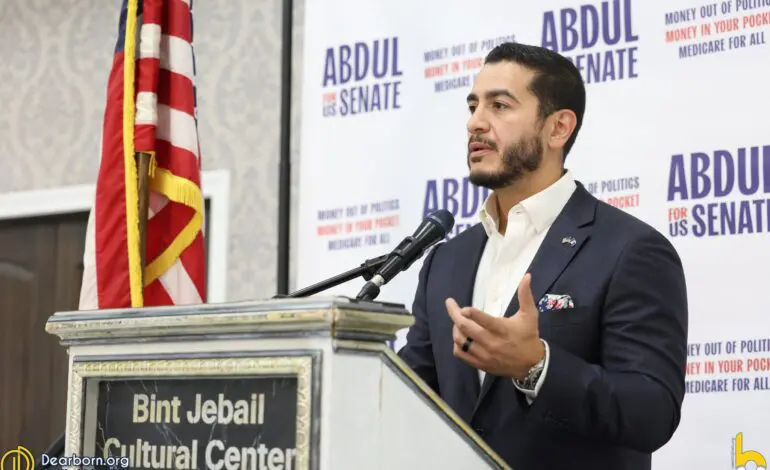

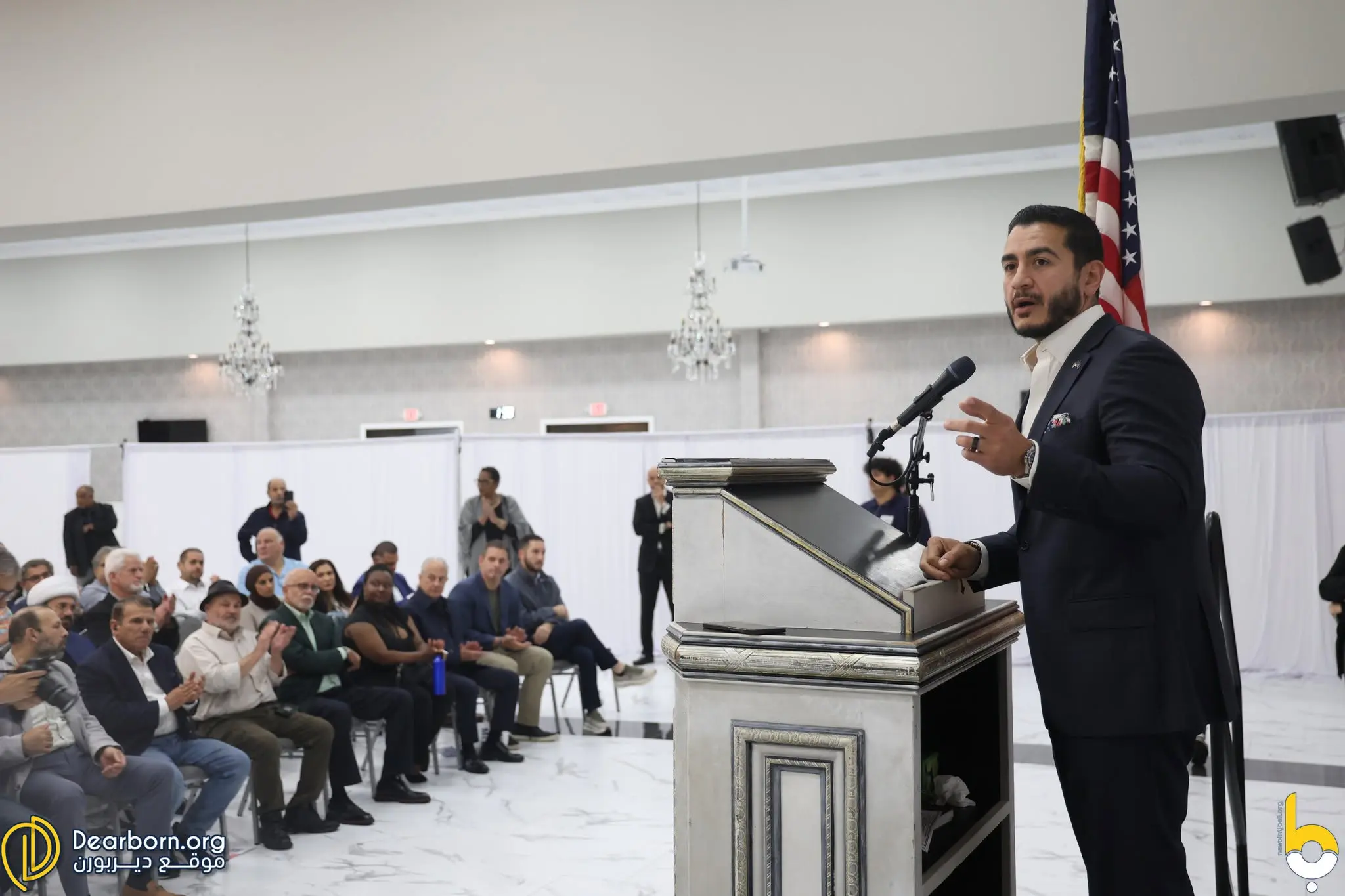
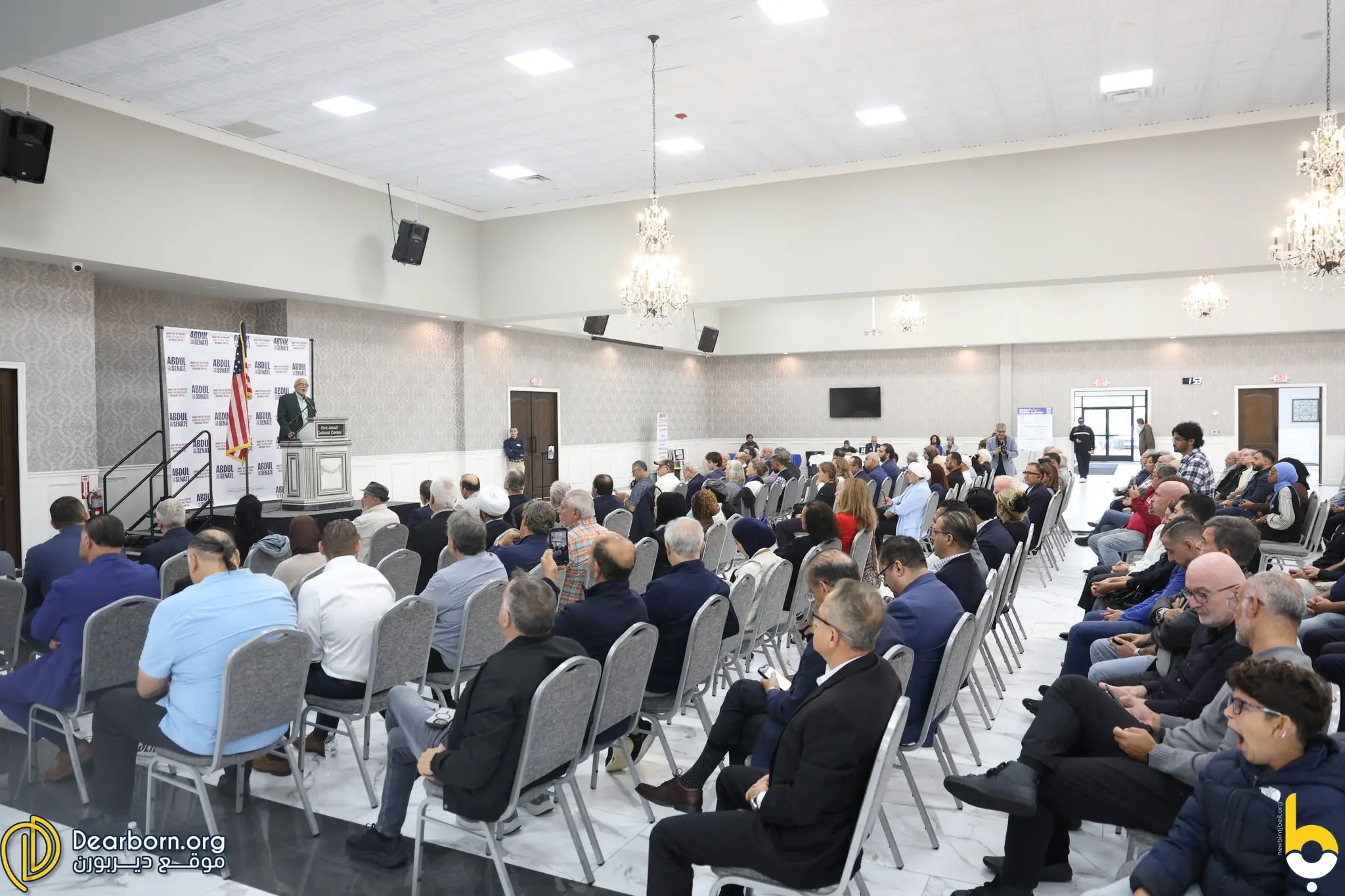
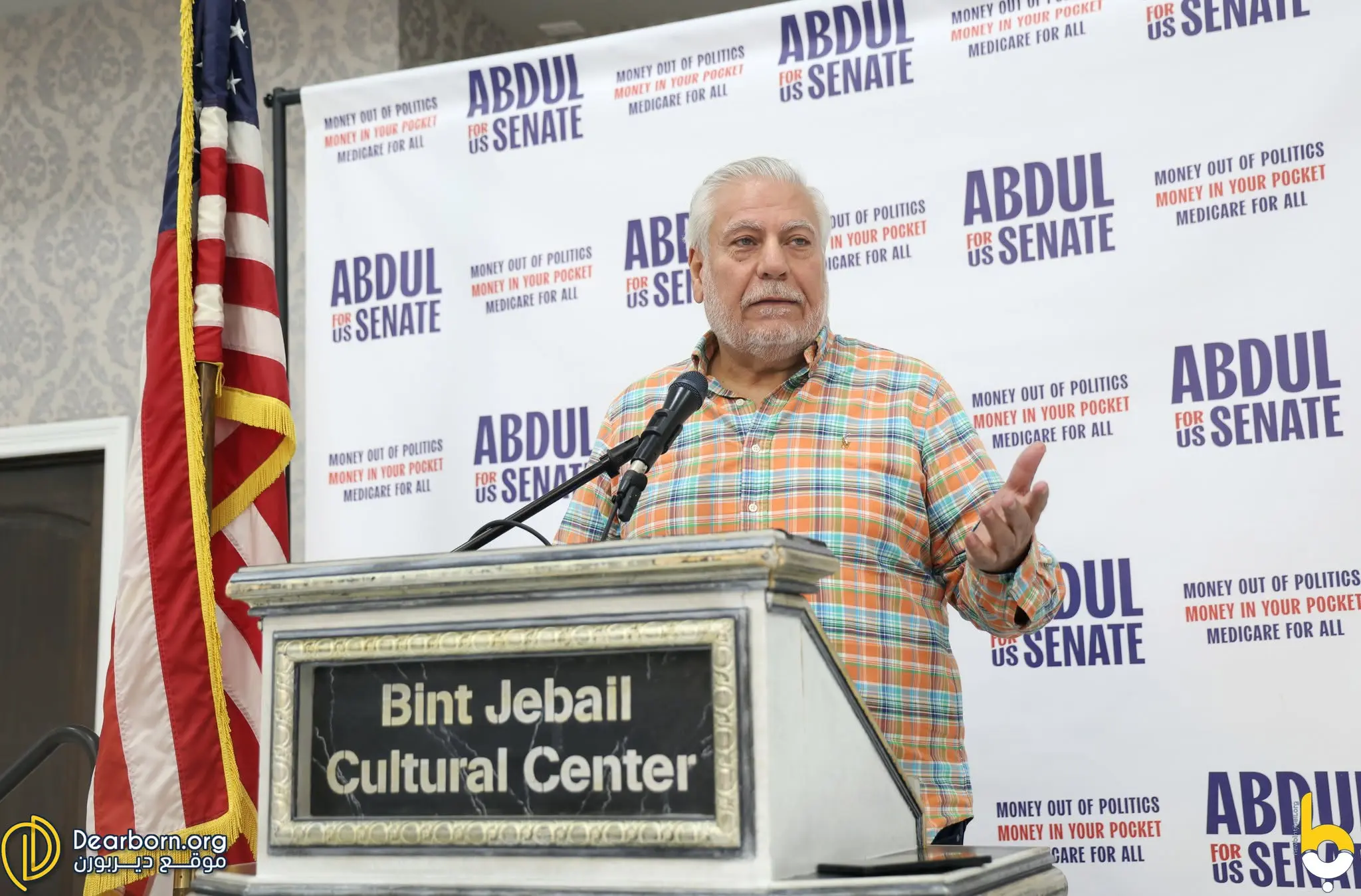
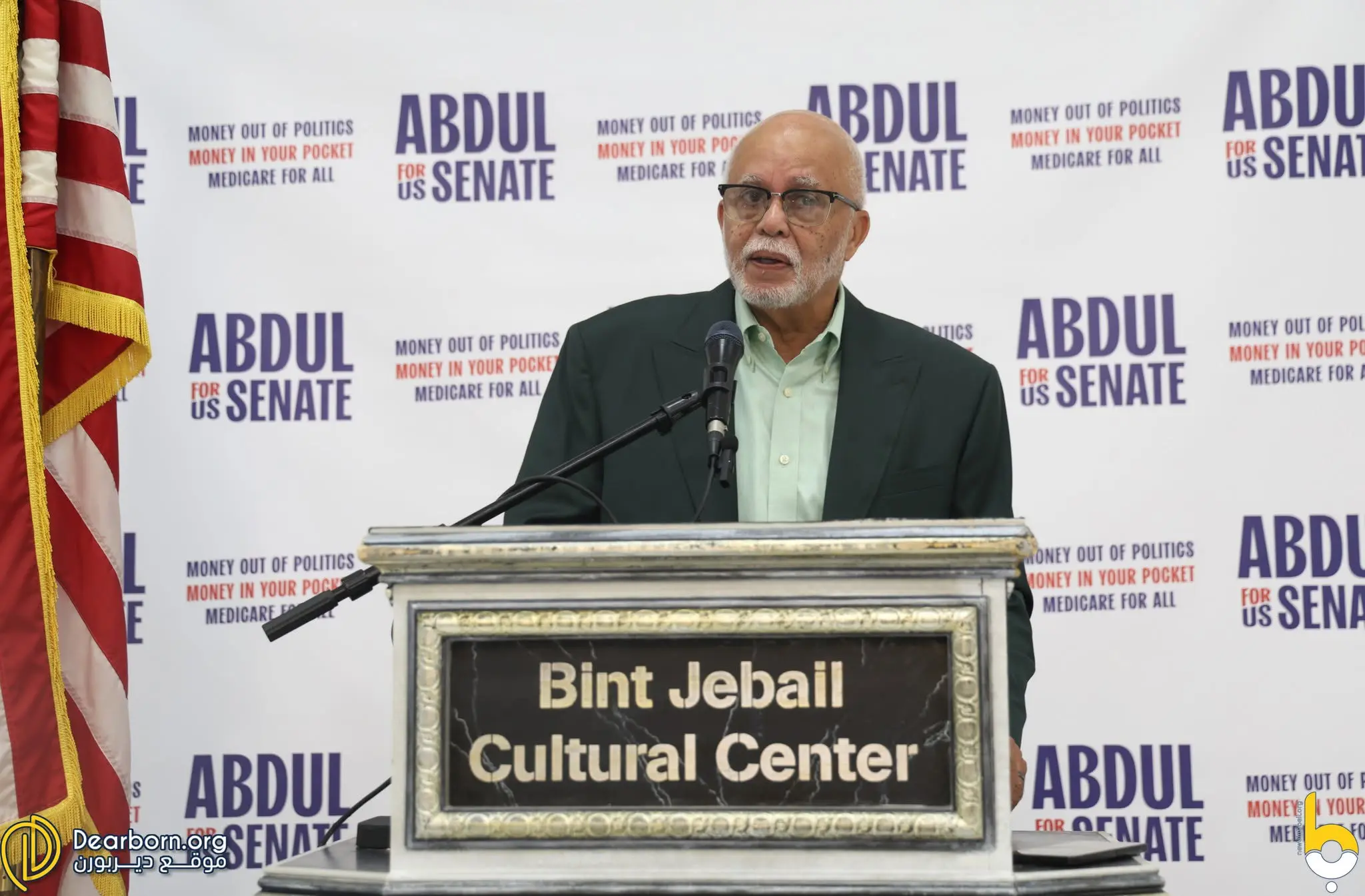
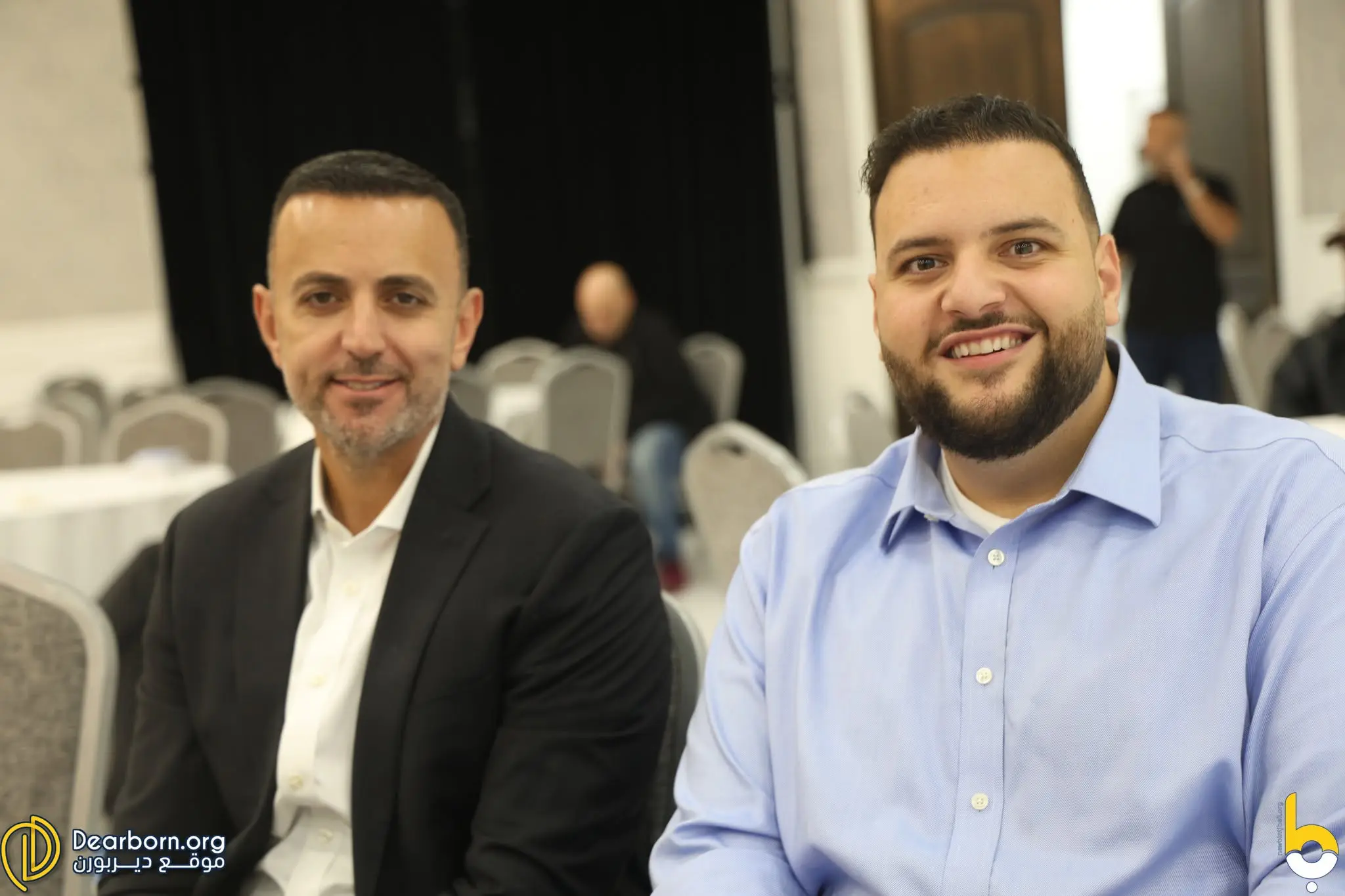
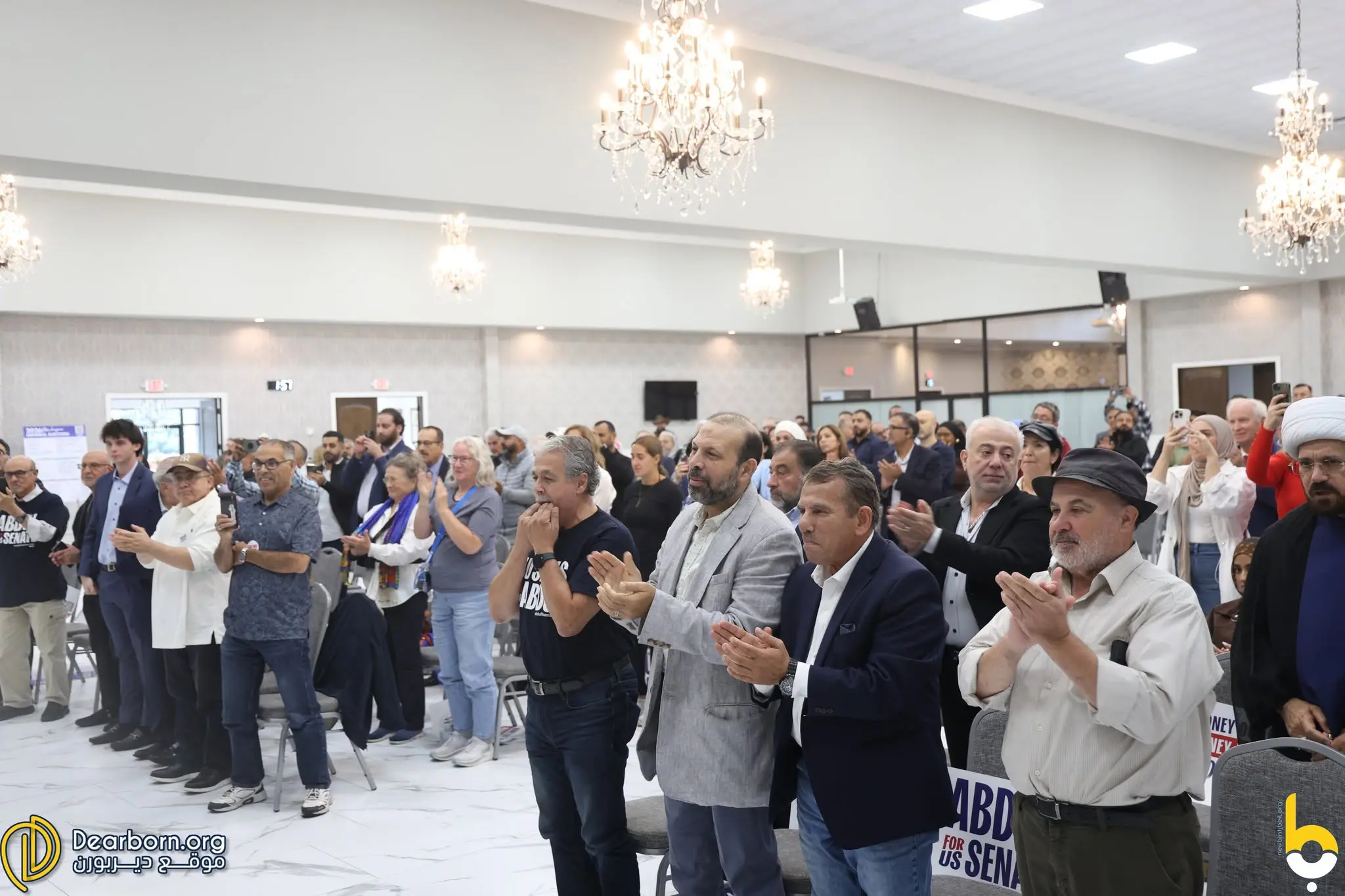
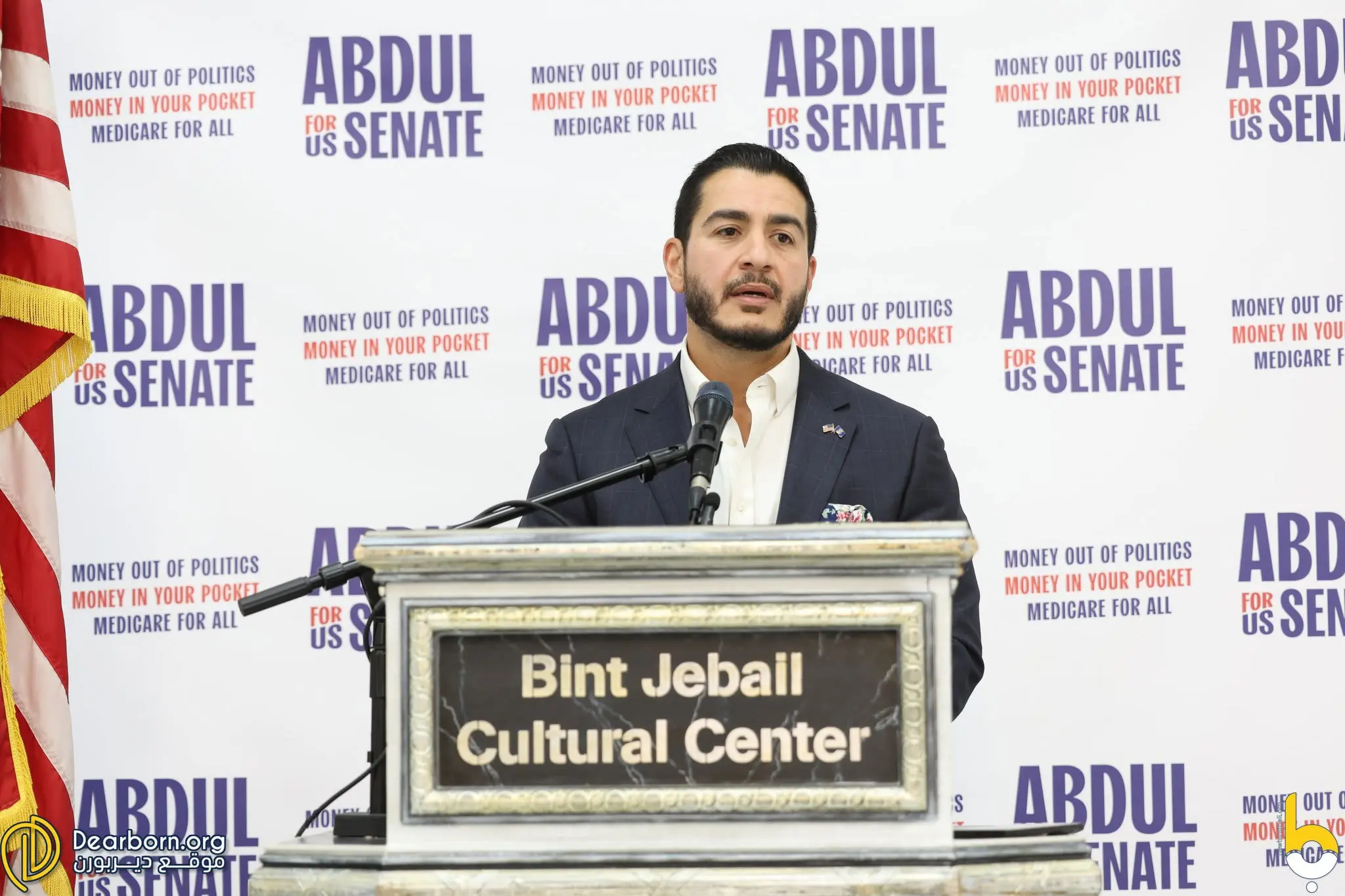
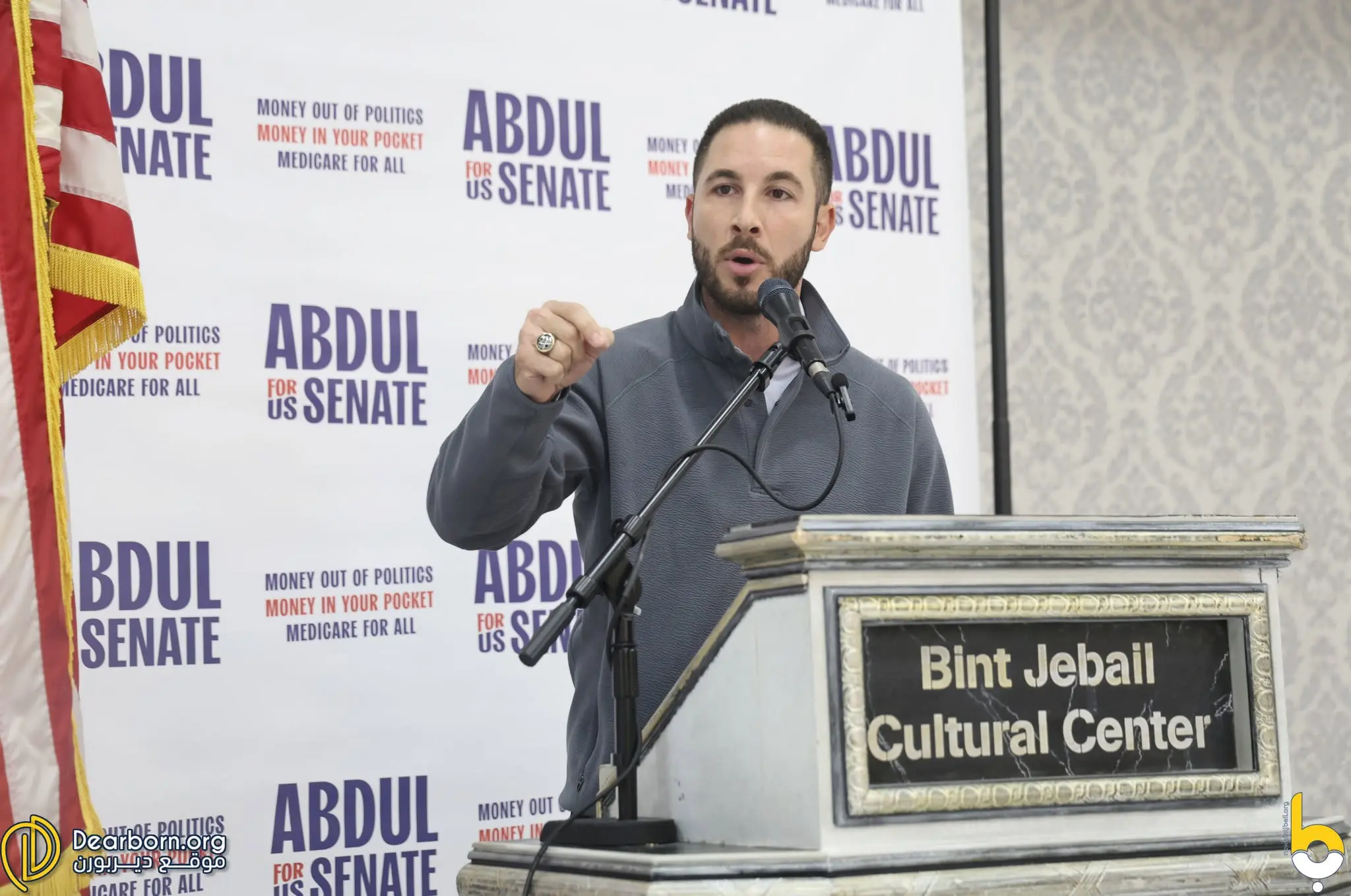
DEARBORN — The Bint Jebail Cultural Center in Dearborn hosted a large fundraiser on Sunday, September 20, for Michigan Democratic U.S. Senate candidate Abdul El-Sayed. The event drew a sizable gathering of elected officials, political figures and community leaders from across Metro Detroit.
The fundraiser brought in approximately $350,000, exceeding its $250,000 goal. It also launched an effort to mobilize local resources in the Dearborn area and turn out voters for El-Sayed against Republican opponent Mike Rogers, who is backed by President Trump.
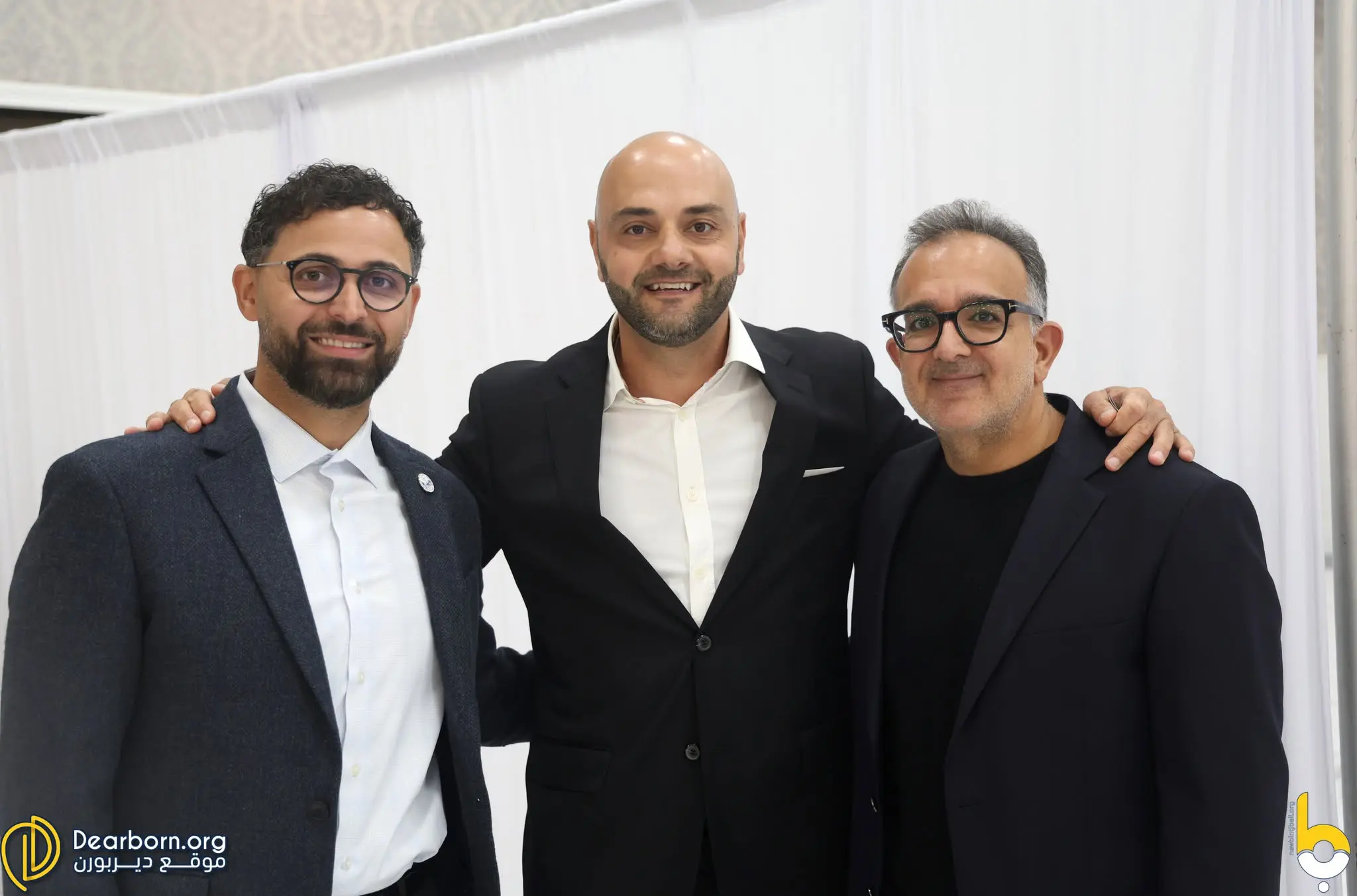
The event resulted from organizing efforts led by Wayne County Deputy Executive Assad Turfe, Dearborn Mayor Abdullah Hammoud, Dearborn Heights Mayor Mo Baydoun, The Arab American News Publisher Osama Siblani and Wayne County Commissioner Sam Baydoun.
A similar initiative took place last month, when a gathering of Syrian physicians in Metro Detroit raised approximately $1 million for El-Sayed’s campaign. El-Sayed relies on grassroots support and refuses contributions from major corporations. His Republican opponent, meanwhile, has devoted a substantial share of campaign spending to attacks on the Egyptian American candidate that seek to frighten voters by targeting his Muslim faith and what his opponents call his “socialist agenda.”
The event
Speakers at the event, introduced by Machhadie Assi, deputy director of coalitions for El-Sayed’s campaign, emphasized the significance of Dr. Abdul El-Sayed’s candidacy at this political moment. They praised his qualifications for public service and the central goals of his campaign, including fighting political corruption, supporting working people and establishing universal health care.
Dearborn Mayor Abdullah Hammoud recalled El-Sayed’s historic victory in August’s Democratic primary, when the progressive candidate defeated U.S. Rep. Haley Stevens, whose campaign had received record support from the pro-Israel lobby, by less than one percentage point, or roughly 15,000 votes.
Hammoud said Dearborn voters made that difference through record turnout, the highest in the city’s primary election history.
The mayor said voters now have an opportunity to make history again in November, both by sending El-Sayed to the U.S. Senate and by supporting other allies, including Democratic attorney general candidate Eli Savit, who was present at the event. He urged attendees to do more than donate: They should go into their neighborhoods, make sure relatives, friends and neighbors are registered, and encourage them to vote.
Hammoud called for a strong turnout, not only to send the first Muslim American senator to the U.S. Capitol but also to elect a leader who would defend the community’s priorities. Those priorities, he said, include raising workers’ wages, removing the influence of money from political campaigns and transforming services through universal health care.
Dearborn Heights Mayor Mo Baydoun said the region’s need for El-Sayed in Washington is greater than ever after decades of marginalization. Political dynamics have changed dramatically in recent years, he said, as young Arab American leaders such as Abdullah Hammoud, Assad Turfe, Alabas Farhat and Abbas Alawieh have taken prominent positions. Their rise, he added, marks an end to the days when Arab Americans had to defend or apologize for their identity in the face of continuing media attacks.
Baydoun said El-Sayed achieved a resounding moral and political victory in August despite more than $70 million spent against him and efforts to defeat him through fear and false accusations.
“When they said Abdul El-Sayed belonged to an organization that promotes terrorism, we came out and spoke up,” Baydoun said. “We said clearly: No, we condemn terrorism, but we no longer need to apologize, and we no longer need to prove that we are American, because we are Americans — and Abdul El-Sayed won.”
Baydoun also criticized Rogers for failing to attend a recent televised debate organized by FOX 2 Detroit. Rogers showed he could not take part in a real debate, Baydoun said, because he knew El-Sayed would outperform him in presenting and defending his arguments.
Born in Michigan to an Egyptian immigrant family, El-Sayed led Detroit’s Health Department before heading public health efforts in Wayne County. His only previous electoral campaign was the 2018 Democratic primary for governor, in which he performed strongly but lost to Governor Whitmer.
“We are the solution”
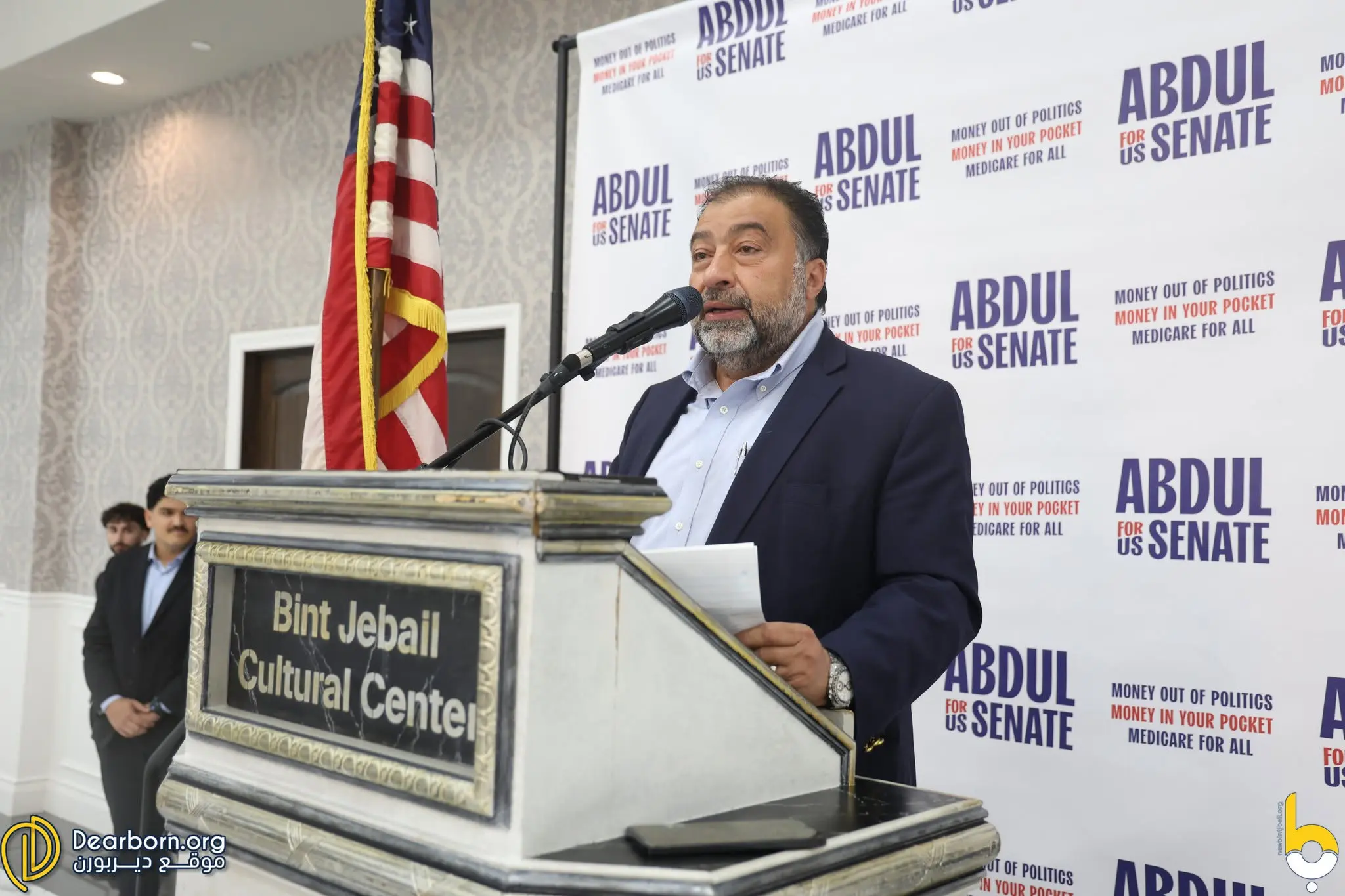
The Arab American News Publisher Osama Siblani urged attendees to contribute generously to El-Sayed’s campaign. Drawing on more than four decades of journalism and political involvement, he recalled a time when the growth of Dearborn’s Arab American community was called the “Arab problem” in local elections. He pointed to former Mayor Michael Guido’s 1985 campaign flyer, headed “Let’s Talk About the Arab Problem!”
The situation has changed profoundly, Siblani said. Arab Americans “have proven that they are not the problem — they are the solution,” he said, citing their leadership in a prospering Dearborn.
“Today, we are not the problem; we are the solution,” he said. “Dearborn’s mayor is Abdullah Hammoud, its police chief is Issa Shahin, the court’s chief judge is Sam Salamey and the City Council president is Mike Sareini.”
Electing El-Sayed to the U.S. Senate would be a natural extension of that progress, Siblani said.
“This is only the beginning,” he added, rejecting efforts to demonize Arabs and Muslims in Dearborn and across the United States.
Siblani delivered a forceful message about Arab Americans’ loyalty to the country and their place in it.
“I say to everyone here today, and let everyone hear us clearly: We are here by choice. We are Americans by choice. We love this country, and we are staying here. You will not get rid of us, and what you are doing makes us stronger.”
He closed by speaking of loyalty to the “land of opportunity.” Disagreements over U.S. foreign policy, he said, do not erase the major changes taking place among Americans.
“Yes, we disagree with American foreign policy, but look at America today,” he said. “A major change is happening, and we must embrace it by electing Abdul El-Sayed to the U.S. Senate.”
At a crossroads
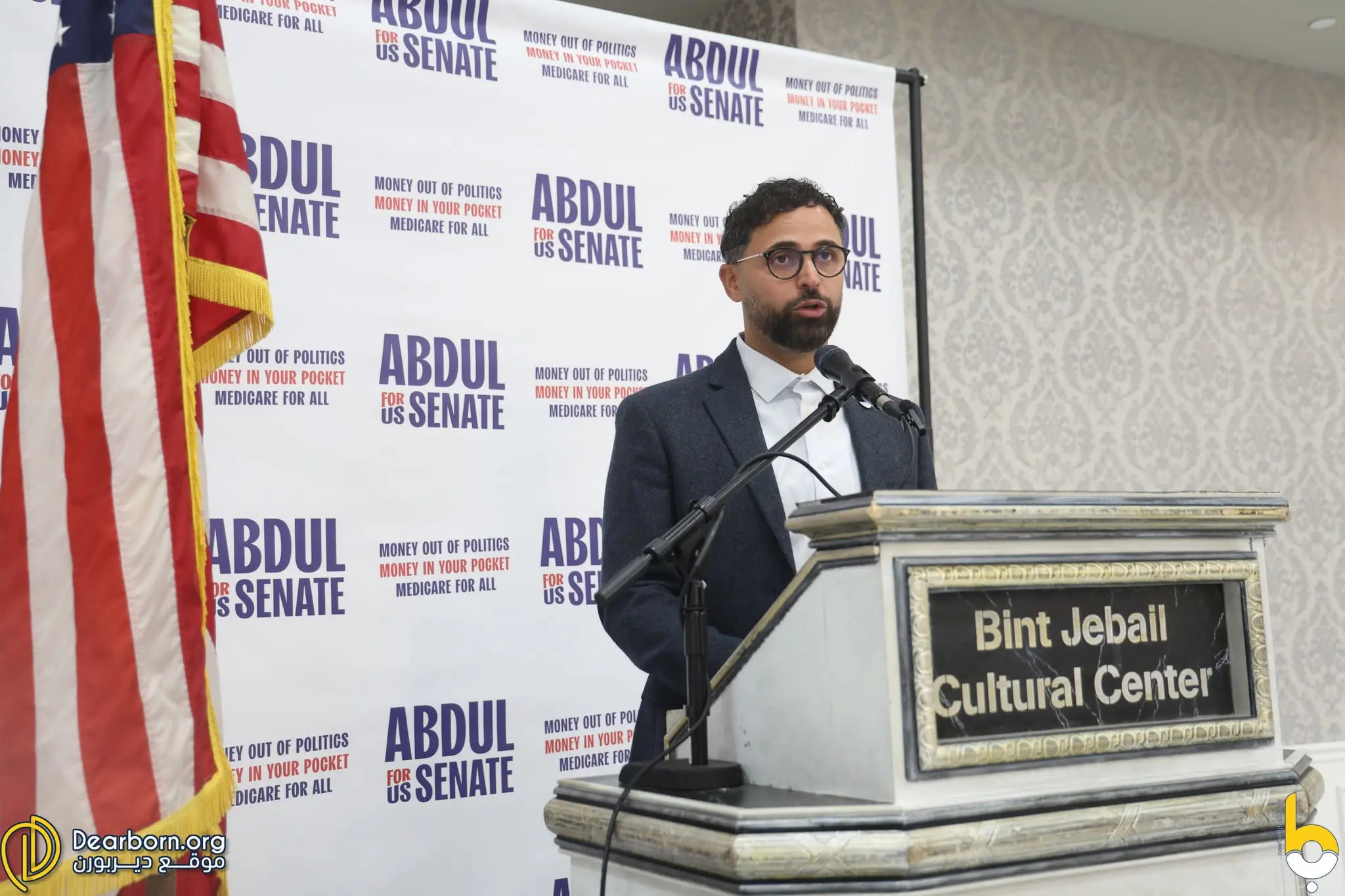
Wayne County Executive Warren Evans warned against efforts to divide Americans. The country stands at a dangerous crossroads, he said, amid strategies intended to tear its social fabric apart. He accused the current administration of fearing anticipated demographic changes and trying to prevent them by every means available.
Evans urged the audience to remain alert to misinformation and political propaganda. He described the large, diverse gathering as a committed base for the change promised by El-Sayed’s campaign.
The Democrat stressed the importance of organizing to overcome apathy among local voters. The Senate race, he said, will depend on how many people go to the polls: “If people turn out and vote in large numbers, Abdul El-Sayed will certainly win.”
The significance of the El-Sayed–Rogers race extends beyond Michigan, Evans said. It could alter the balance of power in the U.S. Senate, check the Trump administration’s current policies and help the country regain what he called its “political conscience.”
Evans described El-Sayed as “the strongest candidate for any office, including the U.S. Senate.”
“His heart is rooted in doing what is right, and I have never seen him back down on anything,” Evans said. “In my view, his position has always been right. That does not mean we agree on everything. It means he is a principled man whom you can support, speak with and trust.”
Congress, in both the House and Senate, needs people like El-Sayed, Evans added.
Recalling their years working together when El-Sayed led Wayne County’s Department of Health and Human Services, Evans said, “When someone works with you for years, you get beyond a passing impression and come to know what they are really made of — the strength of their character and the discipline of their mind.” El-Sayed, he said, had always worked to serve everyone, whether Muslim, African American or White.
El-Sayed understands the country’s failures in education and health care, Evans said.
“He knows children are suffering in this country because of poor education, and he knows health care is failing because people are dying and struggling with illness,” Evans said. “The choice is plain for everyone: A million dollars for bombs versus a million dollars for education. It is that simple.”
“Where would you put a million dollars?” Evans asked. “Multiply that by a hundred or by a billion, and we can all see that the question is not whether this country can afford to fund what is right. It is whether its leaders will fund what is right.”
“We need a senator who cares about America and cares about people,” Evans concluded. “I truly hope Michigan’s next senator is Dr. Abdul El-Sayed.”
El-Sayed’s remarks
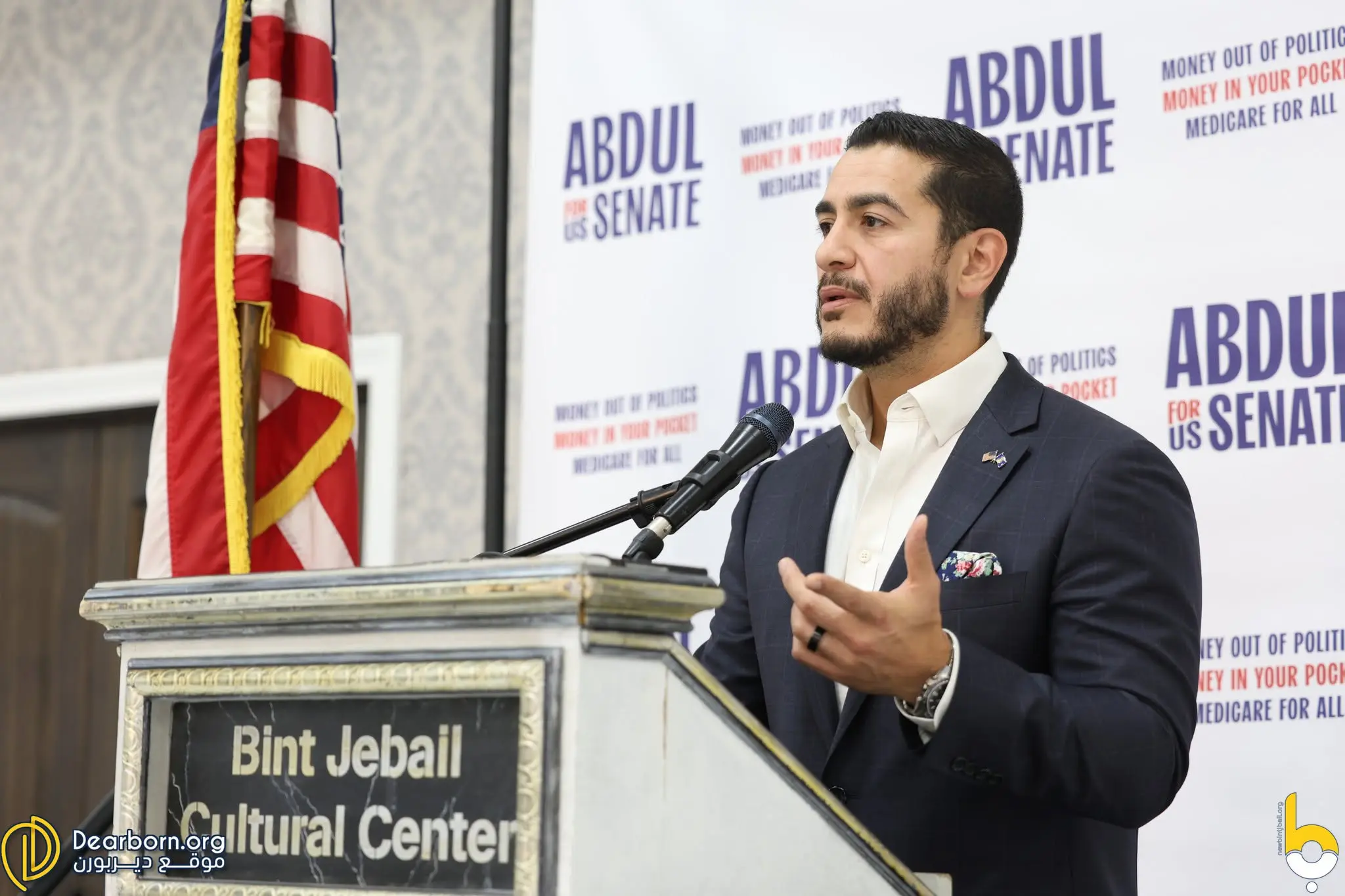
El-Sayed had barely begun thanking his supporters when a member of the audience interrupted him with anti-Muslim and anti-Arab remarks, telling them to go back where they came from. El-Sayed responded calmly as the room erupted in chants supporting the Democratic candidate.
The protester, whose identity could not be determined, grouped Democrats, Arabs and Muslims together in his hostile remarks.
“Democrats are crazy. Jesus is Lord, and Islam is pure evil,” he shouted, adding, “Go back where you came from!”
El-Sayed responded immediately.
“The irony is that this is not the first time this has happened, and it happened in Dearborn,” he said. “The sad thing is that people like this do not just hate one particular group. They hate the America that has room for everyone. That is what they are protesting. But America has always had, and always will have, room for all of us.”
El-Sayed expressed deep gratitude to those in attendance and to the officials and local leaders supporting his campaign. He thanked Evans, Turfe, the mayors of Dearborn and Dearborn Heights and Savit. He also thanked Siblani and representatives of political organizations supporting his campaign, including AMPAC and Emgage, whose representatives spoke at the event.
Turning to his campaign and the questions raised about his identity, faith and name, El-Sayed said American democracy continually confronts two questions: “Who are we? And who do we want to be?”
He described two competing visions of the country: One seeks to make America smaller by excluding others; the other recognizes the country’s breadth and believes in inclusion and pluralism.
“There are people who want America to become smaller, like them,” El-Sayed said. “They want to push certain groups out of the American story. At different times, it was women, then Black people, then immigrants from Eastern Europe. Now they want to exclude people who may hold different religious beliefs and who have names like ours.”
But another vision of the United States also exists, he said.
“There are also people who understand just how big America is and understand that ‘Out of many, one’ was meant to affirm the unity of this great country,” he said. “It was not meant to exclude others, but to keep working to include people and bring them together around American values.”
The country is at a defining moment, El-Sayed said. He argued that the manufactured question of whether America can accommodate more immigrants distracts from the cost of living and the basic rights of all citizens.
“In the richest and most powerful country in the world, you deserve health care,” he said. “You deserve to afford gas and groceries, and to know your tax dollars are going to services and education instead of bombs dropped on other people and their children.”
Those promoting a smaller America have no solutions and instead try to divide Americans, El-Sayed said. He blamed their policies for the cost-of-living crisis and pointed to the effects of the U.S. war on Iran, which he said had pushed gasoline to $5 a gallon and diesel to nearly $7. Families feel the consequences at gas stations and grocery stores, he said.
“They have no solutions to these problems,” he added. “They created them.”
“They do not want to talk about health care,” El-Sayed continued, describing what he sees as his opponents’ approach: “We will take money from the same corporations that raised your health insurance premiums and hold you hostage over your medicine, and then find a way to raise your premiums even more and make your medication more expensive and harder to get.”
El-Sayed said his campaign offers a clear alternative through a grassroots movement that represents people and works for them. Since launching in April of last year, he said, the campaign has visited 110 cities and held more than 400 town halls.
“We started with small meetings of a few people and ended the primary speaking to crowds of thousands,” he said. “The message stayed the same: Life should not be this hard in the richest and most powerful country in the world. When we move beyond our differences and stand together, we can find solutions to every challenge we face.”
Discussing the influence of money in the primary, El-Sayed said major pharmaceutical and technology companies, DTE Energy, Blue Cross and the American Israel Public Affairs Committee (AIPAC) together spent approximately $70 million trying to defeat him. AIPAC alone spent $32 million, he said, a record amount.
“They could have burned their money instead,” El-Sayed said. “We beat them.” The will of the people and an honest message, he added, proved stronger than the most powerful financial interests.
El-Sayed said voters now face a decisive choice about the country’s direction.
“Over the next 45 days, are we ready to invest in an America big enough for every child to see themselves in the future we are building for them?” he asked. “Or will we let a small group of people with narrow ideas and enormous wealth decide our fate and shut us out of the great America we deserve?”
Standing on the shoulders of giants
El-Sayed quoted a familiar expression used by Evans: “We stand on the shoulders of giants.”
“Our opponents try to divide us and convince us that our past has nothing to do with us,” El-Sayed added. “But the truth is that our experiences and our past are like intertwined roots feeding one tall tree. That tree is the America we need and deserve — the America we represent here in Michigan.”
He praised the leadership in the Dearborn area.
“This region is fortunate to have exceptional officials and public servants,” he said. “We all need to understand that we are in the same boat: We either make it together or sink together. This is a world we are building together. We cannot let ourselves be torn apart; we must keep building together.”
El-Sayed said he looked forward to working alongside those leaders and serving the community as a candidate over the next 45 days and as a senator over the following six years.
He ended with a challenge to his opponents.
“If they had real ideas or solutions, they would share them with the people,” he said. “But they do not. All they can do is focus on my name, my faith and my ethnicity. You may have noticed that the president and vice president keep saying my name.”
Imitating their pronunciation, El-Sayed closed to applause: “In November, we will teach them how to say my name correctly.”
Leave a Reply