



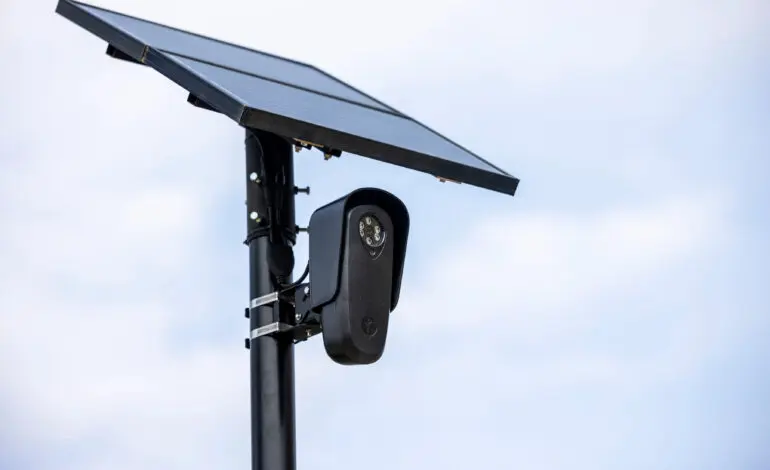

INKSTER — As more Metro Detroit communities abandon Flock license plate cameras along local roads, the city of Inkster announced last week that it had signed a contract with the security company to deploy additional cameras throughout the city, install dozens of gunshot detection devices and provide local police with a new drone.
Seeking to reassure residents of the predominantly African American city of approximately 25,000, Inkster Police Chief Tamika Jenkins said Flock cameras are not intended to place residents under general surveillance. She emphasized that data stored by the system “is not viewed by anyone unless a crime has been committed.”
The contract with Flock Safety, part of the “Inkster Safe City” initiative, will increase the city’s total number of license plate readers from six to 20.
The 10-year agreement also includes five security cameras and 48 gunshot detection systems designed to pinpoint the locations of shootings.
Police also showcased a new drone, which is expected to enter service in late November or early December.
Under the new agreement, Inkster also plans to add a transparency portal to its official website. The portal will display statistics and policies and outline the safeguards and restrictions intended to protect data collected by Flock cameras.
Inkster police officers praised the cameras’ effectiveness in identifying suspicious vehicles and solving related violent crimes, including shootings in the city over the past several weeks and a rape case dating to February 2025.
Flock provides license plate recognition technology in 49 states, including to approximately 180 police agencies in Michigan alone. The Georgia-based company operates more than 120,000 cameras nationwide that photograph passing vehicles and feed a database that allows police officers to conduct extensive searches.
Despite the cameras’ public safety benefits, public opposition to their use has grown recently amid concerns about privacy violations and data misuse in the absence of laws regulating this relatively new technology.
Jenkins acknowledged the possibility that police officers could misuse the technology.
“You will always find people who lack integrity or high ethical standards, right?” she said. “But we have put safeguards in place to address such abuses.”
Before announcing its renewed agreement with Inkster, Flock had lost contracts with 11 Metro Detroit municipalities in the past six months alone. The latest was Madison Heights, which decided last week to deactivate all Flock cameras deployed throughout the city under a pilot program that had been scheduled to continue through 2028.
Along with Madison Heights, municipalities that have recently terminated or suspended their Flock contracts include Westland, which borders Inkster, as well as St. Clair Shores, Eastpointe, Clawson, Ferndale, South Lyon, Milford, Independence Township, Sumpter Township and Lincoln Park.
Opposition in Livonia and Garden City
As Inkster finalized the expansion of its partnership with Flock, Livonia and Garden City were experiencing a wave of public protests against surveillance cameras deployed in the two predominantly White communities in western Wayne County.
Garden City, directly north of Inkster, has approximately 25 license plate cameras at its entrances and exits. At its latest regular meeting on Monday evening, the City Council faced intense public pressure to cancel the Flock contract, echoing scenes in Livonia the previous week.
A Change.org petition launched for that purpose quickly gained momentum among residents of Garden City, which has approximately 26,000 people. Organizers explicitly cited neighboring communities’ decisions, pointing specifically to Westland’s move to switch off its Flock cameras and withdraw from the security system.
At the Garden City Council meeting, a large group of frustrated residents gathered and took turns at the microphone to publicly voice their complaints. They sharply criticized systems that track traffic around the clock, describing Flock cameras as an invasion of privacy that reduces ordinary residents to data points vulnerable to misuse.
Protesters pointed to the concentration of cameras along Ford Road, beginning in Dearborn and Dearborn Heights, which also have contracts with Flock.
During the meeting, Garden City police officials and public safety advocates defended the vehicle monitoring system. They emphasized the network’s importance in tracking stolen vehicles, responding to hit-and-run crashes and intercepting fleeing criminals traveling across municipal boundaries.
Livonia’s City Council experienced a similar atmosphere at its latest meeting, when dozens of protesting residents packed the Council chamber. They voiced opposition to what they called “mass surveillance” and “tracking everyday drivers without cause” through 25 cameras deployed throughout the city of approximately 93,000.
Under pressure from residents, the Livonia City Council adopted a formal resolution prohibiting expansion of the Flock system pending a reassessment of the program.



Leave a Reply