



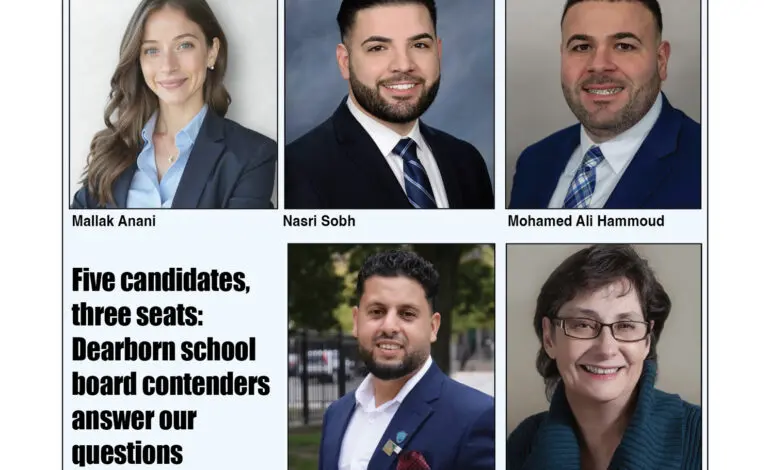

The Dearborn Public Schools district will see a competitive race in the November 3 election, with five candidates vying for three seats carrying full six-year terms on the Dearborn Board of Education, which oversees Dearborn Public Schools and Henry Ford College.
The candidates are three incumbents — Mary Petlichkoff, Adel Mozip and Nasri Sobh — and two challengers, Mallak Anani and Mohamed Ali Hammoud.
This year’s school board election coincides with a vote on a bond proposal exceeding $1.5 billion to build and modernize school facilities throughout the district, which serves all of Dearborn and the northeastern neighborhoods of neighboring Dearborn Heights.
As part of its election coverage, The Arab American News sent the same four questions to all five candidates seeking full six-year terms, asking about their backgrounds, qualifications, leading priorities and positions on the bond proposal. Their responses are presented below as submitted.
Could you tell us about your background, including your profession, education, family and community involvement?
Adel Mozip :
I am Adel Mozip, a Dearborn Public Schools trustee since 2019 and a Dearborn parent. I came here at 13 to join my father, a UAW worker since 1977, graduated from Fordson with a 3.7 GPA and a bilingual medal, and later earned a computer engineering degree from U of M-Dearborn and an MBA from Wayne State with a 3.6 GPA. I have more than 15 years in software and technology leadership. I am a husband of a Henry Ford College graduate and father of two DPS students, one with an IEP. I have served as Eastborn Neighborhood Association vice president, vice chair of the Michigan Commission on Middle Eastern American Affairs, DPS board president in 2025, Rotarian from 2016 to 2023 and chair of the Henry Ford College Board in 2025. I am also a Level 4 MASB certified school board trustee. (Michigan Association of School Boards)
Honesty, integrity and consistency guide my work. I show up, take the public votes and ask for the data behind the claim — enrollment, scores, special-education compliance and budget lines. My son’s IEP keeps this standard personal: the district must keep the commitments it writes down for every student. Integrity means one set of rules on discipline, comment and spending, not a different standard depending on who asks. Consistency means publishing the proposal, recording the vote and checking whether it achieved its promised outcome. Families should be able to predict my next vote because they have seen the last six years of my record.
Mallak Anani:
My name is Mallak Anani. I am a proud Dearborn native and graduate of Dearborn Public Schools. I grew up as one of eight siblings in a family and community that taught me the importance of education, service and looking out for one another. Today, I am a wife and mother of two, a former high school educator, an attorney and a three-time graduate of the University of Michigan, where I earned degrees in law, public policy and the liberal arts.
My professional career has taken me from the classroom to the legislature and the courtroom, but the common thread throughout my work has been public education, civil rights and expanding opportunities for students and families. I began my career teaching high school, and today much of my legal and policy work is geared toward establishing literacy as a fundamental right for students.
Dearborn has always been home, and I have tried to remain actively involved in the community that raised me. Throughout this campaign, I have held community and women-only roundtables, met directly with educators and school employees and worked to create opportunities for people who are not always included in traditional political spaces to have a meaningful voice. I have also created a paid fellowship program to give young people hands-on experience in campaigns and public service. My campaign is built around the idea that “it takes a village” because I genuinely believe our schools are strongest when parents, students, educators, staff and the broader community share responsibility for their success.
Mary Petlichkoff:
Raised 2 children who attended both Dearborn Public Schools and Henry Ford College-(Petlichkoff family 4 generations Dearbornites)
PTA president 5yrs, PTA Council V. P. 5yrs
City Beautiful Commissioner Emeritus after actively serving 14 yrs
Elected City Charter Commissioner 2005-2007/successfully passed charter still used today
Dearborn Federation of Neighborhood Associations- President since 2011
1st elected to serve on Dearborn School board 2008, re-elected 2014, 2020.
Attended U/Mich-Dearborn 1975-79
Mohamed Ali Hammoud:
I am an attorney, husband, father and lifelong member of the Dearborn community. I am a proud graduate of Dearborn Public Schools, and today I am raising my own family here. My son is a student in the district, so the decisions made by our Board of Education directly affect my family just as they affect thousands of families throughout Dearborn.
Professionally, I am an attorney and serve as head of Family Law at Mourad Law Group. I earned my law degree, graduating cum laude, from Western Michigan University Thomas M. Cooley Law School. As an attorney, I spend every day advocating for families, solving difficult problems, negotiating disagreements and making sure people’s voices are heard.
Community service has also been a major part of my life. I serve as chairman of the Dearborn Area Chamber of Commerce, on the Board of Directors of the Dearborn Education Foundation and as general counsel for Al-Huda Islamic Association. These roles have allowed me to work closely with parents, educators, businesses, nonprofits and community leaders throughout Dearborn.
I am a product of this community and its public schools, and now I am a parent raising the next generation here.
Nasri Sobh:
I am a proud product and graduate of Dearborn Public Schools, having grown up in this community and graduated from Dearborn High School. I earned my Bachelor of Business Administration from the University of Michigan-Dearborn, followed by a Juris Doctor and a Master of Business Administration from Wayne State University. Professionally, I practice law as an attorney, working in corporate governance, compliance, economic development and finance, while also serving as an adjunct professor. My family roots in Dearborn run deep, and giving back has always been central to my work. Over the past decade, I have been actively involved in community and youth initiatives, directing educational non-profit programming, mentoring students, leading tutoring programs and guiding college and career readiness initiatives for local youth.
What qualifications and experience do you believe prepare you to serve on the Dearborn Public Schools Board of Education, and what would be your top priorities if elected?
Adel Mozip:
Seven years on this board, a term as president, a Fordson education, and two children in the district prepare me. Voters elected me first overall in 2020. In 2025 I led the board through resignations and leadership transitions and negotiated the new superintendent’s contract. If re-elected, I will focus on academic proficiency and the basics, less classroom screen time, closing gaps for English learners and students with IEPs, supporting teachers so they can speak up, fiscal accountability, safe buildings and parent engagement that leads to action. For Henry Ford College, I’ll focus on expanding bachelor’s programs, increasing enrollment and expanding the college’s tax base, giving tax relief to Dearborn and Dearborn Heights residents.
Mallak Anani:
I believe my background gives me a unique perspective because I understand public education from several different sides. I am a graduate of Dearborn Public Schools, a former high school educator, an attorney, an education policy advocate and now a parent whose own children will soon attend the district. I have worked directly with students in the classroom, on education policy with the Department of Education and legislators, and through the legal system.
Mary Petlichkoff:
With 16 years of board experience and a perspective reflecting the more seasoned community members I can provide a vision and balance for the district’s direction. I will support our newly hired superintendent and college president, who require a background of institutional knowledge to guide their path forward. After three terms I have the working background of educational needs within the schools, I have contributed to maintaining balanced budgets, growing rainy day funds and developing policies and programs that affect student success across the district and College. With major infrastructure bonds that I have helped envisioning we need a strong, committed team serving our community to oversee that development into reality.
Mohamed Ali Hammoud:
My experience as an attorney has prepared me to analyze complicated issues, review policies, budgets and contracts, ask difficult questions, negotiate solutions and make decisions based on facts. My leadership and community involvement have also taught me how to bring people with different perspectives together and work toward a common goal.
But I also bring the perspective of a parent who currently has a child in Dearborn Public Schools. I experience many of the same concerns our families experience, and I understand how decisions made at the board table affect students at the classroom level.
My priorities are simple: put students first, support our teachers and staff, treat parents as partners and provide safe and modern learning environments.
One issue that is especially personal to me is school infrastructure. My decision to run was influenced by my own son’s experience in a school building without adequate air conditioning. Our students should not be trying to learn in classrooms where excessive heat or outdated facilities interfere with their education.
I also want greater transparency and accountability. Parents should know what is happening in their children’s schools. Teachers and staff should know that their concerns matter. And taxpayers should know how their money is being spent.
Nasri Sobh:
My combination of legal expertise, business acumen, board experience and hands-on youth advocacy uniquely equips me to serve effectively on the Board of Education. Navigating complex school budgets, contracts and state regulatory mandates requires rigorous oversight and analytical discipline, which are skills I use daily as an attorney and business professional. Having served on the Board, I also bring practical governance experience and an immediate understanding of district operations. If elected, my top priorities are expanding career, technical and college prep pathways to ensure every graduate is prepared for higher education or high-demand careers, maintaining fiscal responsibility so district dollars go directly into classrooms and neighborhood schools, and supporting teacher recruitment and retention with competitive resources and a collaborative environment.
How would you approach issues that may create disagreement among parents, schools and the broader community, including curriculum, books, school safety and student needs — and how would you ensure that different voices in Dearborn are heard?
Adel Mozip:
Dearborn is not one voice. Parents have a right to know what their children are taught and to raise concerns. Challenged books and curriculum should go through a public process: notice, parent input, educator review and a board vote. Please see my stance in 2022 regarding this issue: https://adelmozip.com/video-library/ Safety is non-negotiable, including secure entrances, clear protocols, mental health and special education. I listen to parents and teachers first, then ask for the data. Hearing someone is not the same as agreeing with them. It is the minimum before a vote.
Mallak Anani:
Disagreement is a normal and important part of healthy public institutions, particularly in a community as diverse as Dearborn. Parents, educators, students and community members will not always agree about curriculum, books, school safety, discipline or how we address the needs of individual students. I do not think the Board’s job is to avoid those disagreements, but to create a fair and transparent process for working through them.
Stakeholders should always have an opportunity to be heard before a decision is made, not simply be invited to comment after the outcome has effectively been determined. I would continue holding community conversations, visiting schools and neighborhoods, meeting with educators and staff, and making a particular effort to hear from families who may face language, economic, cultural or other barriers to participating in traditional board meetings.
Board members have a responsibility to weigh competing perspectives, look at the evidence, consider the educational and legal implications and ultimately make the decision they believe best serves students and the district as a whole. When that happens, every stakeholder should at least understand how the decision was made and know that their position was taken seriously. Dearborn’s diversity is one of its greatest strengths, but only if our institutions are willing to genuinely listen to that diversity. My responsibility as a board member would be to all of our students, families, educators, staff,and residents, including those who disagree with me.
Mary Petlichkoff:
A school board is most effective when it represents a broad cross section of the city and understands its responsibility to the entire community. I have spent years investing in the relationships that matter.
Working with neighborhood associations, city leadership and PTA parents has given me access to the many voices of the community. Compromise and understanding while ensuring regulations and laws are respected is a must. I have already publicly demonstrated for years this standard of behavior.
Mohamed Ali Hammoud:
Dearborn is an incredibly diverse community, and with that diversity will sometimes come disagreement. I don’t believe the role of a school board member is to avoid difficult conversations or simply respond to whichever side is the loudest. The responsibility is to listen, gather the facts, understand the law and district policy, and ultimately make decisions based on what is best for our students.
I strongly believe that parents are partners in their children’s education. Parents deserve transparency and a meaningful voice when it comes to curriculum, instructional materials, school safety and the educational environment their children experience every day. At the same time, we need to listen to our teachers, administrators and support staff who work directly with students and bring important professional experience to these conversations.
When disagreements occur, my approach would be to bring people to the table rather than push them further apart. Listen first. Ask questions. Identify where there is common ground. And when a decision is made, explain clearly why it was made.
I would also make it a priority to hear from people who may never attend a board meeting. A board member should be visible in our schools and throughout the community. That means attending events, talking directly with parents and educators, visiting schools and making yourself accessible to residents.
We may not always agree, but everyone should know that they will be heard, respected, and taken seriously.
Nasri Sobh:
Divisive issues require leadership grounded in empathy, transparency and a commitment to shared goals. When sensitive matters arise regarding curriculum, materials or safety, my approach centers on listening first and maintaining clear, consistent policies rather than reacting hastily. Policies regarding curriculum, library materials and safety measures should follow transparent and objective guidelines that respect parental involvement while upholding educational standards and state law. Rather than waiting for monthly board meetings when frustrations may peak, I believe in proactive outreach through regular neighborhood listening sessions, engaging parent-teacher organizations and communicating across Dearborn diverse cultural and linguistic communities. Most importantly, while disagreements may happen, our common ground must always be the safety, dignity, and academic success of our children.
On a scale of 1 to 10, with 1 meaning “strongly oppose” and 10 meaning “strongly support”, how would you rate your support for the bond proposal, and why?
Adel Mozip:
I strongly support the bond. Our buildings are aging, the plan keeps and renovates Fordson, Dearborn High and Edsel Ford, and Dearborn homeowners see no tax-rate increase. Strong support is not a blank check. After a yes vote, the job is watching every expenditure so the money produces safe buildings and better outcomes.
Mallak Anani:
On a scale of 1 to 10, I strongly support the bond proposal at a score of 9 because I believe Dearborn has a rare opportunity to make a generational investment in our public schools. Many of our buildings have significant infrastructure needs and the proposal would allow the district to modernize facilities across Dearborn, improve heating, cooling and air quality, address aging roofs and mechanical systems, improve school safety, expand STEAM and career and technical education spaces and ultimately provide students with learning environments designed for the future.
I also think the financial circumstances make this an especially important opportunity. For Dearborn homeowners, the proposed bond is structured so that the overall combined city and school tax rate would not increase. This gives us an opportunity to make approximately $1.5 billion in long-term investments without increasing that overall rate for Dearborn homeowners.
My support, however, does not mean that I believe voters should write the district a $1.5 billion blank check. The size and duration of this bond make transparency and oversight ever more important. If voters entrust the district with this investment, the Board has an obligation to ensure competitive and responsible procurement, strong financial controls, regular public reporting and meaningful community involvement as individual projects are designed and implemented. I especially appreciate that the proposal leaves room for community input as the different phases of the plan move forward. Over a 20-year period, educational needs, technology, enrollment and neighborhoods can change. We should have a long-term plan without pretending today that we can predict every need our students will have 20 years from now.
Ultimately, I support the bond because our students deserve safe, healthy, modern schools and I believe this is a unique opportunity to provide them. But my support comes with an equally strong commitment to making sure every dollar is spent responsibly, transparently and in a way that produces meaningful benefits for students across the entire district.
Mary Petlichkoff:
10- I have worked since the last defeated bond on finding the answer to put our district in a position of a fiscally responsible renewal of buildings to provide the best educational environment for both our staff and students. I have attended countless meetings and town halls to hear from experts and families alike to create an opportunity we once dreamed of — fix the entire infrastructure needs without raising the overall tax rate. What once was a tall ask has presented itself as the winning formula we have been looking for.
Mohamed Ali Hammoud:
10. Earlier in this campaign, I publicly stated that I had not yet taken a position on the bond. I did that because I believe a proposal of this magnitude deserves more than an immediate yes or no. I wanted to review the proposal, ask questions, understand where the money would go and determine whether it would meaningfully improve the educational environment for our students.
After doing that work, I support the bond.
The need to invest in our facilities is personal to me. One of the reasons I decided to run for the Board was my son’s experience in a school without adequate air conditioning. When your child comes home telling you how hot his classroom is, you see firsthand why our schools need these improvements. You realize very quickly that the physical condition of our schools affects students’ ability to learn and teachers’ ability to teach.
The bond gives Dearborn an opportunity to make a generational investment in our schools, addressing aging buildings, HVAC systems and roofs, improving safety and security, modernizing classrooms and creating educational environments that will serve our students for decades.
But supporting the bond does not mean supporting a blank check. A $1.5 billion investment comes with an enormous responsibility to taxpayers. If elected, I will insist on transparency, strong oversight, competitive and responsible spending, regular public reporting and accountability for every stage of the bond program.
If we are asking our community to make this investment, then the Board has an obligation to make sure every dollar is spent responsibly and that the improvements promised to our students, families, teachers, and taxpayers are actually delivered.
Nasri Sobh:
My support rating for the bond is a 9. Strong, modernized infrastructure is directly tied to student achievement and health. Our aging school facilities require vital upgrades, including safety enhancements, updated HVAC and air quality systems, modernized learning technologies and equitable improvements across all our buildings. Supporting school infrastructure is an investment not only in our children educational experience, but also in property values and the vitality of the entire Dearborn community. At the same time, my support comes with an unwavering commitment to fiscal accountability, ensuring that every bond dollar is spent transparently, on schedule and strictly as promised to our taxpayers.



Leave a Reply