




The events of this week in the Arab World have painted a grim picture and heightened pessimism about the prospects of achieving the peace promises touted by President Trump during his election campaign.
On one hand, Washington has allowed Israeli Prime Minister Benjamin Netanyahu’s extreme government to continue stalling ceasefire negotiations with Hamas, fully adopting Tel Aviv’s position in insisting on continuing its war of extermination against the Palestinian people in Gaza through various methods of indiscriminate bombing and starvation. On the other hand, Washington has shown troubling tolerance toward the horrific sectarian massacres that occurred in Syria’s majority-Druze Suweida Province, which many fear could trigger an irreparable civil rupture and serve Israel’s ambitions to expand its control over southern Syria.
Escalating famine in Gaza amid stalled ceasefire talks
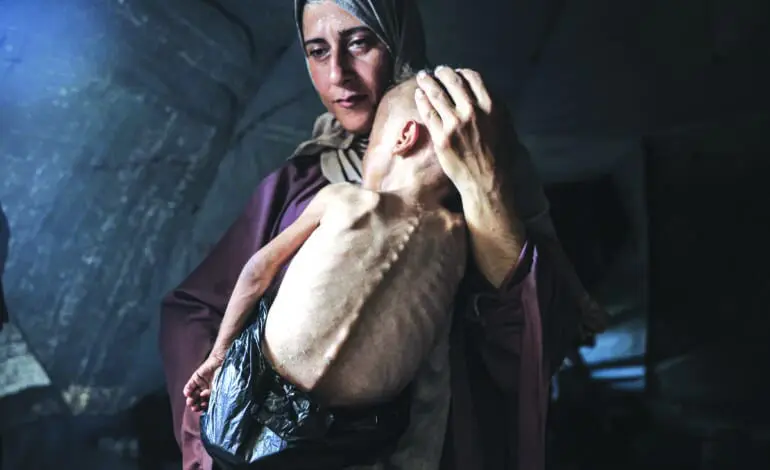
With ceasefire negotiations in Doha faltering, Israel continued its brutal extermination war on the Gaza Strip while mass starvation reached unprecedented levels. Photos and videos from Gaza show extremely emaciated bodies and cries from women, children and the elderly for help, calling for international pressure on Israel to allow humanitarian aid, culminating in a European movement led by France to recognize the Palestinian state.
Gaza residents are enduring a harsher phase of starvation, collapsing in tents and streets, and being rushed to hospitals for IV fluids that are rapidly running out amid soaring malnutrition rates. This comes as the Israeli blockade persists, compounded by Arab and Islamic nations’ inaction, despite the humanitarian catastrophe threatening more than 2 million people since the closure of all crossings on March 2.
As of Thursday, the Ministry of Health in Gaza announced dozens of new starvation-related deaths, raising the total famine death toll to 111, including 80 children. Meanwhile, the total death toll from Israeli aggression has reached 59,587, with 143,498 injured since October 7, 2023. These figures include 1,083 deaths and more than 7,000 injuries caused by the new U.S.- and Israeli-backed aid distribution system — referred to locally as the “death traps.”
On the battlefield, resistance factions continued inflicting heavy losses on Israeli invading forces. Videos circulating online document resistance operations across various areas of Gaza.
As of Thursday evening, 895 Israeli soldiers had been killed and 6,134 injured since the war began on October 7, 2023, according to Israeli army data — though the army is widely accused of concealing far higher losses. Israel imposes tight censorship on casualty figures, and real numbers are expected to be significantly higher.
Collapse of the Doha talks
In a move likely to prolong the extermination and starvation campaign in Gaza, both the United States and Israel withdrew their negotiating delegations from the Doha talks, citing Hamas’ alleged lack of willingness to reach a ceasefire agreement.
On Thursday, U.S. envoy Steve Wietkoff announced in a statement posted on social media that Washington followed Tel Aviv’s lead and pulled its team, accusing Hamas of acting in “bad faith.”
“We decided to recall our team from Doha for consultations after Hamas’ latest response clearly showed its unwillingness to reach a ceasefire in Gaza,” Wietkoff said. “….While the mediators have exerted significant effort, Hamas shows no flexibility or goodwill.”
He added that Washington would now explore “alternative options to bring the hostages home and create a more stable environment for Gaza’s residents”, expressing regret over Hamas’ “selfish behavior.” The U.S. stance came just hours after Israel announced the withdrawal of its delegation, in what many see as part of continued maneuvering and pressure tactics on the Palestinian resistance, holding Hamas solely responsible for the collapse of the ceasefire talk in Doha.
Israel stated earlier that day that it had received Hamas’ response to the latest proposal under negotiation for more than two weeks in Doha and that it was “under review.” Hamas issued a statement confirming it had submitted its and other Palestinian factions’ response to the ceasefire proposal.
Netanyahu, under mounting pressure from within Israel to reach a ceasefire and prisoner swap, warned Hamas not to interpret Israel’s willingness for a ceasefire as weakness. In a speech Thursday night, Netanyahu insisted on, “Achieving all war goals in Gaza and retrieving all hostages.”
He rejected what he called Hamas’ attempt to impose “surrender terms” on Israel.
“If Hamas sees our willingness to reach a deal as weakness or a chance to impose terms that endanger Israel, it is making a grave mistake,” he added.
Indirect negotiations took place in Doha between July 6 and 24, brokered by Qatar and Egypt with U.S. support and presence. Hamas repeatedly expressed its readiness to release all Israeli prisoners at once in exchange for an end to the genocide and Israeli military withdrawal from Gaza. However, according to Israeli opposition sources, Netanyahu prefers partial deals to prolong the war and retain power by appeasing his government’s far-right factions.
European moves amid U.S. complicity
As the U.S. drags its feet on halting the Gaza war, European countries took significant steps last week to push for a ceasefire. France went as far as threatening to recognize a Palestinian state by September.
French President Emmanuel Macron announced that France had decided to recognize the State of Palestine and would do so officially at the United Nations General Assembly.
“An immediate ceasefire, the release of all hostages and massive humanitarian aid for Gaza residents,” he suggested.
“Disarming Hamas, securing and rebuilding Gaza, and establishing a viable Palestinian state that contributes to regional security through disarmament and full recognition of Israel,” Macron emphasized, in a social media post.
France also announced it would co-host, with Saudi Arabia, an international summit next week at the United Nations to save the two-state solution. The Netherlands and Canada also called for urgent aid to Gaza, which faces famine.
Spain’s Prime Minister Pedro Sánchez welcomed France’s stance.
“We must work together to protect what Netanyahu seeks to destroy,” Sánchez said. “The two-state solution is the only option.”
Ireland’s foreign minister also praised Macron’s announcement, stressing its importance for realizing the two-state vision.
U.K. Prime Minister Keir Starmer said he would coordinate with European partners — France, Germany and the U.K. — on urgent action to “stop the killings and provide desperately needed food for Gazans.”
Israel’s first response came from Deputy Prime Minister Yariv Levin, who called Macron’s decision to recognize Palestine “a disgrace and support for terrorism”, while Defense Minister Yisrael Katz said it was “a surrender to terrorism and a reward for Hamas.”
The Israeli Knesset, amid negotiations, passed a bill last week to impose Israeli sovereignty over the West Bank and Jordan Valley by a vote of 71 out of 120. The bill was backed by all ruling coalition parties and the opposition party Yisrael Beiteinu, also known as “Israel is Our Home”, which is a right-wing Israeli political party founded by Avigdor Liberman in 1999.
The Suweida catastrophe
Beginning on July 13 and lasting eight days, Syria’s Suweida province witnessed bloody violence that recalled the sectarian massacres targeting Alawites in the coastal region just four months ago. The clashes erupted between armed Druze factions opposed to the rule of “transitional president” Ahmad Sharaa — whom they label an extremist — and forces loyal to the Damascus government and pro-government Sunni tribes. The latter were mobilized under Sharaa’s directive to support Bedouins in Suweida, a move he later praised as a “patriotic stand” in his first speech after announcing the ceasefire on Monday.
A few days earlier, military convoys from Damascus had advanced toward Suweida under the pretext of disarming Druze factions led by Sheikh Ahmad Al-Hijri. This triggered sectarian clashes and prompted Israeli military involvement in support of the Druze. Israel struck Syrian Army headquarters near the presidential palace in Damascus and military targets in Suweida, demanding the withdrawal of government forces from the Druze stronghold. Sharaa, under pressure, complied in a speech delivered at around 4 a.m. on July 18. The following day, a renewed tribal assault — disguised as a spontaneous tribal initiative — was repelled by fierce resistance from Druze fighters, forcing the attackers to flee toward Daraa and the Damascus countryside. No Israeli airstrikes were reported during this round.
As sectarian incitement, killings and accusations of treason or sectarianism continued, Israel’s deepening control of southern Syria — including parts of the Damascus countryside — has triggered fears of a partition plan, which Sharaa says he will not accept.
The Syrian government announced over the weekend that clashes had ceased following a ceasefire deal with Druze factions and Bedouin tribes. The agreement included a prisoner exchange between both sides.
U.S. Ambassador to Turkey Tom Barak revealed that the ceasefire agreement had been signed between Syria and Israel, with Turkey, Jordan and other neighboring countries welcoming the deal.
Nevertheless, Netanyahu declared on Thursday, “We will not stand idle while our brothers in Suweida are being attacked. We must disarm the area south of Damascus and protect the Druze.”
Though the terms of the ceasefire remain unclear, Suweida awoke to a tragic scene after a series of grave human rights violations, including field executions of dozens of civilians — among them a 35-year-old American Druze citizen from Oklahoma, Hossam Saraya, and eight members of his family. The killings were filmed, showing masked, uniformed gunmen chanting “Allahu Akbar” as they opened fire.
The battles in Suweida caused mass destruction, a near-total exodus and the city now suffers from a service shutdown and a de facto siege amid a shortage of water, electricity and fuel. The U.S. State Department issued only a muted response.
“Syria is at a critical juncture, and we hope the Syrian government will lead the next steps.”
Washington said it had held direct discussions with Damascus over the killing of a U.S. citizen of Syrian descent and called for an immediate investigation.
After months of presenting Sharaa as a political model for Lebanon and the region, U.S. envoy Barak urged him to reconsider his policies and adopt a more inclusive approach or risk losing international support and fragmenting Syria.
Although Sharaa has pledged to protect Syria’s minorities, the country has seen a spike in sectarian violence since he took power in December 2024, unlike anything witnessed since the “1860 civil war.” The deterioration risks undermining U.S. support for the new regime, as suggested by recent congressional calls to amend the Caesar Sanctions Act.
The Syrian Observatory for Human Rights reported 238 field executions, including 30 women, eight children and an elderly man. The executions occurred in various locations, some inside schools and public buildings used as temporary detention centers. Western Suweida, due to its proximity to Damascus and Daraa, was the main launchpad for attacks. The fighting and subsequent atrocities triggered the full-scale flight of Bedouin tribes toward Daraa and the Damascus outskirts.
Field evidence and video testimonies obtained by the Observatory indicate that many of the killings were sectarian revenge acts amid security chaos and the involvement of official forces expected to protect civilians. These massacres — so far met with impunity — underscore the ethical collapse of the country’s military and security institutions.
According to the Observatory, the total death toll from the clashes, field executions, and Israeli strikes stands at 1,386 people, including 657 from Suweida (124 civilians, among them 10 children and 24 women), 469 members of the Defense Ministry and General Security, including 40 Bedouins and a Lebanese gunman. Israeli airstrikes on Damascus, Daraa and Suweida killed 15 security personnel and three civilians. The Observatory also documented the field execution of three Bedouins — a woman, a child and a man — by Druze gunmen.
Activists inside Suweida spoke of thousands killed over the eight-day conflict. The pro-Damascus Syrian Network for Human Rights reported at least 814 deaths from July 13 to 24, noting the figure is “subject to continuous updates.”
Leave a Reply