



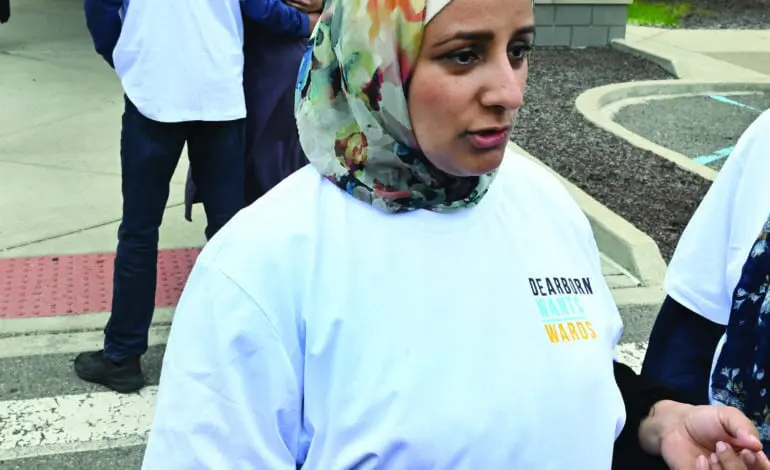

DEARBORN – Last week, due to an insufficient number of valid signatures, Dearborn City Clerk George Darany rejected a petition initiative aimed at restructuring how the City Council is elected. The group behind the petition, however, maintains that the submitted signatures should have qualified, arguing that commonly used Arab and Muslim names are often mistakenly flagged as duplicates.
Dearborn’s current city charter mandates the election of all seven City Council members in one citywide, at-large election every four years. All residents vote for all seats, regardless of their location within the city. The petition, which was submitted with more than 6,300 signatures, proposes dividing the city into seven wards — each electing one Council member — along with two additional at-large Council members, mirroring the system used in Detroit.
According to activists from the group Dearborn Wants Wards, which aimed to place the initiative on the November ballot, the proposal is intended to “ensure fair representation for all neighborhoods across the city.”
Darany’s office invalidated thousands of signatures, labeling them as duplicates or mismatches with registered voter records. The group has said it will audit every disqualified signature and has called for a review process that is more culturally aware, given that most of the city’s residents trace their roots to the Middle East.
Ongoing efforts
The group’s chair, Mona Mawari, said their questioning of Darany’s decision was made “in good faith”, explaining that “verifying such a large number of signatures opens the door to possible errors in the verification process. We just want to ensure that no valid signature was unfairly rejected.”
In a letter sent to the group in mid-July, Darany stated that 2,838 of the roughly 6,300 submitted signatures were “invalid”, leaving the petition 439 valid signatures short of the 3,900 required to qualify for the ballot under Dearborn’s charter, which mandates valid signatures from 5 percent of registered voters.
Mawari claims Muslim and Arab names are frequently misclassified as duplicates. She pointed to factors that might contribute to such confusion, even if the differences seem minor.
For example, Mawari noted that Arabic names typically don’t include identifiers like “Jr.” or “Sr.”, and it’s common for multiple generations of the same family with similar names to reside in the same household.
She added that voter signature-matching systems often disadvantage marginalized communities, arguing they fail to consider issues like illiteracy among older Arab and Muslim residents, who may produce inconsistent signatures or rely on others to complete petition forms on their behalf. Voter records for people of color, immigrants and working-class communities also tend to be outdated, she added, which can lead to rejected signatures if someone’s signature has changed over time.
“The process needs to be transparent,” Mawari said. “We need to know whether the clerk made a good-faith effort to verify rejected signatures flagged by the electronic system — or if he simply trusted the system’s output. That system may not be designed with communities like ours in mind.”
The Yemeni American activist confirmed that Dearborn Wants Wards has received access to the rejected signatures and is currently reviewing them, while simultaneously preparing to collect an additional 1,300 signatures before the legal deadline.
Mawari said the group gathered nearly 6,300 signatures in just 13 days the first time around — proof, she argued, of the community’s strong desire and need for the proposed change.
The group has until July 29 to submit the missing signatures, and must present the final ballot proposal wording to the Clerk’s Office by August 12 to ensure it appears on the November ballot, which will also include elections for mayor, all seven Council members and the city clerk — for four-year terms.
Motivation behind the proposal
Dearborn Wants Wards hopes the change in the Council structure will lead to fairer representation of all city neighborhoods and higher voter turnout, as residents would feel their votes carry more weight.
The group argues that the current at-large system leads to disproportionate representation, pointing out that six of the seven Council members live in the more affluent West Side, home to roughly 45,000 people. Only one member resides in the East Side, which has approximately 65,000 residents.
As a result, the group claims that working-class residents, immigrants and people of color — who predominantly live in the East Side — feel politically marginalized and disconnected from city decision-making and resource allocation.
Polling locations in East Dearborn, especially in the heavily Yemeni-populated South End, consistently record the lowest voter turnout in the city. Mawari said low turnout in the East is largely due to a sense of political exclusion and the belief that votes don’t matter.
Supporters of the proposal say a ward system would not only ensure more equitable representation but also address neighborhood-specific concerns. These include environmental pollution, public service delivery, street maintenance and rodent infestations — issues that particularly affect East and South Dearborn.
The proposal calls for the creation of a citizen-led commission made up of randomly selected residents who apply to join the redistricting panel.
Cities — including Detroit, Ann Arbor and Inkster — already use a ward system for local governance.
Opponents argue that such a change could hinder the City Council’s efficiency and increase division within the city, in contrast to Dearborn’s long-standing slogan: “One Dearborn.”
If the proposal passes in November, the changes would not take effect until the 2029 municipal elections.



Leave a Reply