


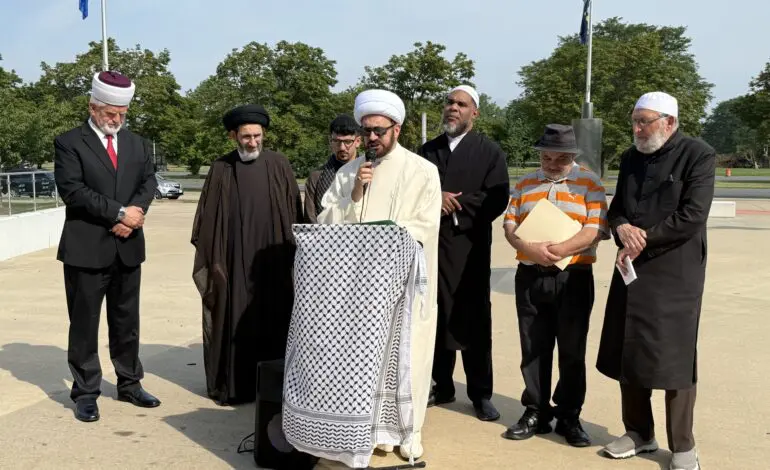

Dearborn, MI — At a press conference Wednesday morning, the Imams Council of Michigan called on Jewish leaders in the state to break their silence and publicly oppose Israel’s ongoing siege and starvation campaign in Gaza, which the council and most human rights groups have recognized as genocide.
Standing before reporters at the Henry Ford Centennial Library, the council’s co-chairs — Imam Mohammad Ali Elahi and Imam Mustapha Elturk — issued an open letter to Michigan’s Jewish organizations, synagogues, rabbis and lay leaders. The letter urges them to leverage their influence with policymakers to push for an immediate end to the blockade and mass deprivation in Gaza.
“This is not about politics. It is not about Israel or Palestine, the IDF or Hamas,” Elturk said. “This is about saving human lives. One human soul. We are all created in the image of God… this is not only a political crisis, this is a moral emergency.”
The council’s appeal comes as humanitarian groups warn of catastrophic starvation in Gaza. According to the American Human Rights Council (AHRC), more than 60,000 Palestinians have been killed since the war began, and more than 142,000 have been injured — an overwhelming amount left with lifelong disabilities. The group says entire segments of Gaza’s population are experiencing such severe organ damage from starvation that even food aid could not reverse the harm.
Imad Hamad of the AHRC emphasized that the ”killing in Gaza has reached a threshold the human mind cannot comprehend.”
“Israel is transforming the population in Gaza into a total disabled community,” Hamad said. “Even now, if food were allowed in, the damage is beyond imagination. I only express that leaders of all faiths break the silence.”
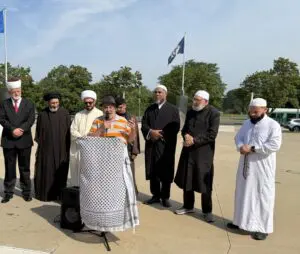
(From left to right): Imam Arif Huskic, Sayed Najah Al-Husseini, Imam Mohammad Ali Elahi, Imad Hamad, Saleh Hamieh, Imam Dawud Walid, Imam Mustapha Elturk and Imam Ayham MishMishan.
Calls for moral responsibility and historical reflection
Speakers at the event drew comparisons to historic moments of moral reckoning. Imam Mohammad Ali Elahi referenced Holocaust survivor Rabbi Joachim Prinz’s 1963 March on Washington speech, which condemned silence in the face of brutality.
“The Washington Post published the names of 18,500 children in Gaza killed by the Israeli army,” Elahi said. “They were not Hamas. They were not fighters. They were innocent babies and children.”
Elahi described the siege as “the denial of Palestinian dignity, the creation of concentration camp conditions, mass destruction, displacement, starvation and death.” He called the campaign “barbaric bloodshed — not just a crime against Palestinians, but a crime against Judaism and against the very Jewish voices of justice that have endured for centuries.”
Dawud Walid, executive director of CAIR-Michigan, stressed that the council’s message was a moral appeal to faith communities.
“We appeal to you in your moral conscience right now,” he said. “Twenty years ago, when extremists committed violence in the name of Islam, we said clearly: not in our name. Likewise, we believe it is the moral obligation of rabbis and Jewish leaders to say clearly: genocide is not in our name.”
Action must accompany words
Amid increasing international pressure, political figures who have shown their adamant support for Israel — including President Trump and Rep. Marjorie Taylor Greene — acknowledged this week the scale of deprivation in Gaza. Trump, who previously said he would end the war but never followed through, had drawn support from Dearborn voters on that promise. Now, many in the city express frustration that the pledge went unfulfilled.
“What’s going on in Gaza right now has only to do with being human,” said Imam Ayham MishMishan. “Mr. President, you made a deal saying that you would stop the war. You are a deal keeper. Keep your deal. Save the people of Gaza.”
Although political rhetoric on Gaza is beginning to shift, speakers expressed that the widespread silence on this genocide is a moral failure that will leave a lasting stain on history. They stressed that words alone are not enough, that action must accompany rhetoric.
“The children of Gaza do not need our sympathy,” Elturk said. “They need food. No more propaganda, no more excuses. Break the silence, deliver aid now.”
The Imams Council’s letter calls for Jewish leaders to:
- Raise their voices publicly against the siege.
- Condemn the starvation and deprivation of Palestinians.
- Demand immediate humanitarian access to Gaza.
- Call for food, medicine and shelter for those suffering.
The council plans to mail its open letter to Jewish organizations across Michigan this week. Council members hope their appeal encourages interfaith solidarity and spurs concrete efforts to address the worsening humanitarian crisis.


Leave a Reply