



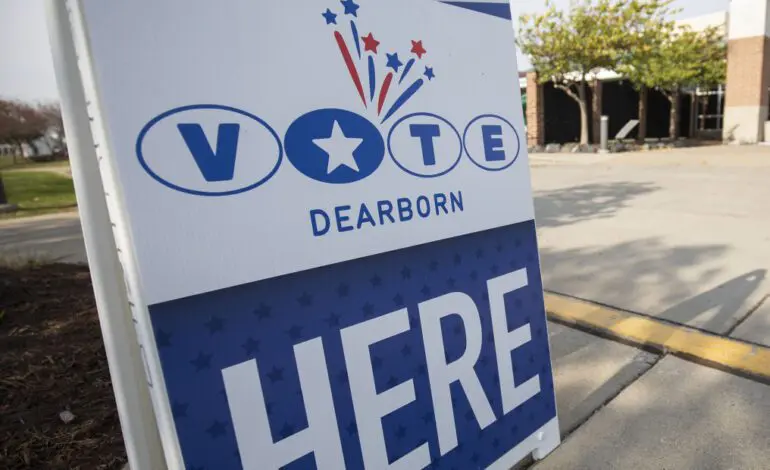

DEARBORN – The Dearborn City Clerk’s office has confirmed that the Dearborn Wants Wards campaign has submitted enough valid signatures to place a referendum on the November ballot, calling for a change in how City Council members are elected.
According to a statement from the campaign, 4,082 of the 8,088 signatures submitted were validated, surpassing the 3,879 signatures required under the Dearborn City Charter — the equivalent of 5 percent of the city’s 77,564 registered voters.
The campaign, which argues that ward-based elections would correct the “historic injustice” faced by neighborhoods in East and South Dearborn, had to scramble in late July to collect an additional 1,788 signatures after the clerk’s office rejected 2,838 of the 6,278 signatures it had initially turned in during June. That left the petition 439 signatures short of qualifying.
City Clerk George Darany dismissed thousands of signatures as duplicates or non-matching with registered voter information, but the campaign closed the gap in just a few days before the July 29 deadline, reaffirming its determination to “ensure fair representation for all neighborhoods in the city.” Campaign activists, however, questioned the validity of rejecting so many signatures, urging a verification process more sensitive to the Arabic-language backgrounds of most residents.
Details of the proposal and funding sources
The ballot proposal would divide Dearborn into seven wards, each electing one Council member, with two additional at-large seats elected citywide — expanding the Council from seven to nine members. This mirrors the system used in neighboring Detroit, where the Council president is no longer picked by the people and will be chosen by the Council members instead. It also changes the rules on vacancy replacement.
Currently, the City Charter mandates that all seven Council members be elected at large in a single citywide election every four years.
The Dearborn Wants Wards group says the change would provide better representation for all neighborhoods and boost voter turnout by making residents feel their votes matter.
They argue the existing system creates disproportionate representation: six of the current Council members live in the more affluent West Dearborn, home to about 45,000 people, while only one lives in East Dearborn, which has a population of roughly 65,000.
Wards won’t improve representation — they will weaken it and divide the city, undermining Dearborn’s motto of “One Dearborn.”— A wards proposal opponent
As a result, the group claims that minorities, working-class families and immigrants — concentrated in the East and Southend of Dearborn — feel marginalized in decisions and resources due to lack of “genuine” representation.
However, opponents to the wards counter this claim by arguing that more voters in the East and Southend of the city are reflected in the elections of the current seven Council members and wards won’t improve representation, but will certainly weaken it.
Official Dearborn Wants Wards campaign finance documents obtained from Wayne County shows that a group called SABIQUN SOLUTIONS, based in Canton, is funding almost the entire campaign which is more than $60,000 so far. Opponents question the motives of outside funders.
Ward elections will make Council members directly accountable to their neighborhoods.— Wahbeh Nuseibeh, A wards proponent
Campaign activists insist that a ward-based system would not only ensure equal representation, but also address specific issues in each neighborhood, such as environmental pollution, public service improvements, road maintenance and rat infestations, which are major concerns in East and South Dearborn.
The campaign also hopes the change would increase voter turnout, pointing out that East Dearborn — especially the Southend — consistently reports the lowest participation rates.
Under the plan, a citizen commission would be formed to draw the ward boundaries, with members selected randomly from applicants.
Campaign and opponents’ voices
Campaign spokesperson Wahbeh Nuseibeh said ward-based elections would make Council members “directly accountable to their neighborhoods.”
“They live in our community and understand our local issues,” he said, emphasizing that the new system would, “strengthen our local democracy, make it easier for new candidates to run, guarantee diversity of perspectives and limit the influence of big money.”
Opponents claim outside big money is already influencing decisions and financing campaigns in the city such as Dearborn Wants Wards. They also point out to the fact that in Dearborn, where many issues — including water, sewer infrastructure, traffic, pollution and business development — span neighborhoods, fragmentation would slow the progress.
In an email to The Arab American News, Nuseibeh described the proposal as a “historic turning point in our community’s struggle for justice, dignity and a political voice.” He noted that on November 4, voters will decide “what kind of democracy they want in Dearborn” — coinciding with elections for mayor, seven Council seats, and city clerk, all for the next four-year term.
Opponents of the wards argue it would hinder the Council’s effectiveness, deepen divisions rather than heal them and contradict the city’s long-standing motto: “One Dearborn.”
If passed in November, the changes would not take effect until the 2029 election.
In addition to Detroit, Ann Arbor and Inkster already use ward-based systems for their local Councils.



Leave a Reply