



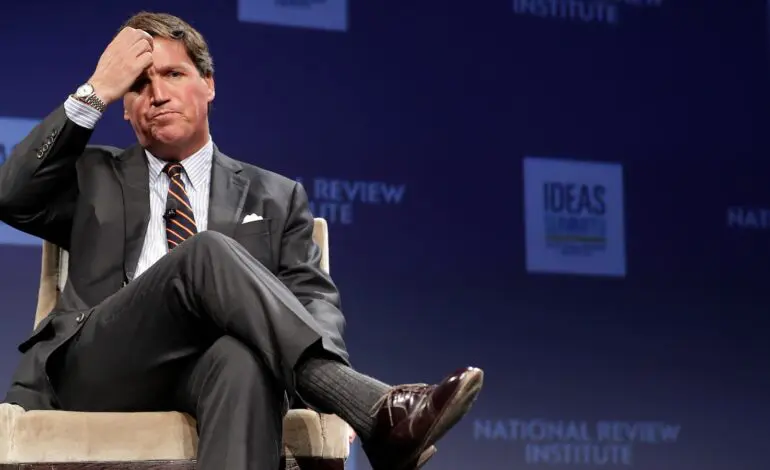

There are moments in American history when a voice rises above the static of politics, a voice that dares to question what has been presented as unquestionable truth. Tucker Carlson has become such a voice. In an era where conformity is often rewarded and dissent punished, he has stepped into the storm with an uncommon blend of clarity and courage. For years Carlson has challenged the carefully curated narratives that flow from Washington and Tel Aviv, and in doing so, he has become a rare champion of America First against the gravitational pull of Israel First.
The courage to question
Carlson’s journey into this role did not happen by chance. For decades American media has presented the Israeli government as a small beacon of democracy surrounded by hostile neighbors bent on its destruction. This story was repeated so often that many Americans never paused to examine its flaws. Tucker Carlson recently has become one of the few to look past the slogans and ask the forbidden questions. Why should the United States, with its own crises and challenges, bend its foreign policy to align almost perfectly with the needs of another state? Why is Israel consistently portrayed as the eternal victim while the Palestinian people, with their long history of dispossession and suffering, are painted as aggressors?
Carlson’s willingness to interrogate these questions placed him at odds with the political establishment in Washington, an establishment that has long treated unconditional support for Israel as sacred. When he spoke openly about the genocide being carried out against Palestinians, he shattered a taboo that few in mainstream media had dared to touch.
October 7 and the manufactured narrative
The events of October 7 were immediately framed by Israel and repeated by Western leaders as a battle between civilization and barbarism. Carlson was among the first to notice how quickly the official story solidified, as though pre written. He questioned why Hamas was described as nothing more than a fringe terrorist group, when in reality it emerged from the desperation of a besieged people living under occupation. He asked why the massacres of Palestinians over decades received little attention in American newsrooms, while Israeli suffering dominated headlines.
In his broadcasts and interviews, Carlson pressed for honesty about the imbalance of power between Israel and Palestine. He reminded his viewers that Israel is not a fragile outpost barely clinging to survival but a heavily militarized state with nuclear weapons, backed by billions of American dollars each year. To present Israel as the eternal underdog while Palestinians live under blockades and bombings is to invert reality itself.
Learning from scholars and witnesses
Carlson did not arrive at these insights alone. He sought the wisdom of experts who had long been marginalized in American discourse. Scholars like John Mearsheimer, coauthor of The Israel Lobby and U.S. Foreign Policy, helped him trace the deep influence that pro-Israel groups exert over Congress and the White House. Mearsheimer’s research made plain what many suspected: American policy in the Middle East is not guided by an impartial assessment of national interest but by the relentless pressure of a powerful lobby.
Carlson also gave space to voices rarely heard in Western media. Among them was the nun who described how Christians in Jerusalem are treated with disdain by Israeli settlers. She recounted how Christian property was defaced, how crosses were spat upon and how believers were mocked. By contrast, she said, Palestinian Muslims treated her and her community with respect, offering protection and friendship. Her testimony was simple yet profound, overturning decades of propaganda that painted Palestinians as intolerant fanatics and Israelis as enlightened guardians of pluralism.
These conversations deepened Carlson’s conviction that the American people deserve to hear the full truth, not the one-dimensional story that has long dominated the evening news.
America first versus Israel first
Carlson’s insistence on prioritizing America First is rooted in a belief that loyalty to one’s nation should never be compromised. He has argued that American citizens have a right to expect their leaders to serve their interests above all else. Yet in Washington, too often, votes and speeches reveal that many lawmakers operate under the principle of Israel First. Aid packages worth billions sail through Congress with little debate, while American families struggle to pay rent or afford healthcare.
By exposing this imbalance, Carlson has not only defended the integrity of American democracy but has also reminded citizens that patriotism requires vigilance. To put America first is not an act of isolation but an affirmation that no foreign power, however close, should dictate the destiny of the republic.
A voice of hope amid despair
For Palestinians living under siege, every acknowledgment of their humanity is a ray of hope. When Tucker Carlson spoke about their suffering, he gave voice to millions who have been silenced. His broadcasts broke through the wall of indifference that has long surrounded their plight. For once, an American figure with a massive platform dared to call things by their proper names: occupation, apartheid and even genocide.
The courage to name what others fear to utter is the seed of change. By doing so, Carlson has inspired a new generation of Americans to question the narratives they have been fed since childhood. Many young people now see the conflict not as a clash of civilizations but as a struggle for dignity and freedom.
Toward a different future
The story of Tucker Carlson’s defiance is not merely about one man. It is about the possibility that truth can still pierce through the fog of propaganda. If a single voice can challenge decades of orthodoxy, imagine what a chorus could achieve. His stance invites Americans of all political backgrounds to rethink their assumptions, to ask who truly benefits from endless war in the Middle East and to consider how much stronger the nation could be if it charted its own course rather than marching to the tune of another.
There is also a spiritual dimension to this story. By listening to the nun who spoke of Christian suffering under Israeli occupation, Carlson reminded the world that faith communities share a common destiny. The respect shown to Christians by Palestinian Muslims testifies to a deeper truth: that coexistence and solidarity are possible when justice is pursued. It is not religion that divides but oppression and inequality.
The valiance of defiance
To praise Tucker Carlson is not to claim he is flawless. Rather, it is to recognize the rarity of his valiance in a political culture where silence often secures career advancement. He has risked reputation, influence and friendships to tell the truth as he sees it. In a time when accusations of anti-Semitism are hurled at anyone who criticizes the Israeli government, Carlson has persisted, making clear that one can oppose Jewish supremacism in Israel without harboring hatred toward Jewish people as a whole.
This distinction matters greatly for the future. By drawing it, Carlson has shown that principled criticism is not only possible but necessary if justice is ever to be achieved.
Seeds of a new era
The story unfolding before us may yet mark the beginning of a new era. When Americans recognize that their media and political class have hidden the full truth about Israel and Palestine, they may finally demand policies rooted in fairness rather than blind loyalty. Tucker Carlson’s role in this awakening cannot be overstated. His broadcasts have opened the eyes of millions, and once opened, those eyes will not easily close again.
Hope lies in the fact that truth has a way of multiplying. One voice becomes two, then ten, then thousands. Already there are signs that younger generations in America are less willing to accept the old myths. They see the images from Gaza, they read the testimonies of scholars and witnesses and they ask why their leaders continue to fund destruction rather than peace.
A story still being written
Tucker Carlson’s defiance is not the final chapter but an early one. The story of America’s reckoning with Israel First politics is still being written. Yet in the pages already turned, his name stands out as a man who dared to speak when silence was safer. That is the measure of true courage.
In years to come, historians may look back and say that the tide began to shift when Americans started to hear voices like Carlson’s. They may note how, in the middle of darkness, one broadcaster lit a candle of truth. That light, however small, carried within it the power to ignite a greater fire, one that could burn away falsehoods and illuminate a path to justice.
Conclusion: The hope of truth
The story of Tucker Carlson’s confrontation with the Zionist narrative is ultimately a story of hope. It shows that even in a landscape dominated by powerful interests, truth can find a voice. It shows that courage still exists in public life, and that America need not be condemned to forever place another nation’s interests above its own.
By championing America First, Carlson has reminded the country of its sovereignty. By exposing the crimes of Jewish supremacists in Israel against Palestinians, he has reminded the world of its conscience. His journey proves that when individuals refuse to be silenced, the future remains unwritten, open to the possibility of justice.
For those who long for peace in Palestine and integrity in America, Tucker Carlson’s example is more than commentary. It is a call to courage, a reminder that history bends not to the loudest propaganda but to the steady force of truth.
– Amjad Khan is a contributing writer for The Arab American News. He is an educator, writer and academic researcher with a deep commitment to addressing the challenges facing the Muslim world. Through his work, he seeks to inspire meaningful dialogue and help chart a path toward unity, justice and peace.

Leave a Reply