



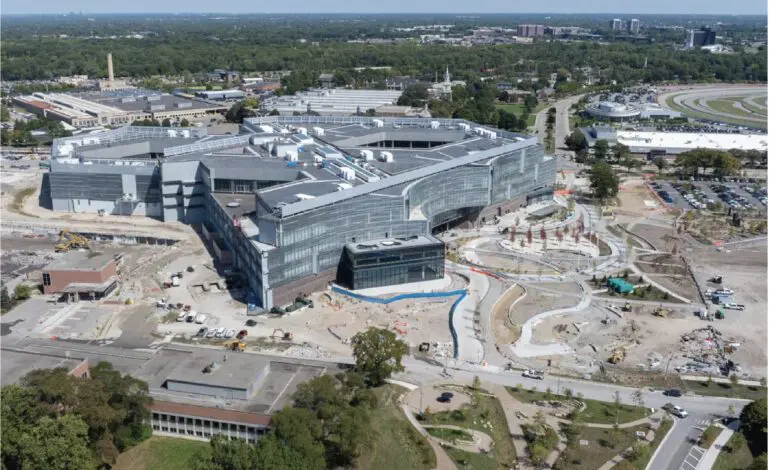

Ford announces move to a new campus
In a move aimed at bringing leadership, administrative staff and product development teams under one roof — and to make the company more agile and effective in attracting and retaining talent — Ford Motor Company announced on Monday that it will relocate its global headquarters in Dearborn to a new campus under construction in the western part of the city, with a grand opening expected in November.
The plan, part of Ford’s effort to modernize all its Dearborn facilities, includes demolishing the current world headquarters near the Southfield and Michigan Avenue intersection. Known as the “Glass House”, the building has served as Ford’s global headquarters since 1956. The adjacent Ford Credit building will also be demolished. Employees are expected to vacate both by the end of the second quarter of 2026, with demolition scheduled between late 2027 and mid-2028.
Designed for the future of the auto industry
The move comes amid a historic transformation in the automotive sector — ranging from the shift to electric vehicles and self-driving technology to digital services and data integration. Ford wants its new campus to serve as a magnet for talent in these fields, competing with rivals like General Motors, Silicon Valley tech firms and other global innovators.
The announcement came in a joint email to employees from Executive Chair Bill Ford and President and CEO Jim Farley. During an online briefing, Bill Ford said the new, modern campus was part of creating an environment that attracts “the best talent.”
The new headquarters — designed by the global architectural firm Snøhetta in collaboration with engineering and design consultancy Arcadis — is located about one mile from the Glass House. The four-story, 2.1-million-square-foot facility, situated on a 320-acre property, will accommodate up to 4,000 employees. It will feature full glass facades and sit west of Oakwood Boulevard across from the Henry Ford Museum.
Centralized location and modern facilities
Ford stated that an additional 10,000 employees will work within a 15-minute walk of the new headquarters, with 9,000 more within a 15-minute drive, allowing the site to serve as a central hub for different divisions, including the Product Development Center on which the new building is being constructed.
Ford said the new campus would solve logistical challenges.
“A one-hour meeting to discuss a product easily turns into two hours because of the time it takes to commute between buildings and find parking,” he said.
He likened the new facility to Apple’s headquarters in California, emphasizing that he wanted it to be a place where people truly wanted to work.
“Our Product Development Center hasn’t changed since I started there in 1979. When we hired new employees, we showed them everything except where they’d be working — the situation was that bad.”
Jim Dobleske, CEO of Ford Land, explained that the current 950,000-square-foot Glass House “no longer fits how people work today.” He emphasized the need to bring engineers, designers, finance teams and marketing together to enhance collaboration and effectiveness.
The new facility will provide flexible spaces — allowing privacy when needed and quick collaboration for hours, days or weeks — run in a completely different way than the Glass House. The design will also reduce travel time across the site to three minutes, compared to 36 minutes under the old layout.
Construction timeline and features
Ford began construction in 2020. The first phase will be complete by the end of this year, allowing about 2,000 employees to move in. Around 500 employees already work on-site. The next group will arrive in late October and early November for the grand opening. The remainder of the project will be finished by the end of 2027, including the demolition of the old Product Development Center built in 1953.
The new campus will house:
-
Six design studios and a full product showroom.
-
Multi-screen office spaces, meeting rooms, phone booths, lounges and diverse work environments.
-
A 160,000-square-foot dining hall with seven food and beverage stations.
-
Wellness rooms, mothers’ rooms and more than 300 tech-equipped meeting rooms.
-
Outdoor spaces and 12 acres of green space.
The building is designed to be 100 percent emissions-free, powered entirely by renewable electricity from Ford’s central power plant. Ninety-five percent of single-use materials will be recycled, composted or reused, and material transport needs will be cut by more than 83 percent.
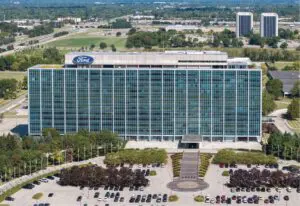
Ford’s current global headquarters, known as the “Glass House”, is scheduled to be demolished within the next two years as part of the company’s redevelopment plans in Dearborn.
The fate of the “Glass House”
Dobleske said Ford will retain ownership of the 12-story Glass House property, though the building itself will be demolished, as it is no longer financially sustainable. Ford is working with the city of Dearborn to transform the 212-acre site into a park-like environment. About 100 acres will be made available for public use, while Ford will retain the Service Research Center garage and Data Center north of the site.
This contrasts with Regent Court, another major Ford property, which was sold in 2022 to Arab American businessman Mike Shehadi, who is redeveloping it into a mixed-use residential and commercial complex.
Integration with the community
Dobleske emphasized that Ford’s campus renewal project — which includes 29 renovated Dearborn buildings covering 14 million square feet — will strengthen integration with the local community.
“We believe our investment will create a walkable environment, not only within the campus but also extending along Michigan Avenue to ensure our team members engage with restaurants, shops and local businesses,” he said.
The announcement was warmly received by Dearborn officials.
“The city of Dearborn will always be home to Ford, whether it’s down the street or across the road,” Mayor Abdullah Hammoud said.
“The city of Dearborn and the Council will work hand-in-hand with Ford to ensure it has the tools to remain the most competitive automaker in the country,” said City Council President Michael Sareini, who also works at a Ford dealership.
Councilman Mustapha Hammoud, an engineer in Ford’s Product Development division, noted that Dearborn’s rich legacy in innovation and auto assembly has long supported Ford’s role in the community.



Leave a Reply