



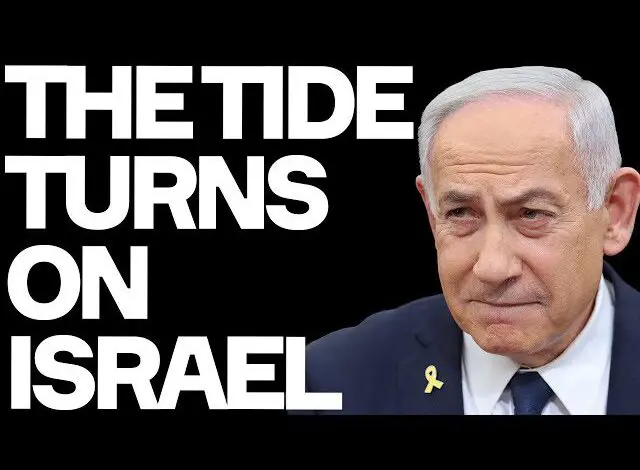

For decades the American political establishment has treated support for Israel as an unshakable pillar of foreign policy. Presidents, senators and governors tripped over themselves to prove loyalty to Tel Aviv, while critics were sidelined and smeared. Yet a profound shift is underway. The tide is turning, and Israel no longer enjoys unquestioned dominance in the United States. What was once taboo to say aloud has become common conversation in households, classrooms and even political campaigns. This change has rattled the halls of Washington and has exposed the crumbling myth of unconditional support.
At the center of this storm stands Donald Trump. The current president built his career on populist fury, positioning himself as a man who takes no orders from the entrenched elite. Yet the Israel question has haunted him from the moment he entered politics. Trump’s opponents and allies alike have accused him of being captive to the interests of Benjamin Netanyahu and the Israeli lobby. In the past he brushed off these charges with a smile, flaunting his role in moving the American embassy to Jerusalem and boasting of his pro-Israel record. Today the political winds are different. The very base that once cheered his embassy move now hisses when they hear Netanyahu’s name.
Trump recently declared in front of cameras that Israel and Netanyahu do not control him. The words sounded defensive, almost forced, like a man cornered by his own supporters. The statement was meant to silence critics, but it had the opposite effect. Nobody truly believes it, not even his most devoted followers. Steve Bannon, Tucker Carlson and Candace Owens, three towering figures of the MAGA movement, have all raised public and private doubts about Trump’s ties to Israel. Their rhetoric has shaped the conversation within conservative circles, leaving Trump with no choice but to follow where the mob points.
A pressure cooker within MAGA
The MAGA base has become a pressure cooker on the Israel question. For years many of these voters quietly simmered with anger over endless foreign aid and military entanglements. The war in Gaza and the ceaseless images of destruction have brought that anger to the boiling point. Social media has amplified their outrage, and influencers on the right now openly question the loyalty of politicians who pledge fealty to Israel. The days when only the progressive left criticized Israeli aggression are gone. Today Trump’s most loyal followers demand that he prove his independence from Netanyahu, or risk being seen as a puppet of a foreign state.
This explains why Trump made a stunning declaration: he will not allow Israel to annex the West Bank. The statement was a line in the sand. For decades Israeli politicians have toyed with the idea of annexation, and American presidents have looked the other way or muttered weak objections. For Trump to reject annexation outright is a thunderclap in the political sky. It shows just how much pressure he feels from his base, and how dramatically the ground has shifted beneath his feet.
Cracks in the wall of silence
The American political class once enforced a rigid wall of silence around criticism of Israel. To question the billions in annual aid was considered political suicide. Yet cracks have appeared in that wall. Polls show that younger Americans, including younger Republicans, view Israel with growing skepticism. They see occupation, apartheid and endless war, not the shining beacon of democracy once described in speeches. The brutal images from Gaza and the West Bank cannot be scrubbed from TikTok or Twitter. Students chant for Palestine in American streets, and their parents quietly nod. The myth that Israel enjoys unanimous support has collapsed.
Conservative media has played a surprising role in this shift. Carlson, once a fixture on Fox News and now a free agent with millions of viewers online, has hammered the Israel lobby with relentless criticism. Bannon, ever the strategist, frames unconditional support for Israel as a betrayal of America First. Owens has taken the message further, speaking bluntly about the manipulation of American politicians by foreign powers. Their voices carry enormous weight in MAGA circles, and Trump knows it. If he defies them, he risks alienating the very people who can deliver him victory in the Republican primaries and beyond.
Trump in the crosshairs
Trump is not a man who enjoys being on the defensive. His persona is built on dominance and swagger, on the image of a man who bends others to his will. Yet on Israel he finds himself trapped. His long record of pro-Israel decisions is a chain around his neck. Moving the embassy to Jerusalem, recognizing the Golan Heights and crafting the Abraham Accords were once his trophies. Now they are daggers in the hands of his critics. Each accomplishment is recast as evidence that he dances to Netanyahu’s tune.
The current president senses the danger. By insisting that he is not controlled by Israel, he tries to regain the upper hand. But his protestations only fuel suspicion. When a leader insists too loudly on his independence, the crowd begins to wonder what strings are being pulled behind the curtain. Trump’s statement against West Bank annexation was meant to appease his base, but it also boxed him into a corner. If he falters, if he reverts to his old pro Israel reflexes, the backlash will be brutal.
A turning point in American politics
This moment marks a turning point in American politics. For the first time in living memory, the Republican base is questioning Israel from the right. The old bipartisan consensus is fractured. Democrats are divided between progressives who see Israel as an oppressor and centrists who cling to the past. Republicans are now divided as well, with the populist wing demanding America First foreign policy and the establishment clinging to the old alliance. Trump straddles these two worlds, and his balancing act grows more precarious each day.
The implications are enormous. If America’s unquestioning support for Israel falters, the entire Middle East equation changes. Israeli leaders who once relied on the automatic veto of Washington at the United Nations now feel uncertainty creeping in. Annexation plans stall, settlement expansion faces new scrutiny and the ironclad military pipeline begins to rust. Israel has built its survival strategy on American power, and if that power wavers, its leaders will find themselves isolated and vulnerable.
The emotional shift
The shift is not merely political. It is emotional. Ordinary Americans are weary of endless wars and foreign entanglements. They watch bridges crumble and schools decay while billions flow abroad. The scenes from Gaza of children pulled from rubble resonate in a way that sterile policy papers never could. The image of Trump, visibly uncomfortable while denying that Netanyahu controls him, has become symbolic of the deeper unease gripping the nation. Americans sense that something is rotten in the relationship, that loyalty to a foreign state has overshadowed loyalty to their own people.
This emotional undercurrent explains the fury in the MAGA movement. It is not only about policy. It is about dignity, sovereignty and the sense that Americans have been played for fools. Trump, once the master at channeling that anger, now struggles to stay ahead of it. His refusal to support annexation of the West Bank was a desperate attempt to align with his base. Yet the suspicion remains, and it will shadow him as the election season unfolds.
The road ahead
The tide against Israel in the United States will not recede. Once a taboo is broken, it cannot be rebuilt. Young voters will not forget the images of Palestinian suffering. Conservative populists will not forget the billions spent on foreign wars while American cities rot. Liberal progressives will not abandon their cause. The bipartisan shield around Israel has cracked, and no amount of lobbying or spin can fully repair it.
For Trump, the challenge is existential. He can either ride the wave of anger against Israel and reposition himself as the true America First candidate, or he can cling to his old alliances and risk being swept aside by his own supporters. His recent words show he knows the danger. His body language shows he feels the pressure. History may record this moment as the time when Israel lost its grip on American politics and when Donald Trump, willingly or not, helped to break the spell.
Conclusion
The tide is turning against Israel in America. The once untouchable alliance is under siege from within, fueled by populist anger and moral outrage. Trump has been forced to publicly deny control by Netanyahu, but the denial rings hollow. His own champions, from Bannon to Carlson to Owens, question his independence. The MAGA base has backed him into a corner, and his refusal to support West Bank annexation is a sign of their power. The old consensus is dead. A new era is dawning and Israel must face a future where American support is no longer unconditional, and where leaders like Trump are forced to choose between loyalty to a foreign state and loyalty to the people they claim to serve.



Leave a Reply