



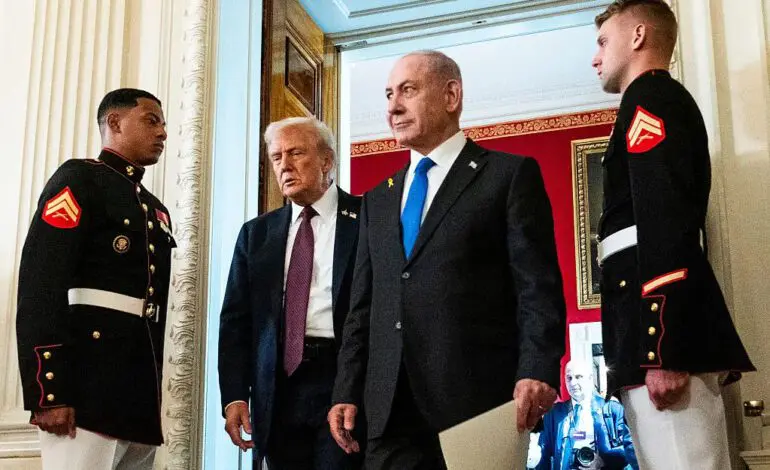

In a move closer to a threat than an offer, President Trump has unveiled his plan to end the war in Gaza — a proposal resembling an upgraded version of his earlier “Deal of the Century.” The initiative aims to disarm the Palestinian resistance and place Gaza under international trusteeship, with Arab states serving as a nominal cover for Israeli control of the devastated territory.
While Hamas and other Palestinian resistance factions continue reviewing the plan — with Trump giving them “three or four days” to respond before Israel is given a free hand to continue its war — Washington has escalated pressure on mediators, particularly Qatar, Egypt and Turkey, to tighten restrictions on Hamas and push them to accept the plan. The deal offers reconstruction, investment and financial aid in exchange for disarmament.
Hamas’ response and U.S. pressure
Though Cairo and Doha expressed reservations over what they called “gaps” in Trump’s proposal, reports from regional capitals indicate that Hamas will not reject it outright but will push for amendments. Washington, however, insists that “the margin for negotiation is extremely narrow, if not non-existent.”
According to Axios, U.S. officials signaled they are willing to discuss clarifications and limited changes but will not reopen the entire plan.
Hamas sources told news agencies the group seeks revisions to provisions requiring disarmament and the removal of resistance members from Gaza. A Hamas-linked Palestinian official told AFP, “The movement wants to amend parts of Trump’s plan, such as disarmament and the forced relocation of Hamas cadres and other factions.” Reuters quoted another Hamas source calling the plan, “an attempt to liquidate the movement under unreasonable conditions.”
Islamic Jihad Secretary-General Ziyad al-Nakhalah condemned the proposal, describing it as “an American-Israeli agreement that entrenches aggression against the Palestinian people”, warning that Washington is helping Israel achieve politically what it failed to achieve militarily.
Plan details
Unveiled at a White House press conference alongside Israeli Prime Minister Benjamin Netanyahu, Trump’s “comprehensive proposal” includes 20 provisions and a map that would radically restructure Gaza’s political, security and administrative landscape.
Highlights include:
-
Immediate ceasefire followed by a phased Israeli withdrawal tied to disarmament of the resistance.
-
Gaza declared “free of terrorism and extremism” as a precondition for reconstruction. Plans call for population relocations and new zoning arrangements.
-
Prisoner exchange: Israel would release 1,700 Palestinians detained since October 7, 2023 — including women and children — plus 250 prisoners serving life sentences, in exchange for all Israeli captives, alive or dead.
-
Technocratic governance: Gaza would be run by a technocrat authority under international trusteeship led by Trump, with participation from global leaders, including former U.K. Prime Minister Tony Blair, until the Palestinian Authority is “reformed” and possibly reinstalled in Gaza.
-
Economic plan: Establishment of a special economic zone in Gaza with foreign investment opportunities, under a new “Trump Development Initiative.” Residents would be allowed either to stay or emigrate.
-
General amnesty: Hamas members who disarm would be granted safe passage out of Gaza.
-
International aid: Humanitarian assistance would flow under U.N., Red Crescent and international oversight, with the Rafah crossing reopened under mechanisms agreed in January 2025.
The plan notably lacks a timeline for Israeli withdrawal, raising fears of a prolonged military presence.
Political reactions
Trump boasted the plan brought him “closer than ever” to ending the Gaza war. Netanyahu endorsed it, calling it a guarantee that Gaza will “never again pose a threat to Israel.”
But Trump warned Hamas that negotiation space was limited.
“We need only one signature. If we don’t get it, they’ll pay in hell.”
Speaking before U.S. military leaders at Quantico, Trump gave Hamas “three or four days” to sign.
“All Arab and Islamic states are on board, Israel is on board — only Hamas remains,” he said.
Axios reported Netanyahu himself inserted significant changes, linking Israel’s withdrawal strictly to disarmament and ensuring a lasting Israeli “security perimeter” in Gaza — effectively guaranteeing ongoing occupation. Arab mediators, including officials from Saudi Arabia, Egypt, Jordan and Turkey, expressed frustration at the Israeli-driven modifications.
Qatar’s prime minister, in an interview with Al Jazeera, said the U.S. plan is “still at its beginnings and needs development”, stressing that Doha is seeking to preserve Palestinian rights.
Inside Israel, reactions were mixed:
-
Education Minister Ze’ev Elkin called it “good for Israel”, despite concern over potential concessions to the PA.
-
Channel 12 warned Netanyahu was already undermining the plan with excessive conditions.
-
Foreign Minister Gideon Sa’ar said any amendment would mean rejection.
-
National Security Minister Itamar Ben Gvir blasted the deal as “dangerous and full of holes.”
-
Finance Minister Bezalel Smotrich dismissed it as “trading real military achievements for political illusions”, urging continuation of the war.
Meanwhile, an Israeli security official told Walla News that military operations in Gaza will intensify in coming days, depending on Hamas’ response: “If the reply is negative, operations will expand.”
Since October 7, 2023, Israel’s U.S.-backed assault on Gaza has killed more than 66,000 Palestinians and injured nearly 169,000, mostly women and children.
Flotilla confrontation: “Fleet of Steadfastness” SUMUD
Defying international condemnation, last week Israeli forces intercepted the Global Fleet of Steadfastness, Sumud, a humanitarian flotilla carrying aid to Gaza. Israeli media reported that more than 40 ships were seized, with hundreds of activists detained and transported to Ashdod Port for deportation proceedings.
Videos shared online showed heavily armed Israeli forces storming the vessels.
International backlash followed:
-
Spain summoned Israel’s chargé d’affaires.
-
Turkey denounced the raid as “terrorism.”
-
Belgium summoned Israel’s ambassador.
-
Colombian President Gustavo Petro expelled all remaining Israeli diplomats, calling the raid a “war crime.” Only four Israeli envoys had remained after Petro severed ties last year.
The flotilla, which set sail in late August from Spanish ports, included 44 vessels with activists from more than 40 countries.
Hamas welcomed Colombia’s decision and urged Arab and Muslim nations to follow suit.



Leave a Reply