



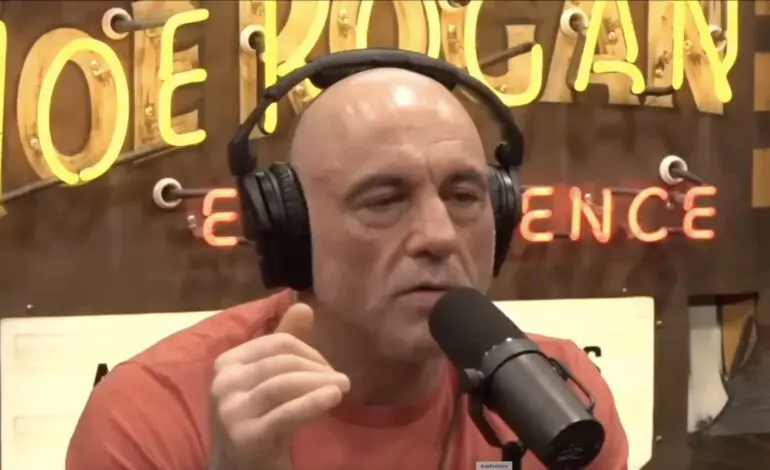

Joe Rogan is hardly a traditional political figure. Comedian, UFC commentator, longtime podcaster and self-described libertarian with left-leaning sensibilities, Rogan roams across topics ranging from psychedelics and health to politics, technology and culture. Yet in recent years, particularly during the 2024 United States presidential cycle, he has increasingly ventured into political terrain. His surprise endorsement of Donald Trump’s reelection bid in 2024 amplified that shift, especially because Rogan had previously expressed open criticism of Trump’s base and agenda. That paradox, endorsing someone he often seemed to critique, caught many off guard and repositioned Rogan in the political media environment.
If you can’t say that’s real, then you’re saying that genocide is acceptable as long as we are the ones doing it.
However, perhaps more striking is how Rogan has engaged with international issues, especially the Gaza war and Israel’s policies toward Palestinians. Over the past year, Rogan has publicly challenged the dominant Zionist narrative, insisting that many accepted frames around the conflict are misleading or one-sided. He has gone so far as to claim that what is happening in Gaza amounts to genocide. This article explores Rogan’s reasoning, the contours of his critique, its strengths and weaknesses and the broader implications when a cultural influencer of his reach engages these questions.
The context: Rogan’s political identity and unexpected endorsement
To understand Rogan’s critique of Gaza, one must first recognize where he stands politically. He is not easily placed within standard partisan categories. Over time, he has identified as a libertarian with certain progressive tendencies. He favors civil liberties, skepticism toward authority and distrust of media institutions. Rogan has criticized the excesses of both left and right.
Yet in the 2024 election cycle, he made headlines by endorsing Donald Trump’s bid for reelection over Vice President Kamala Harris. That endorsement surprised many, given his prior distancing from Trump and outspoken criticism of the Trump movement. The endorsement suggested that Rogan viewed the alternative as more dangerous or that he saw something pragmatic in Trump’s leadership at that moment. It reinforced the idea that Rogan is unpredictable, not reliably in one camp and willing to break with political convention.
This context matters because it helps us understand why Rogan’s views on Gaza are not rooted in simple partisanship. He is less bound to ideological loyalty and therefore freer to criticize powerful interests across different political lines.
The Zionist narrative and what Rogan questions
By the phrase Zionist narrative, Rogan refers broadly to the dominant interpretive framework within much Western discourse. This framework portrays Israel as an embattled democracy surrounded by hostile neighbors, where military actions in Gaza are framed as defensive measures against terrorism. Civilian deaths are often described as unintended collateral damage, and criticism of Israel is sometimes equated with anti-Semitism or the denial of Israel’s right to exist.
Rogan challenges several core aspects of this narrative.
First, he questions whether Israel is truly acting in self-defense or pursuing broader strategic objectives. He asks whether defense can still be considered defensive once it becomes disproportionate in scale and consequence.
Second, he critiques the idea that civilian deaths are merely accidental. He has described images of unarmed people walking through rubble and being struck by drones, asking his audience how such acts could be called collateral damage. His words are sharp: “If you can’t say that’s real, then you’re saying that genocide is acceptable as long as we are the ones doing it.”
When government officials describe an entire population as animals, you’ve already crossed a line where empathy dies and cruelty becomes policy.
Third, Rogan speaks about the stifling of dissent. He believes that media, academia and political institutions have created an environment where questioning Israel’s actions can lead to professional or social punishment. He sees this as a form of censorship that prevents honest conversation.
Fourth, he emphasizes the scale of destruction in Gaza. In his view, the level of devastation far exceeds the boundaries of counterterrorism and instead reflects an effort to destroy the infrastructure and collective life of an entire population.
Finally, Rogan highlights the dehumanizing rhetoric used by some Israeli officials. When leaders refer to Gazans as “human animals” or declare intentions to eliminate entire neighborhoods, he sees these words as evidence of a deeper moral collapse.
For Rogan, the Zionist narrative is sustained by powerful institutions that protect it from challenge. By questioning that narrative, he believes he is reclaiming moral language that has been manipulated for political ends.
Why Rogan calls the war on Gaza a genocide
For Rogan, the term genocide is not a rhetorical flourish. It is a deliberate moral claim based on what he considers clear evidence of intent, scale and dehumanization. His reasoning rests on several key pillars.
Intent and pattern of conduct. Rogan argues that intent can be inferred from consistent patterns of behavior. The repeated bombardment of civilian areas, the destruction of hospitals, schools and homes, and the deliberate imposition of siege conditions all suggest a goal beyond military victory. He believes these are indicators of a project aimed at breaking and erasing an entire people.
Deprivation as a weapon. Rogan often cites reports of Israel restricting electricity, fuel, food and medical supplies to Gaza. He views deprivation as a calculated weapon meant to inflict mass suffering. In his analysis, starvation and disease are not accidental but intentional tools of warfare.
Scale beyond military logic. Rogan argues that the level of destruction cannot be justified as part of a rational military campaign. If the purpose is to eliminate a militant organization, the obliteration of entire neighborhoods, he says, defies that explanation.
Language of dehumanization. He notes the importance of words in shaping moral consent. When government officials describe the enemy population as animals or monsters, they remove human empathy from the equation. Rogan sees this as proof of genocidal mindset.
Silencing and censorship. Finally, Rogan sees the suppression of criticism as a continuation of the violence. When journalists and academics fear being labeled anti-Semitic for questioning Israeli policy, he argues that society itself becomes complicit in the moral erasure of the victims.
Taken together, these elements create, in Rogan’s view, a case that goes beyond war crimes. He describes the campaign in Gaza as systematic destruction aimed at annihilation rather than security.
Strengths and weaknesses of Rogan’s position
Rogan’s argument possesses both moral urgency and philosophical tension.
Strengths
One strength lies in his willingness to speak moral truth in a space where most public figures remain silent. By using the word genocide, Rogan forces the public to confront the full moral weight of what is happening. He also expands the boundaries of acceptable discourse by challenging an established orthodoxy that discourages criticism of Israel.
Silence is complicity, and complicity is moral collapse
Rogan’s critique aligns with his broader libertarian philosophy that opposes censorship and government overreach. For him, exposing hypocrisy in power structures, whether political or media-based, is an act of public service. He presents himself as an independent voice for free thought, even when it invites backlash.
Weaknesses
Yet Rogan’s approach has its vulnerabilities. Genocide is a specific legal term with stringent requirements of proof, particularly regarding intent to destroy a protected group. Critics argue that Rogan simplifies this complexity and treats emotional inference as evidence.
He has also been accused of downplaying the role of Hamas, whose attacks on Israeli civilians initiated the recent escalation. Critics claim Rogan overlooks Israel’s security fears and the difficulty of conducting military operations in densely populated areas.
Another tension lies in his reliance on moral rhetoric rather than systematic evidence. While his passion captures attention, his lack of expertise in international law or Middle Eastern history opens him to accusations of exaggeration.
Finally, some accuse Rogan of fueling anti-Semitic discourse, arguing that by focusing exclusively on Israel’s actions without acknowledging historical trauma or existential fears, he risks feeding prejudice. Rogan has previously faced similar accusations in unrelated contexts, which makes this terrain particularly sensitive.
The paradox of Rogan’s position
Why does Rogan, a celebrity figure in American entertainment, take such a confrontational stance on a foreign conflict? Several reasons explain his posture.
Rogan thrives as an outsider who challenges conventional thinking. His success as a podcaster is built on authenticity and open conversation. Questioning Israel’s actions fits the same pattern as his critiques of government, pharmaceutical companies and media conglomerates. He portrays himself as the voice of those who distrust elite narratives.
Another motivation lies in his personal moral code. Rogan often expresses empathy for suffering people and an instinctive revulsion toward state violence. He frames his comments not as ideological but as human. When confronted with videos of children dying, he refuses to reduce the issue to politics.
Rogan also sees the Gaza war as symbolic of the broader failure of Western moral leadership. He argues that nations claiming to stand for human rights have lost credibility when they rationalize or ignore large-scale killing. For him, silence is complicity, and complicity is moral collapse.
Rogan and Coleman Hughes: A telling exchange
One of the most revealing moments came during Rogan’s discussion with political commentator Coleman Hughes. Hughes challenged Rogan’s use of the term genocide, insisting that such claims require precise legal and factual evidence. Rogan replied that he understood the concern but could not ignore what he had seen. He argued that the sheer number of civilian deaths and the deliberate targeting of basic infrastructure could not be explained as defense.
When Hughes maintained that intent was still unproven, Rogan answered, “Maybe you know more about the law, but I know what I see.” That exchange captured Rogan’s philosophy perfectly: intellectual caution has its place, but moral vision matters more.
To his audience, that humility combined with conviction reinforces his credibility. Rogan is willing to defer on technicalities yet refuses to surrender his moral instinct.
The cultural impact of Rogan’s stance
Rogan’s comments reverberate far beyond his studio. His podcast reaches millions of listeners who often treat it as a trusted source of unfiltered conversation. By raising the issue of genocide in Gaza, he has broadened public discussion of the conflict beyond political elites and media specialists.
His intervention also shifts the Overton window, meaning the range of acceptable public discourse. Before figures like Rogan spoke, using the word genocide in connection with Israel was considered fringe. Now it is part of mainstream debate.
However, this influence also carries risk. Simplifying a complex conflict into a moral binary can deepen polarization. Supporters may adopt his language without nuance, while opponents may dismiss him as an uninformed provocateur.
Still, his willingness to engage pushes institutions to respond. Media organizations, politicians and academics have had to clarify their positions and refine their arguments. Even if one disagrees with Rogan, his presence compels greater accountability.
Conclusion
Joe Rogan’s questioning of the Zionist narrative around Gaza marks a remarkable moment in modern discourse. He has used his immense platform to challenge a deeply rooted political orthodoxy. By calling Israel’s campaign in Gaza genocide, he has forced millions to reconsider assumptions about morality, power, and truth in international affairs.
His approach is both courageous and controversial. It risks misunderstanding and backlash, but it also reclaims moral urgency in a time of euphemism and fear. Rogan’s power lies not in being right or wrong on every detail, but in his refusal to remain silent when faced with mass suffering.
In an era where many public figures hide behind neutrality, Joe Rogan has chosen moral confrontation. Whether one agrees with his conclusions or not, he has reignited a vital conversation about conscience, truth and the cost of silence. His voice reminds us that even in a noisy world, one individual’s refusal to accept the official story can still challenge the machinery of power and awaken a long-dormant moral imagination.
– Amjad Khan is a contributing writer for The Arab American News. He is an educator, writer and academic researcher with a deep commitment to addressing the challenges facing the Muslim world. Through his work, he seeks to inspire meaningful dialogue and help chart a path toward unity, justice and peace.


Leave a Reply