




SHARM EL-SHEIKH, Egypt — After several days of negotiations in the Egyptian resort city of Sharm el-Sheikh over the details of U.S. President Trump’s plan to end the devastating war in Gaza — and coinciding with the second anniversary of Israel’s genocidal war launched in response to the “Al-Aqsa Flood” attack on October 7 — the Palestinian parties, led by the Hamas movement, announced that they had reached an agreement providing for a ceasefire, a gradual Israeli withdrawal from Gaza, the entry of humanitarian aid and a prisoner exchange.
This marks the first phase of a broader settlement that Israeli Prime Minister Benjamin Netanyahu and his far-right government were forced to swallow under Trump’s pressure — a dramatic turn for Trump, who had moved from being a partner in escalation and bombing to an enforcer and a facilitator of de-escalation.
There is little doubt that part of the shift in the American stance toward Israel stems from recent diplomatic developments at the United Nations, where Washington sensed growing international isolation of Tel Aviv amid unprecedented outrage over the genocidal crimes against the Palestinian people. Trump himself acknowledged this frustration in a phone call with Netanyahu after the phase-one deal was reached last Thursday, reportedly telling him, “You can’t fight the whole world.”
Observers note that Trump’s pressure on Netanyahu to end the Gaza war resulted from political, military and economic fatigue, as well as public and international pressure that had reached U.S. soil itself, compelling the president to reassess his approach to the Palestinian issue. However, they also point out that the Sharm el-Sheikh agreement remains fragile and ambiguous, pending implementation of the remaining articles of Trump’s 20-point plan, unveiled on September 29.
Analysts warn that the upcoming second phase of negotiations could take a dramatic turn, as it is expected to address the completion of the Israeli withdrawal, the establishment of a permanent ceasefire and the disarmament of Hamas. Hamas has denied agreeing to surrender its weapons or relinquish Palestinian rights, despite Trump’s public statements that the next phase would include “disarmament and withdrawal after the release of hostages.”
Trump said he expected Israeli captives in Gaza to be released on Monday or Tuesday of next week and expressed hope to attend an official signing ceremony in Egypt, adding that he might visit Israel soon and deliver a speech before the Knesset.
Despite the global relief that followed the announcement, many experts view this first stage as limited in scope — focusing on prisoner exchanges, easing the siege and issuing vague promises of future peace talks, leaving ample room for Netanyahu to undermine or reinterpret key provisions such as security arrangements and postwar governance once international momentum fades.
Details of the agreement
The first phase stipulates the release of 20 Israeli captives alive in one batch, followed by a gradual exchange of prisoners and remains in parallel with stages of Israel’s withdrawal from Gaza.
In return, Israel will release more than 2,000 Palestinian prisoners, including 250 serving life sentences and 1,700 arrested since the war on Gaza began two years ago. Displaced Palestinians will also be allowed to return to Gaza City and northern Gaza immediately after the deal’s implementation.
Under the agreement, approved by all Palestinian factions, a minimum of 400 aid trucks will enter Gaza daily during the first five days after the ceasefire, to be increased later. Aid will flow through five crossings, including the Rafah border crossing with Egypt, which will reopen in both directions, according to Khalil al-Hayya, head of Hamas in Gaza and lead negotiator.
Israel also committed to begin a phased withdrawal within 24 hours of signing the deal, though it will retain control over 53 percent of Gaza’s territory until the final hostage is released.
Trump is expected to arrive in Egypt on Sunday to monitor implementation and attend the formal signing ceremony before traveling to Israel, where he is expected to observe the prisoner exchange, supervised by Egypt, Turkey, Qatar and the United States.
Israeli officials, however, clarified that Fatah leader Marwan Barghouti will not be among those released.
Israel’s government has approved the agreement and published the list of Palestinian prisoners to be freed, as well as the map of initial withdrawals. All military operations in Gaza are to cease immediately, with October 11 set as the date for a complete withdrawal from populated areas to allow Palestinian resistance groups to prepare the release of captives and locate the bodies of slain Israeli soldiers for the initial exchange.
Palestinian sources said the Hamas delegation succeeded in modifying key parts of Trump’s proposed withdrawal map, forcing Israel to expand its pullout and immediately reopen crossings, including Rafah, under the same terms as the January ceasefire — with supervision by the Palestinian Authority and the European Union.
According to the same sources, the second phase of Trump’s plan envisions forming an independent Palestinian technical committee under an international transitional body called the “Peace Council”, chaired by Trump himself and including global figures such as former British Prime Minister Tony Blair.
However, Hamas official Osama Hamdan rejected this proposal.
“No Palestinian can accept this — not Hamas, not Fatah, not any faction,” he said. “No one accepts a return to the era of colonial mandates. If they wish to help, let them help the Palestinian people achieve their full rights, not impose guardianship on them.”
The proposed council would oversee Gaza’s reconstruction until the Palestinian Authority completes its reform program and regains administrative control of the Strip.
The second phase also calls for a regional economic development plan, led by experts who helped design modern Middle Eastern cities, and the creation of a special economic zone with favorable tariffs to attract investment and create jobs.
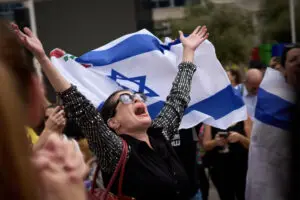
Israelis react with great emotion on Thursday, following the announcement that Israel and Hamas have agreed to the first phase of a peace plan to pause the fighting, at a plaza known as Hostages Square in Tel Aviv. -AP
Guarantees and reactions
Hamas leader Khalil al-Hayya said the movement received guarantees from mediators and the U.S. administration that the war is “completely over,” adding that Hamas remains committed to completing the subsequent steps.
“The world stood astonished before the steadfastness, patience and sacrifices of Gaza’s people,” al-Hayya declared in what resembled a victory speech. “They faced a war like no other — enduring killing, displacement, hunger and the loss of loved ones and homes — yet stood like mountains.”
Marking the anniversary of October 7, al-Hayya saluted the “martyrs of the Al-Aqsa Flood” — Ismail Haniyeh, Saleh al-Arouri, Yahya al-Sinwar and Mohammed Deif — praising the fighters who “stood like immovable cliffs before Israel’s tanks” and the negotiators who “placed the blood of our people and their rights above all else.”
He said Hamas had dealt “responsibly and pragmatically” with Trump’s plan, offering a proposal “that protects our people’s rights, stops the bloodshed and reflects our vision for ending the war.”
He expressed gratitude to Palestinians “in the West Bank, inside 1948 territories and across the diaspora” and extended appreciation to Egypt, Qatar, Turkey, Yemen, Lebanon, Iraq and Iran, as well as to millions of supporters worldwide who took to the streets “in solidarity with Gaza’s struggle.”
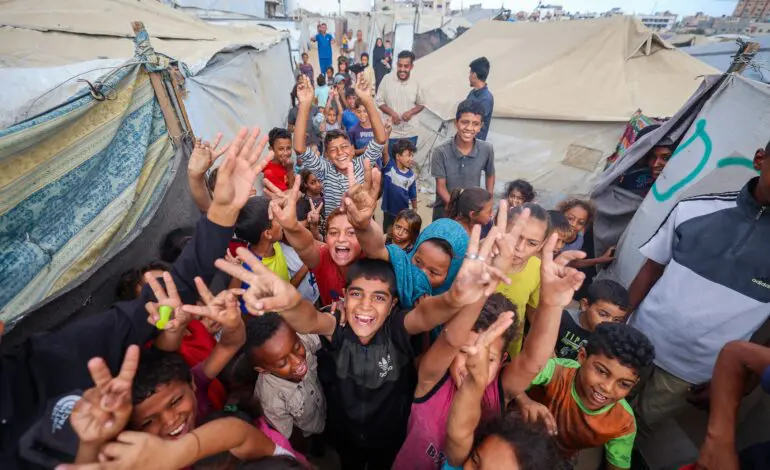
Celebrations erupted across Gaza following the announcement of the ceasefire, with crowds cheering, waving flags and chanting in joy — scenes widely circulated on social media platforms.
Broad international welcome
The announcement of the ceasefire was met with broad Arab, Islamic and international approval, accompanied by calls to consolidate the first phase and ensure a permanent end to the genocide that has devastated Gaza for more than two years.
Trump wrote on Truth Social:
“Israel and Hamas have signed the first phase of our peace plan.
This means all hostages will soon be released, and Israel will withdraw its forces to an agreed line — the first step toward strong and lasting peace.
All parties will be treated fairly. This is a great day for the Arab and Islamic worlds, for Israel and for the United States.”He thanked mediators from Qatar, Egypt and Turkey “for helping make this historic and unprecedented event possible,” concluding, “Blessed are the peacemakers.”
The ceasefire — coming 734 days after the war on Gaza began — drew reactions from world leaders. The war has killed or injured roughly 10 percent of Gaza’s population and destroyed more than 80 percent of its infrastructure.
Palestinian President Mahmoud Abbas said he hoped the deal would be “a step toward a permanent political solution ending the occupation and establishing the State of Palestine.” He praised Trump’s efforts and emphasized that Gaza’s sovereignty must be restored “through Palestinian security institutions, supported by Arab and international partners.”
U.N. Secretary-General António Guterres welcomed the deal, commending the diplomatic efforts of the U.S., Qatar, Egypt and Turkey, and urged all sides to “fully comply with the agreement.”
The European Union’s foreign policy chief hailed the deal as “an important breakthrough, a major diplomatic achievement and a genuine opportunity to end a devastating war and release all hostages,” pledging EU support for its implementation.
Reactions also poured in from Arab and Islamic countries, including Iran, whose Foreign Ministry reiterated support for “any initiative that ends the genocide, ensures withdrawal of occupying forces and secures the release of Palestinian prisoners.”
“The Islamic Republic of Iran has consistently supported every effort aimed at halting the genocide, ensuring humanitarian access and realizing the fundamental rights of the Palestinian people,” the ministry said in a statement on X (formerly Twitter).
Meanwhile, several Arab governments, eager to mask their earlier inaction or complicity, sought to present the Gaza ceasefire as their own diplomatic success.
Media in Saudi Arabia, Egypt, Turkey, Jordan, the UAE, Qatar, Pakistan and Indonesia portrayed the deal as a victory for diplomacy over resistance, while largely ignoring the unjust provisions that compromise Palestinian demands — the product of an Israeli campaign that pushed Gaza to the brink of collapse, making an end to the massacre seem like the only achievable goal.


Leave a Reply