




Temporary peace, permanent doubt: The fragile truce between Israel and Gaza
Here is a clear-eyed look at the new Israel Gaza ceasefire. It is a moment many people prayed to see. The guns have fallen quiet. Hostages are coming home. Prisoners are stepping off buses to tearful embraces. The United Nations and aid agencies are rushing convoys into a strip battered by two years of war. On October 13, reporters in Tel Aviv and Gaza documented the release of the last living Israeli hostages and the start of large-scale Palestinian prisoner releases, all under a ceasefire arrangement that also foresees a surge of humanitarian aid. Those images, after so much loss, are worth a breath of relief. They are also a reminder that relief is not yet peace. The ceasefire is real, but its benefits are fragile and temporary.
What has changed on the ground is measurable but incomplete. Israeli forces have begun partial withdrawals, and aid distribution is shifting from a controversial U.S. and Israeli backed stopgap system toward a larger United Nations led effort that promises hundreds of trucks a day. Hamas has redeployed fighters and police in parts of Gaza in an effort to reassert control and restore basic order, even as reports describe violent score settling that underscore how thin the line is between calm and collapse. None of this resolves the central questions of disarmament, governance or reconstruction that will define whether Gazans can rebuild lives or whether the territory slips back into open war. The ceasefire has paused the killing, but it has not produced an agreed plan for the day after.
The exchange itself has been dramatic. The last group of living hostages has been released and Israel has begun freeing more than 1,900 Palestinian prisoners, with buses carrying men and women into the West Bank and Gaza. Families of captives and detainees have stood for months in visible anguish. For them, the ceasefire is a door opening at last. That opening, however, remains surrounded by a corridor of uncertainty. Israel and Hamas interpret the same clauses differently. Conditions in Gaza are dire. A durable political framework is still missing. Without it, even a successful exchange risks becoming a brief interlude before a return to strikes and raids.
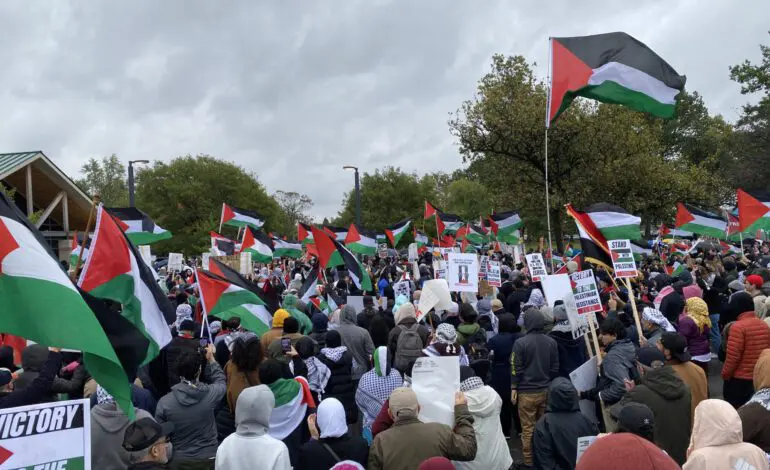
Why then did this ceasefire happen now. Many observers point to shifts in American politics as a crucial wind behind the negotiations. Over the past two years, U.S. public opinion has moved in striking ways. Major polls show decreasing support for Israel’s military campaign and a widening partisan gap in views of the Israeli government, the Israeli people and the Palestinian people. In March, Gallup found that fewer than half of Americans now say their sympathies lie mostly with Israelis, a low point in a quarter century of tracking. In July, Gallup also reported that only about a third of Americans supported Israel’s military action in Gaza, another record low in their trend. In early October, Pew Research Center reported that Democrats view the Palestinian people favorably by a large margin, while Republicans remain much more favorable to the Israeli government and people. These cross currents create a domestic U.S. environment in which unconditional support for the war is no longer politically easy.
Another datapoint undercuts any claim that Washington can ignore the human costs of its weapons. Investigations by journalists and human rights groups have linked U.S. made munitions to strikes that killed civilians in Gaza. The U.S. State Department flagged hundreds of potential incidents of civilian harm involving U.S. furnished weapons, according to reporting in October 2024. Amnesty International and others detailed cases where specific U.S. bombs were used in strikes that caused mass casualties. These findings have increased pressure on U.S. policymakers and complicated the once routine politics of arms transfers. Even if the administration avoids formal sanctions or legal findings, public scrutiny of American complicity has grown, and with it the political cost of continuing a war that many voters view as both endless and aimless.
It is tempting to compress this shift into a simple narrative of a dramatic 50 point swing toward Palestine. The reality is more nuanced. Polls do show a sharp narrowing of the traditional pro Israel advantage and, at times, near parity or slight leads for pro Palestinian sympathies in individual surveys. For example, a recent New York Times and Siena College survey cited by multiple outlets showed more respondents siding with Palestinians than with Israelis by a single point, 35 to 34. Gallup’s long running question still shows more sympathy for Israelis than Palestinians nationwide, but the margin is at historic lows and support for Israeli military action is at historic lows. The direction of travel is undeniable even if the exact magnitude depends on the question asked and the moment it was asked. What matters for policy is that the American political marketplace is no longer aligned behind a maximalist Israeli approach.
These domestic shifts help explain the timing of the ceasefire. Negotiators do not operate in a vacuum. When presidents and prime ministers face rising public unease and restive coalitions, their appetite for open ended conflict shrinks. The sight of an American president standing beside Israeli leaders to hail the release of hostages and the opening of a humanitarian pipeline offers political cover that weeks or months of continued bombardment could not. The ceasefire is a product of battlefield exhaustion, regional pressure and the strategic choices of both sides. It is also a product of democratic constraint. In the United States that constraint has strengthened as the war has lengthened and the humanitarian catastrophe has deepened.
Still, hard experience warns against assuming the quiet will hold. The ceasefire leaves major flashpoints unresolved. Disarmament provisions are vague, and enforcement mechanisms are politically fraught. Reports from Gaza already describe clashes as Hamas seeks to reassert authority and punish rivals, behavior that invites retaliation and complicates any security understandings. Israeli leaders face their own pressures. Some members of the governing coalition have built their careers on promises to finish Hamas by force and to shape Gaza’s future without concessions. If rocket fire resumes from any faction, or if a deadly confrontation erupts in the West Bank, the fragile political balance sustaining the truce could collapse. The longer term question of who governs Gaza remains unanswered, and absent an agreed pathway, spoilers on all sides have every incentive to provoke.
History provides more reasons for caution. Previous pauses in fighting have repeatedly broken down when humanitarian corridors came under fire, when mediated swaps stalled over lists and names or when battlefield commanders acted faster than diplomats. The current deal contains moving parts that invite friction. Aid convoys must cross multiple militarized checkpoints. Local policing must resume in places where institutions have been gutted. Prisoner releases must proceed on schedules that are politically sensitive in Jerusalem and Ramallah. Any single failure can be spun into evidence of bad faith, and any single attack can be used to justify a cascade of reprisals. That is why observers describe the ceasefire as a necessary step rather than a solution. It is a bandage on a deep wound, vital to stop the bleeding, but not a surgery that heals the underlying damage.
There is also an uncomfortable logic that has governed past rounds. When fighting pauses, the world turns away. The cameras leave. Donors move on. Without sustained effort, the political incentives that made the ceasefire possible erode, and familiar habits reassert themselves. In Israel, the security establishment may revert to a model of containment, raids and economic pressure that aims to manage rather than resolve the conflict. In Gaza, factions may regroup, compete for resources and prepare for the next round, especially if reconstruction stalls and living conditions remain intolerable. The status quo ante has always had a gravitational pull. Only a deliberate counterweight can hold the line against it.
The counterweight is a coalition of interests that did not exist in the same form before October 2023. Families of hostages in Israel have become an enduring moral force for negotiated outcomes. Humanitarian agencies have adapted to the most challenging operating environment in recent memory and built networks that can scale quickly. Regional states, reluctant at first, have seen how prolonged war threatens their own security and economies and now have concrete incentives to maintain calm. In the United States, the electorate has become more skeptical of blank check support and more attuned to the humanitarian costs of modern warfare, especially when American made munitions are involved. Together, these actors can keep pressure on leaders to translate a ceasefire into something more permanent.
But pressure alone is not a plan. For the ceasefire to be more than a timeout, three tasks must move in parallel. First, humanitarian relief must be shielded from political gamesmanship. That means expanding the United Nations-led logistics pipeline, securing predictable crossings and insulating convoys from interference by armed groups. The shift away from ad hoc systems that forced civilians to risk their lives to reach food points is encouraging, but it needs to become irreversible through international monitoring and clear consequences for obstruction. Second, a credible interim security architecture has to be negotiated that reduces the chance of spoilers dragging both sides back into war. This may involve vetted local policing under regional oversight, paired with strict constraints on Israeli operations. Third, there must be a pathway for governance and reconstruction that includes Palestinian institutions and provides Gazans with a stake in stability. Without meaningful civilian leadership and visible rebuilding, no ceasefire will withstand the frustrations of daily deprivation.
The claim that Israel will without a doubt break the ceasefire reflects a well earned skepticism, not prophecy. Ceasefires often fail because incentives are misaligned and because the underlying conflict remains unresolved. Israeli governments have a record of using force in Gaza when they perceive rising threats, and Hamas has a record of firing rockets or tolerating factions that do. To reduce the probability of failure, outside actors must keep raising the costs of violations and lowering the costs of compliance. For Washington, that entails conditioning military support on adherence to humanitarian and legal standards, backing serious political processes and maintaining public transparency about civilian harm from U.S. supplied weapons. None of these steps guarantee success, but each one changes the calculus from business as usual to something more disciplined.
The new American politics around this conflict are not a passing mood. They are the product of images seen and stories heard over two long years, of legal and moral arguments made by mainstream institutions, and of a generation less deferential to old certainties. Pollsters can debate trend lines and crosstabs, but the broader reality is that the center of gravity in the United States has shifted toward skepticism of endless war and toward empathy for civilians trapped in it. That skepticism helped make the ceasefire possible. It can also help keep it. If elected leaders conclude that resuming large scale bombing is a political loser, they will search harder for alternatives. If voters keep asking where American bombs land and who they kill, the pressure to avoid another spiral will remain. The more transparent the evidence, the stronger the restraint.
So celebrate the quiet. Celebrate the reunions taking place in hospitals and living rooms. Celebrate the crates of antibiotics at last moving through a checkpoint and the first nights of sleep without the fear of a new blast. Then translate celebration into vigilance. The ceasefire is a chance, not a cure. Its benefits are precious and temporary. Whether they become permanent depends on choices that are political as much as military, in Washington as much as in Jerusalem and Gaza City. If the domestic wind in the United States continues to blow toward accountability and humanitarian restraint, leaders will keep hearing it. If that wind dies, history suggests the noise of war will return.
– Amjad Khan is a contributing writer for The Arab American News. He is an educator, writer and academic researcher with a deep commitment to addressing the challenges facing the Muslim world. Through his work, he seeks to inspire meaningful dialogue and help chart a path toward unity, justice and peace.


Leave a Reply