




Despite ongoing Israeli violations of the Gaza ceasefire, President Trump’s administration spent the past week showing some seriousness about consolidating the truce and reining in Israel’s far-right, led by Benjamin Netanyahu, not only in Gaza but also in the occupied West Bank, after the Knesset’s initial vote to annex it to Israeli sovereignty.
Trump warned Israel it would “lose all U.S. support” if it annexed the West Bank, saying, “That will not happen.”
“We’ve had tremendous Arab support,” he said in an interview with Time. “It [annexation] will not happen because I promised Arab countries it won’t. It will not happen. Israel will lose all U.S. support if it does.”
According to CNN, Trump said he prevented Netanyahu from continuing the war in Gaza, partly by warning him of eroding global support for Israel.
“He would have continued,” Trump said about Netanyahu. “It could have gone on for years. It would have gone on for years.”
He added he told the Israeli prime minister, “Bibi, you can’t fight the world. You can fight individual battles, but the world is against you. And Israel is a very small country compared to the world.”
Trump also said he plans to visit Gaza.
“I will, yes, I will,” he said, without specifying a date.
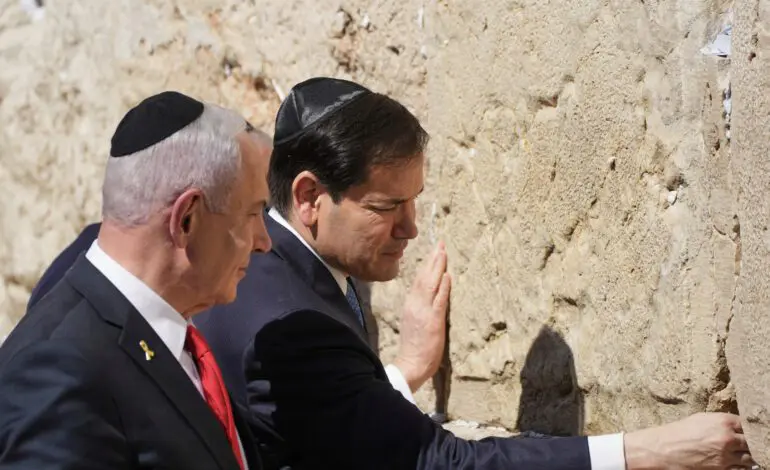
On another front, U.S. Secretary of State Marco Rubio said that a series of visits this week by senior Trump administration officials to Israel indicates that efforts following the Israel-Gaza ceasefire are a top priority for the president.
“The president has made this a top priority, and the proof is that both Steve Witkoff and Jared Kushner were here almost the entire week — we spent time with them,” Rubio said while standing alongside Netanyahu after their meeting. “Vice President J.D. Vance just left, we crossed paths. And I’m here today, because this is a priority.”
Rubio arrived in Israel hours after Vance departed amid an intense diplomatic push to shore up the fragile Gaza ceasefire.
Before leaving Israel, Vance described the Knesset’s preliminary vote to annex the occupied West Bank as a “stupid decision”, stressing that Trump’s policy remains firm: no West Bank annexation. Vance said he felt “insulted” by the Knesset’s vote, calling it “a political stunt.”
“If that’s true, it is an extremely stupid maneuver,” he said.
In a preliminary vote that passed 25–24, the Knesset approved a bill to annex the West Bank, coinciding with Vance’s visit. Likud, led by Netanyahu, called it “an opposition maneuver aimed at harming our relations with the United States”, even as members of Netanyahu’s own coalition have pushed for asserting sovereignty over the West Bank.
Likud said in a statement that “real sovereignty” would not be achieved “by a showpiece law that harms our relations with Washington and our achievements.”
“We are strengthening settlement daily through actions, budgets, construction and industry, not talk,” the statement added.
“The time to apply sovereignty over the West Bank is now,” National Security Minister Itamar Ben-Gvir said in reaction to the vote.
Finance Minister Bezalel Smotrich said “sovereignty is the test”, adding that if Saudi Arabia conditions normalization on a Palestinian state, then “they can keep riding camels in the Saudi desert.”
Opposition leader Yair Lapid responded on X that Smotrich “does not represent the State of Israel.” Smotrich later walked back his comment, posting a video on X.
“My statement about Saudi Arabia was certainly inappropriate, and I apologize for the offense.”
In the United States, 46 Democratic senators urged Trump to prevent Israel from annexing the occupied West Bank. (Democrats hold 47 of 100 seats; Sen. John Fetterman of Pennsylvania was the only Democrat who did not sign.)
Gaza peace deal
On-the-ground obstacles — primarily the ongoing Israeli presence and Hamas’ inability to locate all the remains of Israeli hostages — are blocking a move to Phase Two of the “Trump Plan” for a Gaza ceasefire and prisoner exchange. Israel’s public broadcaster said Israeli intelligence estimates that Hamas can hand over the remains of 10 out of the 13 Israeli captives still unaccounted for, accusing Hamas of using the ceasefire to rebuild capabilities in areas it still controls, including repairing tunnels and recruiting fighters.
In the same vein, IDF Chief of Staff Eyal Zamir reportedly told the U.S. vice president that moving to Phase Two is “impossible before recovering all the bodies of the abductees.”
Meanwhile, U.S. Central Command (CENTCOM) said a new “coordination center” established in southern Israel at an Israeli Forces base is “an essential element” of efforts to achieve lasting stability in Gaza. CENTCOM said numerous countries are interested in joining, stressing that the center extends beyond a military coalition to include civil and security arrangements given the fragility inside Gaza after two years of continuous conflict.
Linked to these efforts, Haaretz reported that the United States has told Israel it must provide advance notice of any exceptional military operation in Gaza, warning that any surprise step could jeopardize the deal. Citing Israeli security sources, the paper said Washington is applying increasing pressure on Jerusalem and effectively extracting some operational prerogatives.
“Netanyahu is walking a very thin tightrope with President Trump; if he keeps this up, he will end up sinking the deal,” Barak Ravid of Axios quoted a senior U.S. official as saying. “And if Netanyahu sinks the deal, Trump will sink him.”
In Cairo, an intensive push is underway to unify the Palestinian house and reach a shared vision for the post-war phase. General Intelligence chief Hassan Rashad met senior Palestinian officials, including Palestinian Authority Secretary-General Hussein al-Sheikh and intelligence chief Majed Faraj; Islamic Jihad Secretary-General Ziyad al-Nakhalah and his deputy Mohammed al-Hindi; and leaders of several factions, notably the Democratic Front, the National Initiative and the Popular Front – General Command.
After Rashad met a Hamas delegation led by Khalil al-Hayya, followed by a session with the PA and Fatah, Egyptian intelligence convened a three-way meeting with Hamas and Fatah to draft concrete, time-bound implementation outputs that could enable either reunification of the West Bank and Gaza or agreement on the shape of the next governing authority.
Hamas, for its part, urged international media and rights groups to press Israel to allow foreign journalists into Gaza, where Israeli airstrikes resumed last week despite the ceasefire.
At the start of last week, Netanyahu stated openly that he was never prepared to end the war by capitulating to Hamas.
“The entire state was on the brink of annihilation,” he said.
He reiterated his commitment to “destroying Hamas’ military power and administrative rule as outlined in the Trump Plan”, claiming Hamas violated the ceasefire, leading to the deaths of two Israeli soldiers, and that Israel responded with 150 tons of bombardment in one day on Gaza.
Netanyahu said his government is committed to bringing back all captives.
“Just as we promised to return all the live captives and did so, we are committed to bringing back all the bodies from Gaza,” he said. “We returned 239 captives through a series of deals and are determined to finish the job. We are determined to achieve the goal of disarming Hamas and the rest of the war’s objectives.”
In what was seen as an indirect response, Trump said Monday he will not send U.S. troops to Gaza, absolved Hamas leaders of the alleged violations and denied that he had asked Israel to resume fighting — after the Israeli military carried out heavy airstrikes on Sunday that killed 45 people, including a journalist.
Trump said the ceasefire deal requires Hamas to “behave well.”
“We made a deal with Hamas that they would behave very well, that they would be nice, and if they break it we will intervene and eliminate them if we have to,” he said. “They know that.”
Asked if the U.S. military would intervene if needed to eliminate Hamas, he replied there would be “no American troops on the ground, ever.”
“We have 59 countries signed onto the deal,” he said.
Following U.S. pressure, the Israeli military announced a return to implementing the ceasefire, after Netanyahu chaired an emergency security meeting on Gaza. Reports also said the government backtracked on a decision to close all Gaza crossings, though it kept the Rafah crossing closed.
The latest escalation followed an Israeli claim that its forces and engineering units were attacked by gunmen in Rafah, killing an officer and a soldier. The Palestinian resistance denied involvement, accusing Israel of violating the ceasefire from day one and fabricating pretexts to sabotage the deal.
On the ground, resistance-aligned security forces continued to pursue gangs recruited by Israel to track fighters and steal incoming aid. Palestinian media reported that several members of the Yasser Abu Shabab militia, based in eastern Rafah, were arrested in a security ambush Tuesday evening.
On the humanitarian front, U.N. deputy spokesperson Farhan Haq stressed the need to allow far greater volumes of shelter materials into Gaza before winter. He said aid groups are expanding operations in areas that were previously hard to reach and noted that U.N. teams brought 10,638 tons of essential supplies through the border crossings during the first two weeks of the ceasefire.
“Migration wave” out of Israel
New Knesset data show a worrying rise in emigration since 2020, with a net outflow of about 146,000 Israelis who left and did not return, amid no comprehensive government plan to stem departures. A Knesset Research and Information Center report shows emigration increased markedly after the Gaza war began in October 2023, amid growing security tensions and domestic political polarization.
Figures cited: about 83,000 Israelis left in 2023, up 39 percent from 2022. From January–August 2024, around 50,000 left — similar to the same period in 2023. Returnees fell sharply: 24,200 returned in 2023 (vs. 29,600 in 2022), and 12,100 returned January–August 2024. The result is a worsening negative migration balance, peaking at –58,600 in 2023 and –36,900 through August 2024.
Knesset Immigration Committee chair Gilad Kariv called it a “tsunami.”
“Many Israelis are choosing to build their future outside the state, while the number returning declines,” he said.
He said what we’re seeing is a direct result of government policies that “tore society apart before the war and neglected the home front over the past two years.” He warned that without a clear plan, the trend could worsen. The report says the government has no organized plan to reduce emigration or encourage return, deepening the crisis.
Lebanon and Syria
In Lebanon, as the Trump team continues to press for disarming Hezbollah, Israel has kept up daily strikes, while sharp political debates continue in Beirut over parliamentary elections scheduled for spring 2026.
U.S. envoy Tom Barrack argued that disarming Hezbollah is not only a security necessity for Israel but also Lebanon’s “opportunity for renewal”, noting that regional partners are ready to invest provided the Lebanese government reasserts exclusive control of force through the Lebanese Army alone.
In what sounded like a warning, Barrack wrote on X that if the Lebanese government continues to hesitate, Israel may act unilaterally with serious consequences. He said disarmament would secure Israel’s northern border; for Lebanon, it would “restore sovereignty” and open the door to economic recovery; for the U.S., it advances the president’s “peace through prosperity” framework while reducing U.S. exposure; and for the region, it removes a “key Iranian proxy alongside Hamas”, accelerating “Arab modernization and integration.”
On Syria, Barrack said the “winds of reconciliation” that began in Gaza should cross Israel’s northern border and revive Syria’s salvation, urging the U.S. House of Representatives to follow the Senate and vote to repeal the Caesar Act.
He added that the “Gaza Peace Summit” was not a symbolic spectacle but the opening movement of a new symphony of cooperation based on energy integration, economic interconnection and shared humanitarian aspirations.
The Gaza Ceasefire Framework — Key Facts
Phased structure
Phase One:
-
Immediate ceasefire between Israel and Hamas.
-
Exchange of all living Israeli hostages for Palestinian prisoners.
-
Unrestricted humanitarian aid under U.N. supervision.
-
Gradual withdrawal of Israeli forces from central Gaza.
Phase Two (pending):
-
Return of the bodies of deceased Israeli captives.
-
Full Israeli military withdrawal to pre-October 2023 positions.
-
Deployment of an international monitoring and reconstruction mission.
-
Restoration of civil administration under a restructured Palestinian authority acceptable to both Hamas and Fatah, supervised by Egypt, Qatar, and the U.S.
Phase Three (long-term):
-
Launch of “Trump Plan for Gaza Stability”, emphasizing economic reconstruction, demilitarization and regional investment via the “Peace Through Prosperity” framework.
-
Involvement of 59 signatory states, including Egypt, Jordan, Saudi Arabia, the UAE, Turkey and several European countries.
Ceasefire oversight and enforcement
-
U.S. Central Command (CENTCOM) operates a joint coordination center in southern Israel to monitor ceasefire compliance.
-
Egypt and Qatar serve as co-mediators.
-
U.N. relief agencies coordinate aid delivery.
-
Israel required to give advance notice for any exceptional military action in Gaza.
Outstanding issues
-
Remains of three Israeli captives are still missing in Gaza.
-
Ceasefire violations reported by both sides.
-
Hamas rebuilding efforts vs. Israeli airstrikes despite the truce.
-
Israeli far-right pressure on Netanyahu to abandon the deal.
Key timeline
-
October 7, 2023: War begins after Hamas-led attacks.
-
October 13, 2025: Last living Israeli hostages released; ceasefire begins.
-
October 21, 2025: Israeli Knesset holds preliminary vote to annex the West Bank.
-
October 22–23, 2025: Trump administration dispatches top envoys to Israel to reinforce the truce.
-
October 24, 2025: Netanyahu orders partial return to ceasefire after U.S. pressure.



Leave a Reply