




Osama Siblani: “Those who claim to represent the Lebanese diaspora in America speak only for a small minority, not for the majority in Michigan.”
By Roaa Qassem – Al-Akhbar (Lebanon)
Since 2017, Lebanon has witnessed ongoing debate over its parliamentary election law and the place of expatriates within it. As was the case before the 2022 elections, Lebanon and its diaspora communities are once again living through decisive days that will determine the composition of the next parliament for the coming four years.
Given the importance of the upcoming term — amid Israel’s continuing war and sensitive domestic issues such as the disarmament of the resistance, negotiations with Israel and broader regional shifts — several political forces inside and outside Lebanon are attempting to leverage the expatriate vote to pressure Hezbollah and the Amal Movement, seeking to influence internal Lebanese politics through the ballots of Lebanese abroad.
Michigan community demands implementation of 2017 law
In this context, a group of “community leaders, organizations, and institutions representing the largest segment of the Lebanese community in Michigan” sent a letter to the Lebanese Ministry of Foreign Affairs and the three branches of government — the presidency, parliament and premiership — calling for the implementation of Article 122 of the 2017 electoral law, which allocates six parliamentary seats for expatriates.
(The full text of the letter was attached to the statement.)
The statement emphasized that the signatories “will not allow any group or individual to speak in their name for political purposes that do not reflect their will or aspirations.” They also strongly rejected attacks against Speaker of Parliament Nabih Berri, describing him as “a pillar of national stability and the last guardian of the Taif Republic.”
“Respect for national institutions and figures is central to our values and aspirations,” the statement read.
Accordingly, the signatories urged the Foreign Ministry to coordinate with the three presidencies to implement the 2017 law’s provisions by adopting the six dedicated diaspora seats, to ensure equality and electoral fairness.
They stressed that those who represent the interests of the Lebanese expatriate community should be members of parliament elected from the diaspora districts, not candidates running in Lebanese territorial constituencies.
They also called for a transparent and impartial registration process for expatriates wishing to vote abroad — one free from the internal partisan disputes that dominate Lebanese politics.
“The position of the Lebanese community in Michigan must be taken into account as a legitimate and broad component that represents hundreds of thousands of expatriates seeking to contribute to their homeland through their political and representative rights,” the letter stated.
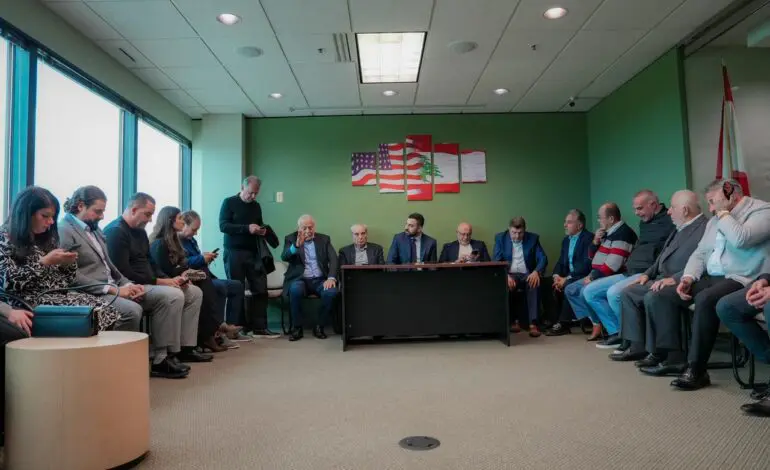
The Lebanese Consulate General in Detroit, led by Consul General for the Midwest Ibrahim Charara, confirmed receipt of the letter during a meeting attended by 31 expatriates, held at their request, and said it was forwarded to the Ministry of Foreign Affairs for follow-up.
Siblani: “We represent the largest and most active community”
Osama Siblani, publisher of The Arab American News and president of the Arab American Political Action Committee (AAPAC), led the Michigan delegation that delivered the message to Consul General Charara.
Siblani said the meeting came after “certain groups falsely claiming to represent the Lebanese diaspora in America” sent letters to Beirut, even though they “represent only a small fraction of the community.”
“We requested an urgent meeting with the consul general of Lebanon in Detroit before the scheduled sessions of the Lebanese parliament and cabinet to address the issue of expatriate voting,” Siblani told Al-Akhbar.
He referred to the earlier meeting between Lebanon’s ambassador to the United States, Nada Hamadeh Moawad, and four individuals described as “representatives of a coalition of Lebanese diaspora organizations.” That group had delivered a letter calling for allowing Lebanese abroad to vote for all 128 parliamentary seats rather than for just the six diaspora seats.
“Those people do not represent the majority of the Lebanese community in America — they are not even known in its circles,” Siblani said.
He clarified that the Michigan delegation does not claim to represent all Lebanese Americans, acknowledging that “there are other groups and opinions that must be respected.” However, he noted that the delegation represents the largest and most influential segment of the diaspora, including Lebanese who hold positions of official and community leadership.
He pointed out that in Dearborn, Dearborn Heights and neighboring cities within Wayne County, there are more than 80,000 Lebanese voters.
“It is unacceptable that this significant constituency be so easily overlooked,” Siblani said.
Siblani said during Ambassador Moawad’s recent visit to Michigan, she expressed her admiration at the size and vitality of the Lebanese community in Metro Detroit.
“Let residents of Lebanon choose their own representatives”
Regarding the content of the letter sent to the Foreign Ministry, Siblani stressed that:
“Out of respect for our families in Lebanon, they and only they should make the decision who is the best representatives for them.”
He argued that it would be unfair for expatriates, who enjoy comfortable living conditions abroad, to decide on behalf of citizens inside Lebanon “who suffer daily hardships that expatriates, even the well-informed ones, may not fully grasp.”
Security and fairness concerns
Siblani said the idea of expatriates voting for all 128 members of parliament raises serious concerns within the U.S.-based Lebanese community — especially in Michigan — where many fear potential legal or security repercussions if they vote for candidates affiliated with groups listed as terrorist organizations by the U.S. government.
“Even if the election process is conducted with full transparency and secrecy,” Siblani said, “these fears remain legitimate. Anyone voting in districts identified with the social base of organizations classified as terrorist by the United States could be exposed to pressure or prosecution — directly or indirectly.”
He added that requiring expatriates to vote for all 128 seats would force them to cast ballots for candidates they barely know, whereas electing six dedicated diaspora representatives would allow voters to choose independent candidates they can know personally and communicate with, giving them a stronger voice in parliament.
Such a model, Siblani argued, would ensure better accountability and protect the diaspora’s political participation from the constraints of local partisanship or security risks.
Different priorities for diaspora voters
Siblani further noted that the priorities of expatriates differ greatly from those of residents in Lebanon:
“The parliament in Beirut mostly deals with local development and domestic legislation, while expatriates are more concerned with their relationship to the embassy and the Foreign Ministry — and with how they can support their towns and villages through community initiatives.”
Should the Lebanese authorities proceed with the plan to let expatriates vote for all 128 MPs, Siblani reiterated a core demand:
“Guarantee full transparency and absolute secrecy in the registration and voting process, to ensure a genuinely democratic election.”
Summary
The Michigan initiative underscores a growing divide among Lebanese abroad over how best to participate politically in Lebanon’s parliamentary system. While some advocate for full integration into domestic voting, others — like Siblani and the Michigan community — argue for dedicated diaspora representation, insisting it would strengthen democracy, ensure fairness and reflect the true voice of Lebanon’s vast expatriate population.
——————————————————-The letter ——————————————————–
The Ministry of Foreign Affairs and Emigrants of the Lebanese Republic
Via the Consulate General of Lebanon in Detroit
(Copy to the Embassy of Lebanon in Washington, D.C.)
Greetings,
We, the undersigned community figures, institutions, and organizations representing the largest and most active segment of the Lebanese community in the State of Michigan, submit this statement to the Ministry of Foreign Affairs and to the three branches of government, the President, the Speaker of the Parliament and the Prime Minister, requesting that the necessary measures be taken to implement the allocation of six (6) parliamentary seats for expatriates as stipulated by the 2017 Parliamentary Election Law, as follows:
-
Based on Law No. 44/2017, enacted on June 16, 2017, Article 122 (Electoral District No. 16) provides for six seats designated for Lebanese citizens residing abroad.
-
As active representatives of the Lebanese community in Michigan, we affirm that we constitute the broadest and most representative segment of the diaspora. We know our community’s interests and will not allow any individual or group to speak on our behalf for political purposes that do not reflect our will or aspirations.
-
In this context, we strongly reject any attack or defamation directed at a national figure who stands as a cornerstone of Lebanon’s stability — Speaker of Parliament Nabih Berri — whom we consider the last guardian of the Taif Accord. Respect for Lebanon’s institutions and national leaders is fundamental to our values and aspirations.
Accordingly, we request the following:
1. That the Ministry of Foreign Affairs and Emigrants, in coordination with the President, the Speaker of the Parliament and the Prime Minister, activate and implement the provisions of the 2017 election law by allocating six seats for Lebanese expatriates, as the law clearly stipulates. This step would strengthen the representation of Lebanese abroad and promote electoral equality and justice. We emphasize that those who represent and defend the interests of our diaspora community must be members of parliament elected from the expatriate districts, not from the electoral districts inside Lebanon.
2. That the registration process for expatriates wishing to vote abroad be conducted with complete transparency, integrity, secrecy and independent from domestic partisan divisions.
3. That the position of the Lebanese community in Michigan be taken into full consideration as a legitimate and broad constituency, representing hundreds of thousands of Lebanese expatriates eager to contribute to their homeland through their political and representative rights.
We also wish to note our readiness to cooperate with all relevant authorities and to provide support and participation necessary to ensure the implementation of this vital reform, which represents a central and rightful demand of the Lebanese diaspora.
With our highest respect and appreciation,
Detroit, October 25, 2025
We, the undersigned, endorse the content of the above letter.
(The following is a partial list of those who attended the meeting at the Consulate General of Lebanon in Detroit. The list remains open for additional endorsements.)
-
Osama Siblani – Publisher of The Arab American News and president of the Arab American Political Action Committee (AAPAC)
-
Ali Jawad – Founder of the American Lebanese Heritage Club (LAHC)
-
Dr. Ned Nassib Fawaz – Founder and president, Lebanese International Business Council (LIBC)
-
Moussa Kadouh – Chairman, Board of Trustees, the Islamic Institute of Knowledge
-
Dr. Mohamad Sobh – Chairman, Board of Trustees, the Islamic Center of America
-
Judge Salem Salameh – Chief Judge, city of Dearborn; president, Barachit Cultural and Social Club
-
Judge Helal Farhat – Third Circuit Wayne County Court
-
Hassan Ahmad – Chairman, Board of Trustees, American Lebanese Club; City Council president, Dearborn Heights
-
Engineer Mohamed Mansour – Vice president, Amal Foundation U.S.A
-
Attorney Nabih Ayad – Founder and president, Arab American Civil Rights League (ACRL)
-
Attorney Sujoud Hamadeh – President, Arab American Bar Association of Michigan
-
Journalist Ali Mansour
-
Naim Bazzi – Board member, Bint Jbeil Cultural and Social Center
-
Attorney Maria Mourad – Assistant prosecuting attorney, Wayne County
-
Mohamad Chebbani – Lebanese American Association
-
Abdullah Hashem – Businessman
-
Ali Charara – Businessman
-
Marwan Faraj – President, Dearborn Community Council
-
Dr. Youssef Mosallam – Superintendent, Crestwood School District, Dearborn Heights
-
Attorney Hussein Saad – Secretary, Arab American Political Action Committee (AAPAC)
-
Rashid Al-Masri – Lebanese American Association
-
Hussein El haf – Honorary Consul of Lebanon in Grand Rapids, Michigan
-
Attorney Jana Haj Hassan, Activist
-
Dr. Amina Ammar – Political and social activist
-
Amira Haidar – Political activist
-
Abbas Alawieh – Political activist
-
Hassan Beydoun – Wayne County Commissioner
-
Razan Zaher – Social activist, Dearborn Public Schools
-
Souheil Aoun – President, Salha Social Club
-
Ramez Bazzi – Community activist
-
Pharmacist Shadi Saad – Community activist


Leave a Reply