



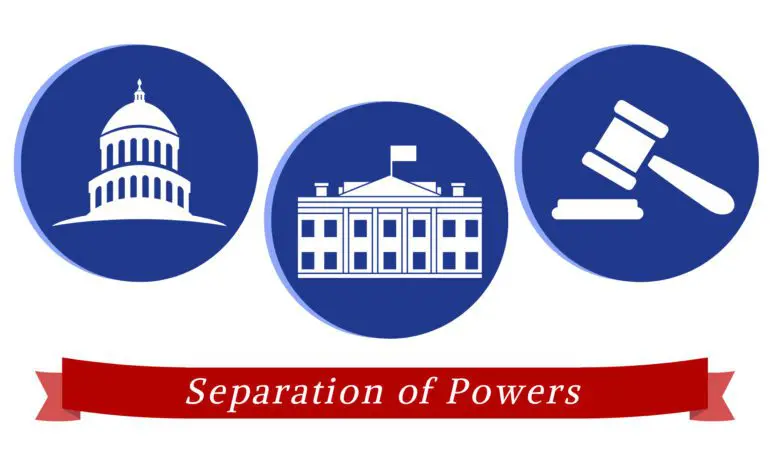

Checks and balances are essential to our representative democracy. Under our system of government, the legislative, executive and judicial branches provide balance and prevent each other from growing too powerful. The American people have supported this arrangement.
My concern is that the checks and balances have eroded. The system is under strain, and this feature of our government requires more attention than it gets.
The battle is not lost, we still have three branches of government. Congress and the courts sometimes rise to the occasion and limit what the executive branch can do. But the growing power of the presidency has become a real problem. It’s time to raise an alarm flag about the direction in which our country is going.
The growing power of the presidency has become a real problem, one our founders feared and our institutions now struggle to contain.
America’s founders were learned men who thought seriously about the purpose and structure of government. Drawing on the work of French political theorist Montesquieu and others, they crafted a constitution that assigns the powers of government to distinct executive, legislative and judicial branches.
But separation of powers wasn’t enough to ensure liberty, James Madison wrote in one of his influential essays known as the Federalist Papers, and each branch of government needed to check the others. “Ambition must be made to counteract ambition,” he wrote, recognizing that presidents, legislators and judges would try to expand their power.
Ambition must be made to counteract ambition, the founders understood that only competing powers could preserve liberty.
Under the Constitution, the president can check the legislative branch by vetoing legislation. Congress can override the veto with a two-thirds vote. Courts can declare legislation and executive action unconstitutional. The president appoints judges, and the Senate confirms them. Congress can approve or reject spending.
Congress also has an important role in overseeing the executive branch. As I explained in a recent commentary, congressional oversight can inform the American people about the workings of government, erect guardrails against presidential overreach and expose misconduct. Unfortunately, that kind of oversight has too often become an afterthought.
The system of checks and balances has served us well, but it has always been a source of tension. New presidents take office with big ideas. They want to get things done, and they don’t want Congress and the courts to put up roadblocks. The growing importance of foreign affairs and other factors has increased presidential power, a trend the historian Arthur Schlesinger wrote about 50 years ago in his book The Imperial Presidency.
It’s true that, in today’s world, events sometimes call for a quick response, and the executive branch is best suited for that. But we shouldn’t forget that the Constitution gives the legislative branch an important role in foreign affairs. Congress enacts laws and provides funding for military action and diplomacy. The Senate must ratify treaties. Importantly, only Congress can declare war. The founders put Congress first in the Constitution because it would be the branch that would be closest to the people.
President Trump has challenged our system of checks and balances. He shows little appreciation for Congress and the courts and seems to expect them to defer to him. He governs by executive order, uses government to punish his adversaries and acts audaciously without consulting Congress.
With Trump’s fellow Republicans in the majority, the legislative branch often puts up little resistance. The Supreme Court has also been deferential, often using its so-called shadow docket to greenlight the president’s actions. Fortunately, we’re starting to see signs that Congress has its limits and will push back. Hopefully, it will see the current situation not just as a challenge but as an opportunity to assert itself.
Madison warned that concentrating power in a few hands is the very definition of tyranny — and that warning has never felt more urgent.
Madison wrote that concentrating power in a few hands is “the very definition of tyranny.” It’s up to Congress to check the power of the executive branch, and it’s up to the American people to ensure Congress does its job.
– Lee Hamilton is a distinguished scholar at the IU Hamilton Lugar School of Global and International Studies and senior advisor for the Indiana University Center on Representative Government. He was a member of the U.S. House of Representatives for 34 years.



Leave a Reply