




By Mohamad Ozeir
This week marked the first anniversary of President Trump’s return to the White House for a second term, after a forced four-year interruption. That comeback was loaded — during those loud and turbulent years — with authoritarian promises, racist delusions, totalitarian programs, distorted ideas and hotheaded impulses that sought, in the opening decades of the 21st century, to push America back into the tunnels of chauvinism and exclusionary “national” identities — those same currents that swept through Europe in the second half of the 19th century and, with instinctive enthusiasm, led it into two devastating world wars in the first half of the 20th century.
With some simplification — but with considerable accuracy — it can be said that this anniversary was not at all what those who celebrated passionately on January 20, 2025 had envisioned. Over the last twelve months, many illusions have evaporated, major plans have collapsed and countless schemes have been tried. Yet the bloated populist mountain — swollen with extremism, arrogance and shamelessness — produced, in reality, a grotesque mouse that inspires contempt and disgrace (for it deserves no pity), instead of the promised white giant that had tickled the primitive racial and religious instincts of the descendants of European colonizers and settlers. These were people who saw in the slogan “Make America Great Again” a serious promise — one capable of turning back the wheel of history and returning America to eras of dominance, segregation, racial apartheid and even earlier atrocities.
Exactly one year ago — amid celebratory applause that continued uninterrupted since the announcement of the 2024 election results — South African-born billionaire Elon Musk was sharpening his electric chainsaw to become the symbol of smashing the pillars of the modern “welfare state” under the slogan of ending waste and fraud. His newly allied fellow billionaires lined up in Washington seeking favor, while his older colleagues in Silicon Valley raised their glasses to the ascent of one of their own (J.D. Vance) to the vice presidency. Major media institutions, academic bodies and human rights organizations rushed to offer their obedience to “the strongman.” And the Republican majority in both chambers of Congress openly declared its willingness to surrender legislative power to him.
In that moment, Trump’s supporters expected the first anniversary of his return to resemble the Nazi Nuremberg rallies — those mass parades that gathered to salute Führer Adolf Hitler in southern Germany after his peaceful rise to power in 1933.
But what happened this week was the exact opposite.
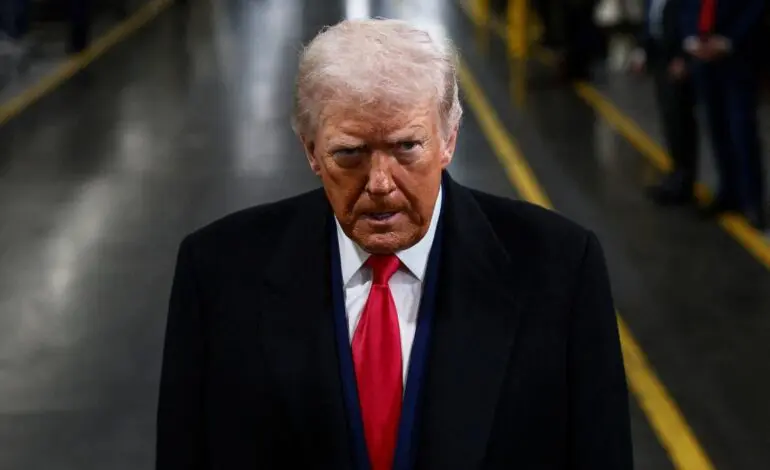
A semi-isolated president spends most of his time staring at his mobile phone screen, obsessed with posting and responding on social media. He lashes out at world leaders through interventions that beg for media attention — attention that has become the remaining objective of a presidency that completed its first quarter in a state of frustration, lethargy and fragmentation.
To such a degree, in fact, that Trump himself sent a bizarre message to the Norwegian prime minister, writing:
“Dear Jonas: Considering your Country decided not to give me the Nobel Peace Prize for having stopped 8 Wars PLUS, I no longer feel an obligation to think purely of Peace, although it will always be predominant, but can now think about what is good and proper for the United States of America. Denmark cannot protect that land from Russia or China, and why do they have a ‘right of ownership’ anyway? There are no written documents, it’s only that a boat landed there hundreds of years ago, but we had boats landing there, also. I have done more for NATO than any other person since its founding, and now, NATO should do something for the United States. The World is not secure unless we have Complete and Total Control of Greenland. Thank you! President DJT”
That message came after a post in which he announced the imposition of additional tariffs of 10 percent on imports from 10 European countries — among them France, Britain, Italy and the Scandinavian states — because they do not support his position on annexing Greenland. It also came two days after he enthusiastically accepted at the White House the Nobel Peace Prize — handed to him by Venezuelan opposition figure Maria Corina Machado.
What president — or what official — could behave this way?
“The world is not secure unless we have complete and total control of Greenland.” – President Trump
On the popular level, opinion polls conducted by numerous institutions reveal that Trump’s approval rating has deteriorated from 52 percent to 36 percent in a single year — the lowest approval level recorded for any president at the end of the first year of a term. Trump’s numbers were negative across all categories and among nearly all groups, with the exception of his conservative base, which still supports him at an exceptionally high rate approaching 90 percent.
Yet 55 percent of respondents in a poll conducted by CNN said Trump’s policies have made economic conditions worse, while 64 percent said he has not done enough to improve the economy. Two-thirds of respondents believe Trump does not place the country’s interests above his personal interests.
Even on issues that should theoretically be attractive or politically profitable for the administration, the numbers remain similarly weak. Support for the attack on Caracas and the arrest of Venezuelan President Nicolás Maduro did not exceed 40 percent. Support for Trump’s immigration approach and the security campaigns targeting undocumented immigrants ranges between 35 percent and 38 percent. As for support for his tariff policies, it stands at just 32 percent.
Legislatively, despite conservatives holding majorities in both chambers of Congress, Republicans have not succeeded in maintaining total loyalty to Trump. The House of Representatives saw three cases of “forced voting” — a procedure that compels House leadership to bring a bill to the floor. While the first case concerned funding for an irrigation project in the Arkansas Valley, the other two attracted far greater attention because they involved votes on:
-
publishing files related to the wealthy convicted sex offender and human trafficker Jeffrey Epstein (a friend of Trump), and
-
extending support for universal health insurance known as “Obamacare.”
The House also witnessed the resignation of prominent members of Trump’s alliance following a public dispute with him.
In the Senate, members voted on legislation preventing the president from taking any military action against Venezuela — or any other country — without first obtaining legislative approval. (This legislation came after the raid on Caracas.)
Judicially, the wave of court rulings against Trump’s administration and its policies continues across all sectors. The lawsuits in progress range across wrongful termination of public employees, defunding government programs, targeting the president’s political opponents through malicious prosecutions, deportation orders involving undocumented immigrants, the deployment of federal forces in cities and states governed by Democrats and attempts to financially blackmail states to force cooperation with the administration.
The state of California alone has won 48 cases out of 52 filed against Trump during the past year, while waiting for decisions on the remaining four lawsuits. Meanwhile, informed legal circles await two critical Supreme Court rulings: one concerning the president’s authority to remove heads of independent federal agencies and another concerning the legality of Trump’s arbitrary tariff decisions.
The populist mountain gave birth to a humiliating mouse.
Historically, any academic or observer can recognize that authoritarian, despotic and totalitarian models — regardless of their origins or the circumstances of their birth — cannot normalize within the very climate they were created to attack. They do not belong to the broader context. If they fail to achieve the desired transformation and change the landscape quickly, they lose momentum, appeal and followers. They become a floating body tossed by storms — and quickly, escape and abandonment operations begin, especially when the political environment remains experienced, aware and resistant to emotional submission, because it has not lost all the elements of its civil society at the moment of populist ascent — particularly its media, human rights and protest components built over decades of public work and democratic practice.
One year into Trump’s second term, he has little left except the old-new talisman of media flooding — something Trump practices obsessively. But tweets alone are not enough to rescue a project that has ended.
And that leaves one crucial question: How can the damage he has inflicted on America, domestically and internationally, be contained?
– Mohamad Ozeir is a regular contributing writer for The Arab American News in the Arabic section.



Leave a Reply