



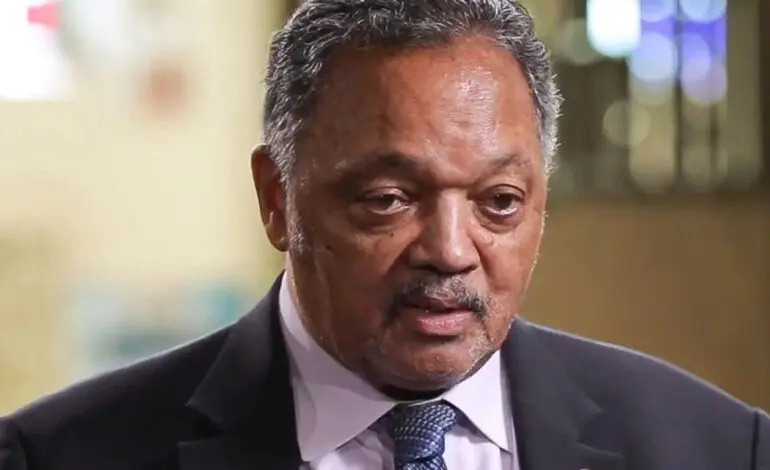

CHICAGO — The Rev. Jesse L. Jackson Sr., the fiery preacher-turned-power broker who carried the civil rights movement into the post–Martin Luther King Jr. era and reshaped modern Democratic politics with two groundbreaking presidential campaigns, died Tuesday, February 17, at 84, according to multiple news reports citing family and organizational statements.
Jackson’s death comes after years of public health struggles, including Parkinson’s disease and progressive supranuclear palsy (PSP), a rare neurodegenerative disorder that had increasingly limited his public appearances.
A protégé of King who became a movement in his own right
Born October 8, 1941, in Greenville, South Carolina, Jackson rose from the segregated South to become one of the nation’s most recognizable voices for racial and economic justice — an orator known for call-and-response cadence, moral certainty and a knack for turning protest slogans into political language.
He entered the civil rights struggle as a young organizer and soon worked closely with Dr. Martin Luther King Jr. within the Southern Christian Leadership Conference (SCLC). He was among those near King in his final days and, after King’s assassination, emerged as a central figure in continuing and expanding the movement’s agenda beyond desegregation — toward jobs, voting power and economic leverage.
Operation Breadbasket, PUSH and the politics of economic pressure
In Chicago, Jackson became a major civic force by fusing street-level activism with boardroom negotiation. He helped popularize strategies that pushed corporations and institutions to hire Black workers, buy from Black-owned businesses and invest in long-neglected neighborhoods — tactics that supporters credit with opening doors for minority participation in corporate America and public contracting.
Over time he founded organizations that became synonymous with his brand of coalition politics, including Operation PUSH (People United to Save Humanity) and later the Rainbow/PUSH Coalition, a vehicle for voter mobilization, economic justice campaigns and national advocacy based in Chicago.
Historic presidential runs that broadened the Democratic map
Jackson’s influence reached its peak in electoral politics with his 1984 and 1988 bids for the Democratic presidential nomination — campaigns that proved a Black candidate could mount a serious national run, win primaries and assemble a multiracial “Rainbow Coalition” of Black voters, progressives, labor, Latinos and parts of the anti-war movement.
While he did not win the nomination, his campaigns pushed the party’s center of gravity on civil rights, voting access, poverty and representation — building organizational muscle and political confidence that later generations of candidates would inherit.
Global spotlight: diplomacy, prisoners and controversy
Jackson also cultivated an international profile, sometimes operating in the gray zone between activism and unofficial diplomacy — efforts that news accounts have long noted included advocacy and negotiations connected to the release of detainees abroad. Admirers saw humanitarian pragmatism; critics argued he blurred lines that elected officials should police.
His long career was not without controversy at home, including political feuds, questions about influence and personal scandal that periodically threatened to eclipse his public work. Even so, he remained — especially in Chicago — an enduring institution, capable of drawing cameras, crowds and presidents into his orbit.
Health battles in his later years
Jackson disclosed in 2017 that he had Parkinson’s disease and later reports detailed additional complications, including PSP — an illness that can affect movement, speech, swallowing and balance. In recent years he was hospitalized multiple times and appeared less frequently in public, often in a wheelchair or with assistance.
On Tuesday, family statements cited by major outlets said he died peacefully surrounded by relatives.
Tributes and legacy
Jackson received some of the country’s highest civic recognition during his lifetime, including the Presidential Medal of Freedom in 2000, and remained a reference point for politicians across the spectrum whenever debates turned to civil rights, coalition building and the moral language of politics.
In death, reactions poured in from political leaders, community organizations and longtime allies, reflecting a life that straddled the pulpit, the picket line and the campaign trail.
What’s next: services and public mourning
Chicago outlets reported that more details about memorial services were expected as family and organizers finalize plans.
Jackson is survived by his wife, Jacqueline Jackson, and their children, including Jesse Jackson Jr. and Jonathan Jackson, according to widely published biographical accounts.
Local officials, community mourns his death; he was a great ally
“The Arab American Civil Rights League is deeply saddened by the loss of a giant in the civil rights arena, Reverend Jesse Jackson,” said Nabih Ayad, founder of the Arab American Civil Rights League (ACRL) in a statement. “Jesse was not only a civil rights leader for African Americans, but for Arab Americans and all Americans who stood up against injustice. His courage, compassion, and unwavering commitment to justice made him a unifying force for all communities seeking equality.
“Rest in peace, Brother Jesse. Your legacy will continue to move millions toward justice for all mankind.”
Governor Whitmer and Lieutenant Governor Gilchrist issued the following statements on Jackson’s passing:
“Today, we mourn the loss of Reverend Jesse Jackson, a fierce advocate for justice, equality and prosperity for all,” Whitmer said. “He dedicated decades of his life to advancing civil rights and economic opportunity for the working class in the United States and around the world.
“Rev. Jackson had a special connection to Michigan and especially the city of Detroit. He visited often, standing with labor, working with local leaders and inspiring the next generation of changemakers. I was honored to meet and partner with him on our shared goals of investing in working people and ensuring every Michigander is treated with dignity and respect.”
“Reverend Jesse Jackson was a once-in-a-lifetime leader who believed in the power of ordinary people to win the ongoing battle for justice, equality, and freedom,” Gilchrist said. “He fought tirelessly for these values with purpose and vision as part of the civil rights movement in America and against persecution across the globe throughout his entire career. He loved Michigan, spending time in our communities and with our people.”
U.S. Rep. Debbie Dingell (D-Ann Arbor) released a statement recalling Jackson’s contributions and longtime friendship:
“I am heartbroken by the passing of Reverend Jackson,” Dingell said. “For more than 50 years, our family has known and worked alongside him and his family in the long struggle for justice and equality. John stood with him in the 1960s, when both were young men marching in the streets and organizing in communities to advance civil rights and human dignity. They shared a belief that America could — and must — live up to its promise.
“We have lost a giant in the movement for civil rights, but his legacy lives on in every young person he encouraged, every community he empowered, every industry he worked with and every barrier he helped break down. My heart is with the Jackson family, whom I love dearly. May we honor his life by continuing the work he so passionately advanced.”



Leave a Reply