



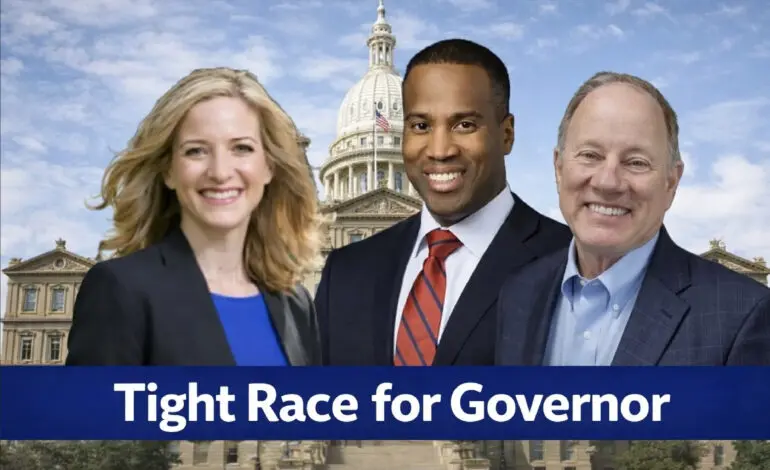

DETROIT — Despite varying results, multiple polls suggest that Michigan’s gubernatorial race is shaping up to be an exceptionally close contest between three leading figures: Secretary of State Jocelyn Benson (Democrat), U.S. Rep. John James (Republican) and independent candidate Mike Duggan.
Although the Democratic and Republican nominees will not be officially determined until the August primaries, polling consistently identifies Benson as the Democratic frontrunner and James as the leading Republican contender, despite crowded primary fields in both parties.
Duggan leads in latest chamber-backed poll
Assuming all three advance to the November general election, three separate polls have produced varying but closely aligned results. The most recent survey, conducted by the Glengariff Group on behalf of the Detroit Regional Chamber, showed Duggan narrowly leading.
The poll, conducted between January 27 and February 2 among 600 likely voters, found Duggan at 30.1 percent, compared with 28.9 percent for James and 28 percent for Benson. About 13 percent of respondents remained undecided.
Detroit Regional Chamber President Sandy Baruah said he was “truly surprised” by Duggan’s rising popularity, noting that the former mayor had moved from third place in earlier surveys to first.
Duggan’s campaign manager, Ed Duggan, said the poll reflects voter fatigue with traditional partisan politics.
“Most Michigan voters are tired of Democrats and Republicans attacking each other,” he said, arguing that Duggan represents “the best opportunity to bridge political divides in Michigan.”
He added that increased criticism from Democrats has only boosted Duggan’s support, asserting that “both parties underestimate how frustrated Michigan voters are.”
Skepticism over Duggan’s surge
Democratic and Republican officials alike have questioned the credibility of the Chamber-backed poll, citing the organization’s endorsement of Duggan.
Michigan Democratic Party Chair Curtis Hertel criticized the survey, saying the Chamber has openly supported Duggan and regularly promotes his candidacy.
“The idea that they’re not part of his campaign is simply not true,” Hertel said, describing the poll as an internal survey intended to demonstrate Duggan’s viability.
Another poll conducted in January for the Detroit News and Local 4 showed James leading with 33.8 percent, followed by Benson at 32.2 percent and Duggan at 26.1 percent.
Benson spokesperson Maggie Amjad described the race as “extremely close” and emphasized that nothing should be taken for granted. She pointed to Benson’s electoral track record, noting that she has consistently expanded her coalition and won counties that other Democrats had not.
Benson’s campaign has also promoted an internal poll conducted by Impact Research showing her at 39 percent, three points ahead of James and 19 points ahead of Duggan. The campaign argues that Duggan’s support may be nearing its ceiling despite significant advertising expenditures from allied groups.
Political observers, however, often treat internal campaign polls with caution, as they are frequently released strategically to shape public perception.
Andrea Bitely, a Duggan campaign strategist, countered that independent polling consistently shows Benson hovering around 30 percent, calling the Impact Research survey the only exception and noting it was funded by Benson herself.
James campaign spokesperson Hannah Osantowski similarly dismissed the Chamber survey as effectively internal, citing what she characterized as the organization’s bias toward Duggan. She described James as “the experienced conservative leader Michigan needs to restore freedom, opportunity and integrity.”
Regional divides emerge
Speaking at a press conference following the Chamber poll release, Richard Czuba, founder of the Glengariff Group, said Duggan has made significant gains in the Detroit metropolitan area, where he enjoys strong name recognition.
Czuba noted that Duggan remains weaker in rural regions, where he still trails James by a wide margin, but suggested there remains room for growth.
“His real strength appears to be in the Detroit metro area,” Czuba said, pointing to gains in Wayne, Oakland and Macomb Counties.
According to the survey, James leads outside the Detroit metro area, while Duggan leads within it. Benson ranks second in both regions.
The poll also found Duggan performing strongly among independent voters, capturing 48 percent of their support compared to 9 percent for Benson and 7 percent for James, with roughly one-third undecided.
Duggan also draws more support from Democratic-leaning voters than Republican-leaning ones, raising concerns within the Democratic Party about retaining the governor’s office currently held by Democrat Gretchen Whitmer, who has served since January 2019.

A historically unusual race
This year’s gubernatorial contest is considered historically unusual due to the presence of a formidable nonpartisan candidate. Duggan, who served 12 years as Detroit mayor and left the Democratic Party in late 2024, is seeking to leverage his record in Detroit’s economic turnaround as the foundation of an independent bid.
To appear on the November ballot, Duggan must submit 12,000 valid signatures from registered Michigan voters. By contrast, James and Benson must first secure their respective party nominations in the August statewide primaries.
On the Democratic side, Benson faces Genesee County Sheriff Chris Swanson, former Cape Coral, Florida Mayor Marnie Sawicki and biochemist Kevin Hogan. Lt. Gov. Garlin Gilchrist II recently withdrew from the gubernatorial race to run for secretary of state.
On the Republican side, James competes with former Michigan Attorney General Mike Cox, former State House Speaker Tom Leonard, State Senate Minority Leader Aric Nesbitt and businessman Perry Johnson.
With early polling showing razor-thin margins and significant regional divides, Michigan’s 2026 gubernatorial race is poised to become one of the most closely watched contests in the country.

Leave a Reply