



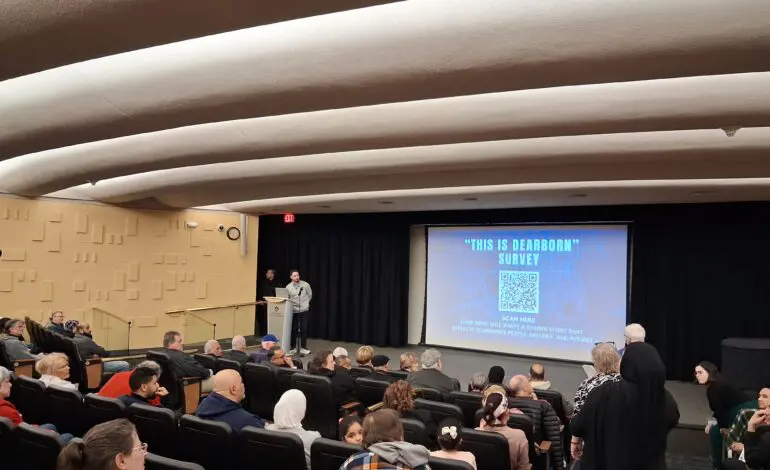

DEARBORN — In an open meeting with residents Wednesday evening, Mayor Abdullah Hammoud reviewed his administration’s latest accomplishments, presenting an ambitious roadmap for the city’s future before taking time to hear questions and concerns from attendees at the Henry Ford Centennial Library.
In his opening remarks, Hammoud outlined key strategies his administration has adopted to develop sustainable solutions to long-standing challenges, while advancing municipal service digitization, launching community initiatives and leveraging federal grants to support development — all while maintaining fiscal discipline aimed at reducing the tax burden on residents.
Addressing the flooding crisis
Hammoud gave priority to the issue of flooding, offering a detailed overview of the unconventional solutions his administration has pursued since taking office in early 2022.
He said the city did not wait for outside agencies to act, instead allocating $1 million to remove more than 50 debris blockages along the Rouge River. This effort reduced water levels and increased flow speed by 70 percent without the need to construct additional drainage channels.
Hammoud also highlighted what he described as a “green infrastructure strategy”, launched about a year ago with a pilot project on Morrow Circle Street in east Dearborn.
The conversion of 24 residential easements along Morrow Circle into bioswales engineered to absorb up to 40,000 gallons of water in a single storm event; and investments in green infrastructure and permeable surfaces at parks and green spaces.
As part of what he called “smarter infrastructure solutions”, Hammoud announced securing a federal grant to install four flap gates and two pumps that will act as backflow preventers, protecting roughly 13,600 residents from basement flooding during heavy rains, similar to the 2021 storm, which flooded some 20,000 homes in under 24 hours.
Construction is expected to begin soon in the area surrounding Michigan Avenue and Chase Road, covering approximately 3,500 homes.
Hammoud emphasized that this project — like others — will be funded through federal and state grants, without relying on local tax revenue, reinforcing his administration’s approach to easing the tax burden on property owners.
On the strategic planning front, Hammoud revealed findings from a comprehensive two-year study evaluating the efficiency of Dearborn’s stormwater system. He acknowledged that the current system, originally designed to handle 3.5 inches of rainfall within 24 hours, is no longer adequate in the face of extreme climate changes.
Addressing this gap, he said, would require doubling or tripling the city’s capacity — a goal his administration is translating into a $500 million infrastructure plan over the next decade.
Support for new families
Hammoud also highlighted Dearborn’s leadership in implementing the RX Kids program, which provides thousands of dollars in support to pregnant women and newborns in the city — which he described as the “birth capital” of Michigan due to its high birth rate.
He explained that the program acts as a “cash prescription”, granting mothers $1,500 during pregnancy, followed by monthly payments of $500 during the baby’s first six months.
Eligibility is open to all Dearborn residents without bureaucratic restrictions or income requirements.
Hammoud said the program has already attracted around 900 families and distributed approximately $2 million, noting that while modest, these funds help cover essential needs.
He added that the program has achieved near 100 percent participation due to its ease of access compared to other assistance programs.
Urban redevelopment
On development, Hammoud reported significant progress in plans to redevelop what he referred to as the “three residential blocks” — the former Oakman Boulevard apartments demolished last year, the Village Plaza building undergoing demolition and the long-abandoned Hyatt Regency hotel.
He described these sites as long-standing challenges since taking office, noting that the Oakman apartments project in east Dearborn is now moving through legal phases ahead of redevelopment.
The city also recently resolved legal challenges surrounding the demolition of Village Plaza in west Dearborn, clearing the way for redevelopment preparations.
Regarding the vacant Hyatt Regency hotel, Hammoud announced a comprehensive development agreement with its new owner to transform the iconic structure into a mixed-use residential and commercial complex featuring approximately 200 hotel rooms and 200 residential units.
In parallel, the mayor outlined a forward-looking vision for reimagining public libraries, including a $10 million project to transform the Esper Library on Warren Avenue into a modern children’s learning center.
The library is expected to close for about one year, with completion targeted for spring 2027.
Additional initiatives
To strengthen direct engagement with residents, Hammoud discussed the introduction of a “neighborhood and business district coordinators” system, designed to serve as a direct communication channel between the city, residents and business owners.
In response to what he described as a “cleanliness crisis” that worsened after the COVID-19 pandemic, Hammoud announced the formation of dedicated field crews to collect waste from parks and municipal facilities and clean major roads such as Telegraph and Ford Roads — addressing maintenance gaps typically handled by the state and Wayne County.
Digital transformation of city services
In a major shift toward digital governance, Hammoud announced the consolidation of municipal communication channels under the 311 system, allowing residents to connect directly with customer service representatives or interact with an advanced AI-powered assistant.
He said the new platform (dearborn.gov/311) now handles all public works requests, from tree planting and trimming to pothole repairs and park maintenance, with the ability to upload photos and location data for accuracy.
In administrative modernization, Hammoud announced a full transition of the city’s permitting system from paper-based processes to 100 percent digital operations through the BS&A platform.
A temporary service pause is scheduled next week to complete the transition. The new system will allow not only online applications and payments, but also inspection scheduling and real-time updates.
He also highlighted the recent launch of the TextMyGov platform, enabling residents to receive real-time updates on city services and neighborhood developments via text message.
Rebranding the city
As part of a broader effort to redefine the city’s identity, Hammoud announced a new initiative to redesign Dearborn’s logo, replacing the current “D” within a hexagonal shape, which he described as failing to reflect the city’s character and unique identity.
Unlike a previous effort led by the Downtown Development Authority, the new initiative will be managed directly by the city, with residents and stakeholders playing a central and equal role in shaping the new brand.
Financial stability
In closing, Hammoud outlined the framework of the upcoming fiscal year budget, emphasizing that Dearborn is experiencing a level of financial stability not seen in decades.
He noted that expenditures now closely match revenues and highlighted a significant achievement: the city has recorded its lowest property tax rate in 15 years, dropping from 61 mills to approximately 51 mills — now lower than neighboring Dearborn Heights.
Hammoud attributed part of this success to the performance of the city’s Office of Philanthropy and Grants, established under his administration, which has secured nearly $200 million in government grants over four years — surpassing the city’s total general fund budget of $150 million.
At the conclusion of the meeting, attended by approximately 100 residents, Hammoud took questions from the audience, reaffirming his commitment to transparency and direct engagement with residents and business owners across the city.



Leave a Reply