



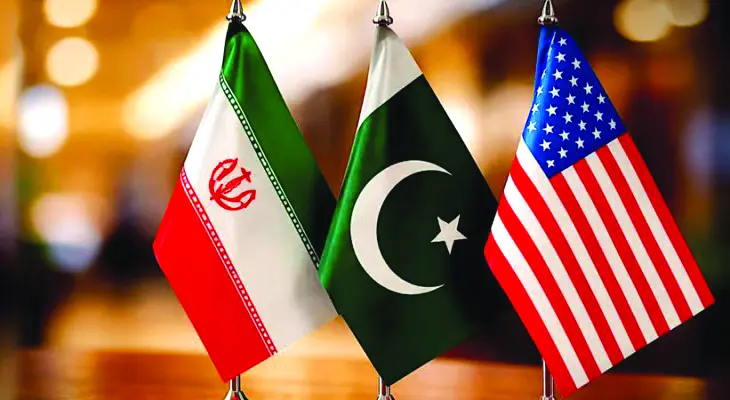

Forty days after refusing to negotiate with the United States, and amid President Trump’s escalating rhetoric and foul language, which reached the level of threatening to erase an entire civilization from the face of the earth, Iran agreed to begin indirect talks with the Americans in Pakistan’s capital, Islamabad, setting 10 key conditions as a basis for negotiations. Foremost among these is a two-week ceasefire across all fronts in the region, including Lebanon.
Just two hours before the Tuesday evening deadline Trump had set to destroy Iranian bridges and power generation facilities, he moved quickly via his platform Truth Social to accept Tehran’s offer for direct negotiations to end the war, opting to abandon escalation and avoid deeper entanglement in what has become an Iranian quagmire, especially following the destruction of U.S. aircraft during a rescue operation for a downed F-15 fighter jet in western Iran.
Recognizing the difficulty of subduing Iran militarily, and after failing to build an international coalition to help reopen the Strait of Hormuz, which remains under Iranian control, Trump appeared to seize the opportunity to step down from the ladder of threats he had climbed since launching “Operation Epic Rage.”
His shift triggered shock among Israel’s supporters and allies in the region, with many describing the move as a surrender to Iranian terms. Israeli Prime Minister Benjamin Netanyahu, meanwhile, attempted to sabotage the peace talks before they began by carrying out devastating massacres against civilians in Lebanon throughout Wednesday, in blatant violation of Tehran’s condition of a ceasefire in Lebanon as a basis for negotiations.
Multiple diplomatic sources, including Pakistani officials, revealed that Trump had initially agreed to a ceasefire that included Lebanon. However, the U.S. position shifted following a phone call between Netanyahu and Trump, after which the Israeli prime minister declared that no ceasefire would apply to Lebanon.
According to Pakistani officials, Iran had rejected any ceasefire proposal that did not include Lebanon and insisted that the Pakistani mediator secure confirmation from Washington that Lebanon would be included in a two-week ceasefire. After receiving U.S. assurances, Prime Minister Shehbaz Sharif announced the success of mediation efforts, explicitly stating that Lebanon was part of the agreement.
Following Trump’s reversal, Iran clearly linked the Islamabad negotiations to a halt in Israeli aggression against Lebanon, warning that it could collapse the entire negotiation process if the United States failed to compel Israel to stop its attacks.
Tehran also kept the Strait of Hormuz closed, pending a decision on the Lebanon ceasefire. CNN reported that traffic through the strait remains limited, with many ships still anchored in Gulf waters. This prompted Trump to call Netanyahu on Thursday, urging him to de-escalate in Lebanon, two days before the talks scheduled for Saturday, April 11 in Islamabad.
In a candid admission that developments in Lebanon could derail negotiations, NBC News quoted a U.S. official as saying that “Trump asked Netanyahu to reduce strikes on Lebanon to help ensure successful negotiations with Iran.” It was also reported that U.S. envoy Steve Witkoff contacted Netanyahu with the same request. Meanwhile, Israel’s Channel 13 cited Trump as saying Netanyahu would scale back fighting in Lebanon, though not halt military operations in the south.
Pakistan’s representative to the United Nations Security Council confirmed that “including Lebanon in the agreement was clearly part of the deal’s official statement”, adding that it was unclear why confusion later emerged. He stressed that “nothing should be allowed to obstruct negotiations, as they are extremely important.”
The road to negotiations
Shortly before the expiration of his deadline for Iran to reopen the Strait of Hormuz, and in what appeared to be an attempt to soften the perception of defeat and conceal the retreat from initial war objectives, Trump claimed that Pakistani officials had “requested” a delay of the “destructive force” planned against Iran that night.
He announced he had agreed to suspend attacks and bombardment for two weeks, conditional on Iran’s agreement to the “full, immediate and safe reopening” of the Strait of Hormuz. Trump again claimed that military operations had been halted because “we have achieved and exceeded all military objectives.
“We are very close to a final agreement on long-term peace with Iran and peace in the Middle East,” he added.
He described Iran’s 10-point proposal as “a negotiable foundation”, asserting that most points of contention had already been resolved, and that the two-week period would allow for finalizing the agreement.
On the Iranian side, the Supreme National Security Council declared a “great victory”, stating that the United States had been forced to accept Tehran’s 10-point plan. It said Iran and the “Axis of Resistance”, as “representatives of honor and humanity”, had delivered “an unforgettable lesson” to “the enemies of humanity”, destroying their forces, infrastructure and political, economic, technological and military assets to the point of collapse.
According to the statement, the plan includes:
- A commitment not to attack Iran again
- Continued Iranian control of the Strait of Hormuz
- Acceptance of uranium enrichment
- Lifting all primary and secondary sanctions
- Ending all U.N. Security Council and Board of Governors resolutions
- Compensation payments to Tehran
- Withdrawal of U.S. combat forces from the region
- Ending the war on all fronts, including against Lebanon
The council emphasized the need for patience and unity to consolidate this “victory.”
Iranian Foreign Minister Abbas Araghchi, speaking on behalf of the council, thanked Pakistani officials for their efforts to end the war. He said that if attacks on Iran ceased, Iranian armed forces would halt defensive operations, adding that safe passage through the Strait of Hormuz would be possible for two weeks under coordination with Iranian forces.
Trump had previously threatened to destroy Iran’s power stations and bridges and “return it to the Stone Age” if no agreement was reached.
“An entire civilization will die tonight,” he warned in a social media post “… 47 years of extortion, corruption and death will finally end.”
“We will cut off every finger raised in threat against the Iranian people,” Iranian Parliament Speaker Mohammad Bagher Ghalibaf replied.
Iran’s proposal explicitly rejected any temporary ceasefire, insisting instead on a complete end to the war, arguing that temporary truces would allow the U.S. and Israel to regroup militarily.
Meanwhile, China and Russia vetoed a draft U.N. Security Council resolution submitted by Bahrain regarding maritime security and reopening the Strait of Hormuz.
Negotiation complexities
Under a fragile truce, Iran’s negotiating delegation arrived in Islamabad on Friday, led by Araghchi and Ghalibaf, with the U.S. delegation expected to follow, led by Vice President J.D. Vance and envoys Steve Witkoff and Trump’s son-in-law, Jared Kushner.
The nuclear issue remains central, with Washington demanding:
- Transfer of 450 kilograms of highly enriched uranium
- Full cessation of Iran’s nuclear program
Iran, however, insists on its “non-negotiable principles”, with Atomic Energy Organization chief Mohammad Eslami rejecting limits on enrichment as “daydreams.”
Israel, acting as a third player, warned that the ceasefire is only a “pause”, with Netanyahu stating enriched uranium would leave Iran “either by agreement or renewed war.”
Massacres in Lebanon
Netanyahu — described by his Israeli critics as “failing” — escalated attacks on Lebanon in an apparent effort to derail negotiations. Israeli occupation forces launched their most intense airstrikes since September 2024, targeting more than 100 locations across Lebanon.
The strikes killed more than 200 people in one day and wounded around 1,000, bringing total casualties since renewed clashes with Hezbollah forces on March 2 to 1,888 killed and 6,092 injured. Israeli attacks on Lebanon have continued since the outbreak of the Gaza war in October 2023.
The assaults struck previously untouched residential areas, including parts of Beirut, Mount Lebanon, the Bekaa Valley and southern Lebanon, particularly the densely populated Hayy al-Sellom area in Beirut’s southern suburbs.
A crisis of missing people emerged, with victims trapped under rubble or unidentifiable due to severe injuries.
“Israel will continue to strike Hezbollah forcefully,” Netanyahu said the following day, despite reduced strikes.
Israeli media reported a full shift of air force resources toward Lebanon, with five divisions deployed up to nine kilometers inside Lebanese territory.
Netanyahu called for direct negotiations “under fire” with Lebanon, focusing on disarming Hezbollah.
Lebanese President Joseph Aoun said the only solution is a ceasefire followed by direct negotiations, noting strong international support.
However, Lebanese authorities opted for direct talks under U.S. sponsorship, while confirming Lebanon is not covered by any broader agreement.
The battlefield
Despite negotiations, Israeli siege tactics continue in an attempt to advance deeper into southern Lebanon.
In response, Hezbollah resumed operations, launching rockets and drones and engaging in close-range combat in Bint Jbeil, using “active defense” tactics reminiscent of the 2006 war.
Meanwhile, Netanyahu insists fighting will continue until “securing the north”, though Israeli settlers increasingly doubt that goal.
Israeli Channel 12 reported that while fighting continues, northern settlers recognize that it does not guarantee dismantling Hezbollah.


Leave a Reply