



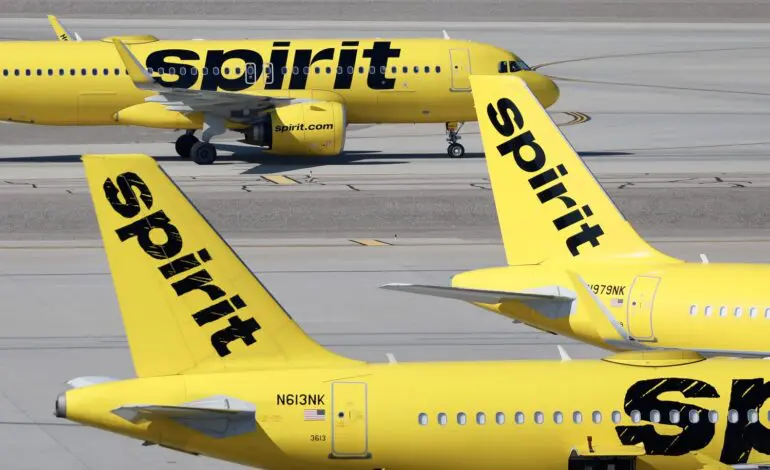

FORT LAUDERDALE — Spirit Airlines announced Sunday that it has ceased operations entirely after failing to secure a proposed $500 million federal rescue package, bringing an end to one of the most recognizable low-cost airlines in the United States.
Its parent company, Spirit Aviation Holdings, confirmed that it has begun implementing an orderly shutdown plan effective immediately, canceling all flights and advising passengers not to travel to airports beginning Sunday.
In a statement, the company said the decision followed extensive efforts to restructure operations and pursue deals aimed at strengthening its financial position and establishing a sustainable path forward. However, a sharp rise in oil prices in recent months, coupled with mounting operational pressures, severely worsened the airline’s financial outlook.
The company added that without additional financing, it had no option but to begin winding down operations.
Regarding passengers, Spirit said refunds for tickets purchased with credit or debit cards would automatically be issued back to the original form of payment. Travelers who booked through travel agencies were instructed to contact those agencies directly. Compensation for reservations purchased using vouchers or loyalty points will be determined later as part of the bankruptcy proceedings.
The shutdown marks a dramatic end for the airline best known for its bright yellow aircraft and “bare fare” business model, introduced in 2007, which offered low ticket prices while charging separately for services such as baggage and meals.
The company traces its origins to 1964 in Macomb County, where it began as a trucking company called Clippert Trucking.
In 1983, Ned Homfeld transformed the business into a charter airline known as Charter One Airlines before renaming it Spirit Airlines in 1992 and launching scheduled flights through Detroit Metropolitan Wayne County Airport.
In 1999, the airline relocated its headquarters to Fort Lauderdale to be closer to its primary Caribbean and Latin American markets, using Fort Lauderdale-Hollywood International Airport as its operational hub. Despite the move, Spirit continued serving Detroit Metro Airport, where it ranked second only to Delta Air Lines in passenger volume, carrying approximately 1.7 million passengers in 2025.
Spirit’s collapse comes amid worsening financial conditions. The airline filed for bankruptcy protection twice beginning in 2024 after accumulating more than $2.5 billion in losses since 2020.
The collapse of the first airline tied to surging jet fuel prices during the Iran war — now entering its third month — is expected to cost thousands of jobs. The shutdown also represents a political setback for President Trump, who had proposed allocating $500 million to rescue Spirit despite opposition from some of his closest advisers and many congressional Republicans.
In 2025 alone, Spirit laid off approximately 4,000 employees and eliminated 200 underperforming routes, ending the year with roughly 7,500 workers, including 2,000 pilots and 3,000 flight attendants.
The company again warned of severe financial uncertainty in August 2025 when it filed another bankruptcy disclosure stating that there was “substantial doubt” regarding its ability to continue operating.



Leave a Reply