



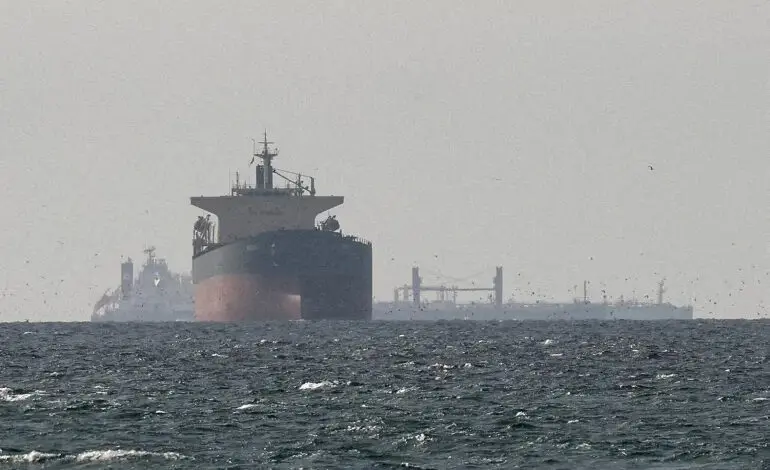

The language of war has once again overtaken all other discourse in the escalating U.S.–Iran confrontation, as President Trump renewed his call for Tehran to “surrender” after reviewing newly proposed military options targeting the Islamic Republic. This comes as Iranian forces continue to maintain effective control over the Strait of Hormuz, despite Washington’s counter-blockade targeting Iranian ports and maritime trade.
Yet Washington’s strategy — described by analysts as a “blockade of the blockade” — has placed Trump in an increasingly complex and open-ended predicament. By entering a high-risk “game of chicken” with Iran, the administration now faces mounting domestic pressure, particularly as fuel prices in the United States begin to approach record highs last seen during the 2022 Russia–Ukraine war. This surge is intensifying political strain on Trump and the Republican Party just months before the midterm congressional elections.
While Tehran continues to assert control over one of the world’s most vital maritime chokepoints in response to what it frames as a failed U.S.–Israeli war aimed at regime change, Trump has reverted to increasingly aggressive rhetoric. This comes amid Iran’s unwavering insistence on its nuclear rights and as the United States deploys unprecedented military reinforcements to the region.
Growing indicators suggest Washington may be preparing to resume large-scale military operations, with the past week witnessing a sharp escalation in mutual threats — placing the already fragile ceasefire at a decisive crossroads.
Military options on the table as Washington weighs escalation
On the political front, Trump, who is preparing to host Israeli Prime Minister Benjamin Netanyahu in Washington next week — has significantly raised both political and military rhetoric. He reiterated his commitment to preventing Iran from acquiring nuclear weapons “by any means necessary,” including the possibility of renewed war.
Despite the scale of ongoing operations, Trump has continued to reject labeling the confrontation a “war,” stating instead, “I do not call what is happening against Iran a war, but a military operation.” He added that such action “should have been undertaken long ago.” He further claimed that Iran is “very eager” to reach an agreement, while asserting that the details of any negotiations remain known only to him and a limited circle of officials.
At the same time, the commander of United States Central Command (CENTCOM) briefed Trump on a range of potential military scenarios. These reportedly include rapid, high-intensity airstrikes targeting Iran’s energy infrastructure, as well as specialized ground operations designed to deliver strategic blows within a short timeframe.
According to U.S. media reports, Trump is seriously evaluating military escalation as a parallel track to the ongoing comprehensive blockade, particularly in light of the slow progress in negotiations. ABC News cited a senior U.S. official confirming that the administration has initiated consultations with lawmakers regarding a potential congressional authorization for war with Iran — especially as more than 60 days have passed since the launch of what has been termed “Operation Epic Rage.”
In parallel, the Wall Street Journal reported that Washington is actively working to expand an international coalition tasked with securing maritime navigation and commercial shipping through the Strait of Hormuz — an effort that underscores growing concerns about global energy supply disruptions.
Israeli media has also pointed to unusual military activity. Channel 14 noted that “it does not require intelligence expertise to recognize that something significant is unfolding”, highlighting an unprecedented increase in U.S. military aircraft landings and takeoffs in Israel, alongside intense political and security consultations at the highest levels over the past 48 hours.
Israeli Defense Minister Israel Katz reinforced this narrative, stating that the expanding “air and sea bridge” is enhancing Israel’s operational capabilities and military superiority. He emphasized that ensuring the army has all necessary tools remains a top priority, enabling it to “return and act with full force against its enemies at any time and place.”
Further underscoring the scale of the conflict, a senior Pentagon budget official revealed that U.S. expenditures on the war with Iran have reached approximately $25 billion — representing the most comprehensive public estimate of the conflict’s cost to date. Acting Pentagon Comptroller Jules Hurst presented these figures during testimony before the House Armed Services Committee alongside Defense Secretary Pete Hegseth.
Negotiations falter amid competing visions
Diplomatic efforts have stumbled following Iran’s submission of what it described as a “comprehensive proposal” aimed at ending the war. The proposal was presented during Foreign Minister Abbas Araghchi’s recent visit to Pakistan.
According to the Iranian newspaper Etemad, the proposal outlines a phased approach. The first stage would involve a mutual declaration of war termination, followed by Iran reopening the Strait of Hormuz and establishing new mechanisms governing maritime transit and toll collection. In return, the United States would lift its naval blockade against Iran.
Subsequent phases would then address more complex issues, including Iran’s nuclear program, enriched uranium stockpiles and U.S. sanctions.
The proposal also included discussions in Oman, where Araghchi met with Sultan Haitham bin Tariq. Talks reportedly explored the possibility of joint management of the Strait of Hormuz, whose northern coast lies within Iran and southern coast within Oman. Oman also suggested involving Saudi Arabia in a legal consortium that would establish a new governance framework for the strategic waterway.
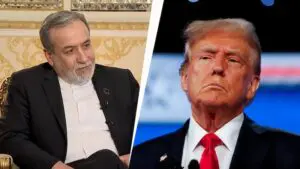
The Iranian minister said relations could improve if Washington adopted a respectful approach.
Iran’s approach reflects a “step-by-step” and “stage-by-stage” strategy, shaped by the failure of previous negotiations held in Islamabad in April, which collapsed under the weight of deep disagreements.
However, the U.S. administration appears divided over how to respond. One faction, reportedly led by Vice President J. D. Vance, favors a swift end to the conflict to minimize costs, while another, led by Defense Secretary Hegseth, advocates maintaining pressure through continued blockade and military readiness.
Despite the proposal offering a potentially low-cost exit strategy, it faces significant political obstacles. Domestic critics increasingly portray the conflict as “Israel’s war”, arguing that Washington became entangled under pressure from Tel Aviv. Accepting a deal that merely restores pre-war maritime conditions without securing concessions on Iran’s nuclear program could expose the administration to further criticism.
A major unresolved issue remains the future governance of the Strait of Hormuz. Washington seeks a return to the status quo ante without Iranian oversight, while Tehran insists on establishing a new regulatory framework reflecting its strategic leverage.
Iranian Defense Ministry spokesman Reza Talaei-Nik emphasized that post-war maritime activity would be governed by protocols ensuring Iran’s security. He also stressed that Iran does not consider the war over and has updated its target bank accordingly. He added that the Islamic Revolutionary Guard Corps secures the western portion of the Strait, while Iranian forces control the eastern side.
Iranian media, including outlets close to the Revolutionary Guard, argue that the war — originally intended by the United States and Israel to dismantle Iran — has instead shifted the regional balance of power in Tehran’s favor. They emphasize that Iran’s control over the Strait of Hormuz may be more strategically significant than nuclear capabilities.
Escalating Iranian rhetoric and regional messaging
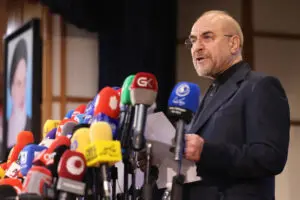
Iranian Parliament Speaker Mohammad Bagher Ghalibaf
Iranian Supreme Leader Mojtaba Khamenei declared that the Persian Gulf is entering “a new chapter free of American presence”, framing recent developments as a humiliating defeat for the United States.
He argued that U.S. military presence is the primary source of instability in the region and asserted that regional countries share a common destiny that excludes external powers.
President Masoud Pezeshkian reiterated Tehran’s willingness to resume diplomacy, provided Washington changes its behavior, while condemning what he described as “American piracy” targeting Iranian vessels.
Parliament Speaker Mohammad Bagher Ghalibaf echoed these sentiments, arguing that Iranian management of the Strait would ensure a future free from U.S. interference.
On the military front, a senior Revolutionary Guard commander warned U.S. forces that Iran would respond with “painful, prolonged and wide-ranging strikes”, even against short-term operations.
Lebanon: Political pressure meets battlefield escalation
In Lebanon, a parallel dynamic is unfolding, as the government led by President Joseph Aoun and Prime Minister Nawaf Salam faces mounting pressure between political concessions and ongoing resistance operations.
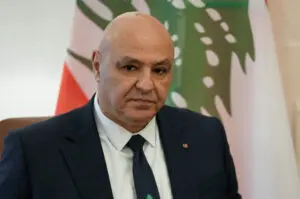
Lebanese President Joseph Aoun
The U.S. Embassy in Beirut has urged a direct meeting between Aoun and Netanyahu, framing it as a “historic opportunity” to secure sovereignty guarantees, humanitarian aid and reconstruction support.
According to Reuters, Aoun has privately expressed openness to normalizing relations with Israel as a means of ending the war. However, internal divisions have complicated such efforts, particularly after Parliament Speaker Nabih Berri publicly criticized Aoun’s statements as inaccurate.
On the ground, Israeli forces have expanded evacuation warnings beyond previously defined buffer zones, increasing pressure on civilian populations and raising fears of renewed displacement.
Meanwhile, resistance forces have intensified operations against Israeli troops and northern settlements, relying heavily on precision drone strikes targeting armored vehicles and troop concentrations. These operations reflect a tactical shift combining accuracy with sustained pressure aimed at exhausting Israeli military capabilities.
Israeli forces have also escalated systematic demolition of homes and infrastructure in southern border areas, in what observers describe as a campaign of “urban erasure” intended to reshape the region’s demographic and geographic reality.
Iraq: Political compromise ushers in new leadership
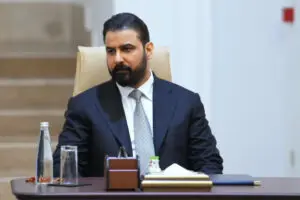
Iraqi Prime Minister-designate Ali al-Zaidi
In Iraq, political forces have reached a compromise following months of internal divisions. The Coordination Framework has nominated businessman Ali al-Zaidi as its candidate for prime minister, after disagreements between outgoing Prime Minister Mohammed Shia al-Sudani and former Prime Minister Nouri al-Maliki prevented either from securing the position.
President Nizar Amidi has formally tasked al-Zaidi with forming a government within 30 days.
Al-Zaidi, a 40-year-old businessman from Dhi Qar with a background in law and banking, presents himself as an economic manager rather than a traditional politician. While supporters argue this gives him an advantage in governance, questions remain about his financial networks and their intersection with politics.
His task is further complicated by Iraq’s deep entanglement in regional dynamics, as the country faces increasing U.S. pressure while Iran seeks to consolidate its influence — particularly amid perceptions in Tehran that the outcome of the conflict has worked in its favor.


Leave a Reply