



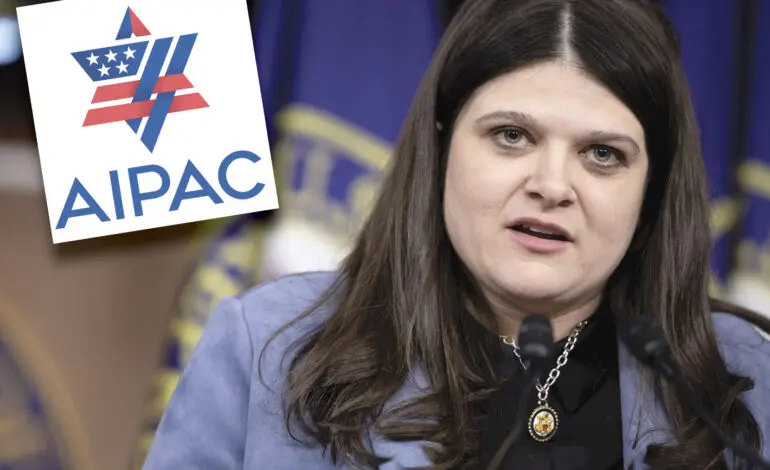

DETROIT — Amid an increasingly fierce Democratic primary battle for Michigan’s open U.S. Senate seat, U.S. Rep. Haley Stevens received more than $5 million in mysterious outside support last week aimed at boosting her standing against her Democratic rivals Abdul El-Sayed and State Senator Mallory McMorrow less than three months before the August 4 primary election.
The support for Stevens, who has represented Michigan in Congress since 2019, came through a previously unknown organization that reserved approximately $5.3 million in advertising purchases scheduled to air across major Michigan media markets through the end of May.
The ads purchased by the Center for Democratic Priorities Inc. tout Stevens’ efforts to “hold ICE accountable.” They praise Stevens for calling for federal oversight of immigration enforcement agencies. In one television spot, a narrator says Stevens is pushing legislation to create an independent special prosecutor to investigate alleged misconduct by the U.S. Department of Homeland Security.
Questions swirl over possible AIPAC-linked influence as Abdul El-Sayed and Mallory McMorrow intensify attacks on Stevens
The advertisement also features footage of the Birmingham-based congresswoman saying, “This is about holding an agency accountable that has never been held accountable.”
The group, the Center for Democratic Priorities Inc., placed the ad buy in the Detroit, Grand Rapids, Flint, Lansing and Traverse City media markets. The ads are scheduled to run from May 9 through May 31.
The Center for Democratic Priorities is an organization with virtually no public record other than having been registered in Dover, Delaware in late October of last year.
According to The Detroit News, the group has not filed any official disclosures with either the Federal Election Commission or the Internal Revenue Service.
The Center for Democratic Priorities bought the airtime through Waterfront Strategies, a media-buying firm that has previously worked with AIPAC-affiliated super PACs, including the United Democracy Project.
While Stevens’ campaign declined to comment on the mysterious outside spending, the ad campaign is expected to continue airing on television and radio stations across Michigan through the end of May.
Israeli fingerprints
El-Sayed’s campaign quickly pointed to what it described as the unmistakable fingerprints of the Israeli lobby behind the new ad blitz.
El-Sayed, who has been outspoken in support of Palestinian rights and opposition to unconditional U.S. military aid to Israel, suggested that the organization sponsoring the ads may be indirectly financed by the American Israel Public Affairs Committee, commonly known as AIPAC, which has spent millions of dollars — directly and through affiliated groups — supporting Stevens since her first congressional campaign in 2018.
Given growing frustration with Israel among Democratic voters nationwide, political observers say it would not be surprising for pro-Israel organizations to increasingly rely on indirect funding channels to support favored candidates while avoiding negative backlash among anti-war and pro-Palestinian voters.
Since changes to campaign finance rules during the administration of former President Obama, AIPAC and affiliated groups have relied heavily on outside political action committees and super PACs to support pro-Israel candidates and target critics of Israel.
El-Sayed’s campaign specifically highlighted connections between the Center for Democratic Priorities and Waterfront Strategies.
Documents submitted to television and radio stations also listed John Jones as one of the organization’s board members, the same name carried by the treasurer of Blue Wave Action, a political organization that spent $2.3 million in 2024 backing U.S. Rep. Shri Thanedar against Democratic challengers in Michigan’s 13th Congressional District’s primary race.
It later emerged that Blue Wave Action was funded by two groups tied to AIPAC: the United Democracy Project and Voters for a Responsible Government.
“Michigan voters will recognize this clear attempt to buy this election for Congresswoman Stevens,” said Roxie Richner, spokesperson for El-Sayed’s campaign.
Richner added that “AIPAC has repeatedly stated that it views Abdul as a major threat to U.S.-Israel relations because of his consistent opposition to Netanyahu’s genocide and the unconditional aid we are currently providing to Israel.”
McMorrow joins criticism
McMorrow’s campaign also accused Stevens of attempting to rebrand herself politically after facing criticism over immigration and law enforcement issues.
“No amount of dark money will paper over the fact that Haley Stevens voted to thank Trump’s ICE agents and proudly took thousands in corporate PAC money from the company that makes ICE’s TASERs,” said Hannah Lindow, spokesperson for McMorrow’s campaign.
The McMorrow campaign pointed specifically to Stevens’ June 9, 2025 vote in favor of a House resolution expressing gratitude to law enforcement officers, “including U.S. Immigration and Customs Enforcement personnel, for protecting the homeland.”
The resolution passed the House by a vote of 280-113, with Stevens among 75 Democrats who supported the measure.
Stevens previously defended her vote by saying she “takes anti-Semitic violence extremely seriously and will always vote to condemn it”, referring to the firebomb attack targeting pro-Israel demonstrators in Boulder, Colorado in June 2025. The suspect in the attack was an Egyptian immigrant whose tourist visa had expired.
McMorrow herself claimed the mysterious ad campaign appeared shortly after she publicly criticized Stevens during an American Federation of Teachers forum.
“Why now? Because I criticized Haley Stevens…” McMorrow said in a video posted on social media, adding that Stevens’ campaign revised language on its website the very next day and urged outside groups to “immediately help” raise awareness about her fight against “Trump’s abuses of power and her defense of Michigan.”
A pivotal Senate battleground
Michigan’s Senate race is widely viewed as one of the most critical battlegrounds in the national fight for control of the U.S. Senate, where each state is represented by two senators.
The race intensified after incumbent Democratic Sen. Gary Peters announced he would not seek reelection, opening the door to a highly competitive Democratic primary between Stevens, El-Sayed and McMorrow.
Democratic voters statewide will choose their nominee in the August primary in what polls suggest is an exceptionally close contest.
Fundraising figures also reflect the intensity of the race. Campaign finance reports filed at the end of the first quarter of 2026 showed Stevens leading with $8.87 million raised, followed closely by McMorrow with $8.62 million and El-Sayed with $7.65 million.
The Democratic nominee will face the Republican nominee in the November 3 general election.
On the Republican side, former Michigan U.S. Rep. Mike Rogers is widely expected to secure his party’s nomination with relative ease in the August primary.

Leave a Reply