



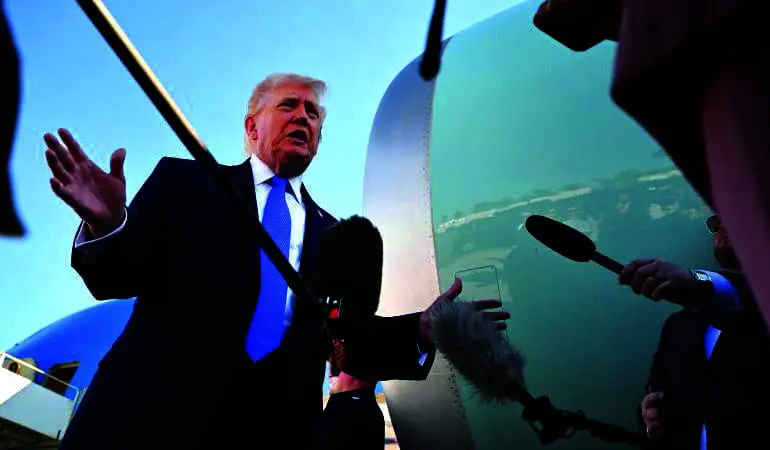

Since returning from China, President Trump has gradually adopted a noticeably softer tone toward Iran, tempering his rhetoric day after day while still keeping military threats as an option on the table.
Only days earlier, Trump claimed he had been “one hour away” from authorizing renewed military strikes against the Islamic Republic of Iran. By Thursday, however, the president was publicly speaking about a “near end” to the crisis, narrowing his stated objectives to what he described as the “highest and most important goal”, preventing Iran from obtaining a nuclear weapon while still insisting that Washington must secure control of Tehran’s stockpile of highly enriched uranium “one way or another.”
Trump also appeared to seize on a new Iranian ceasefire proposal delivered through Pakistani mediation as an opportunity to step back from the brink while framing the move as a strategic decision.
“The attack I decided to suspend would be underway in Iran right now,” Trump said, adding that he had been “one hour away” from approving military action before choosing to postpone it to allow negotiations another opportunity to succeed.
According to Trump, the delay followed direct appeals from Qatari Emir Tamim bin Hamad Al Thani, Saudi Crown Prince Mohammed bin Salman and UAE President Mohamed bin Zayed Al Nahyan. However, the three leaders have denied the claim for the appeal.
Negotiations gain momentum
As Washington’s rhetoric became less confrontational in recent days, optimism surrounding the negotiation track steadily increased.
Diplomatic sources now describe only a limited number of unresolved issues in the indirect talks taking place through Pakistani mediation, even as Tehran continues insisting on what it calls its “full rights”, including preservation of its nuclear program and authority over the strategic Strait of Hormuz.
Trump publicly expressed hope that the “Iran crisis” could soon be resolved, noting that a settlement would likely lower fuel prices that continue burdening both American and global consumers amid Iran’s continued leverage over shipping routes through the Strait of Hormuz.
Still, Trump simultaneously warned that military action remains an option if negotiations fail.
“Believe me, if we don’t get the right answers, things will move very quickly,” Trump said Wednesday at Joint Base Andrews. “We are all ready to move.”
When asked how long negotiations would be allowed to continue, Trump replied, “Maybe a few days, but things could move very quickly.”
He also confirmed ongoing coordination with Israeli Prime Minister Benjamin Netanyahu, who continues pressing for renewed military action against Iran despite Trump’s repeated claims that Netanyahu ultimately follows Washington’s lead on the issue.
Congress moves to limit war powers
At the same time, Trump nearly faced new congressional restrictions on military escalation with Iran.
Republican leaders in the U.S. House of Representatives moved to block a vote on legislation that would have required congressional authorization before any expanded war with Iran could proceed, just two days after similar measures advanced in the Senate.
Democratic lawmakers, joined by several Republicans, argued that the U.S. Constitution grants Congress, not the president, authority to declare war.
They also voiced growing concern that Trump may have drawn the United States into a potentially prolonged regional conflict without a clear long-term strategy.
Iranian skepticism remains high
Iranian officials, meanwhile, remain deeply suspicious of Washington and Tel Aviv, citing what they describe as previous American-Israeli deceptions during earlier negotiation rounds that later collapsed under pressure from Netanyahu.
Iran’s Islamic Revolutionary Guard Corps warned that renewed attacks would trigger a broader regional conflict extending far beyond the Middle East.
“If aggression against Iran is repeated, the promised regional war will this time extend beyond the region,” the IRGC said in a statement.
Iranian Parliament Speaker Mohammad Bagher Ghalibaf also warned that visible and covert enemy movements indicate the United States may be preparing for future attacks.
At the same time, Iranian President Masoud Pezeshkian reiterated Tehran’s willingness to continue negotiations but rejected any suggestion of surrender.
“Forcing Iran into submission through coercion is nothing more than an illusion,” Pezeshkian wrote on X.
A deal within reach?
Sources linked to the Pakistani mediation effort say conditions for a potential agreement are increasingly falling into place and that Washington appears prepared to work from a framework previously proposed by Tehran.
However, the primary obstacle reportedly remains Iran’s stockpile of uranium enriched to 60 percent purity and above, estimated at approximately 440 kilograms.
According to mediators, both the United States and Israel remain unwilling to accept any agreement allowing that quantity of highly enriched uranium to remain inside Iran.
Iranian Foreign Ministry spokesman Esmail Baghaei confirmed that Tehran had received “American viewpoints” and was reviewing them.
Meanwhile, Reuters cited a senior Iranian source saying that while no final agreement has been reached, “the gaps have narrowed.”
Reuters also reported claims from two senior Iranian officials alleging that Iran’s supreme leader, Mojtaba Khamenei, had instructed authorities not to remove highly enriched uranium from the country, a report Tehran later strongly denied as false.
On the American side, Secretary of State Marco Rubio expressed hope that Pakistani mediation efforts could help produce an agreement ending the crisis.
Rubio repeated Trump’s core demands: preventing Iran from obtaining nuclear weapons, securing control over enriched uranium and guaranteeing unrestricted passage through the Strait of Hormuz without Iranian fees or restrictions.
Israel prepares for prolonged confrontation
At the same time, Israel has intensified preparations for the possibility of renewed confrontation with Iran, amid growing assessments that any future war could extend for years.
Hebrew-language media reported that Israeli military Chief of Staff Eyal Zamir recently held multiple high-level security discussions coordinated with U.S. officials in an effort to prepare Israel’s domestic front for prolonged conflict.
According to reports published by Yedioth Ahronoth, Israeli security officials are increasingly attempting to prepare the public for a new strategic reality in which “the war against Iran may not end with a single strike.”
A senior Israeli security official told the newspaper that the public must understand the conflict could involve repeated military rounds for years.
“As long as the regime has not collapsed, we expect recurring rounds of fighting, perhaps annually, perhaps even more frequently,” the official said.
Even under the “most optimistic scenario,” he added, Iran would likely accelerate missile and weapons development regardless of any nuclear settlement.
Israeli concerns have also intensified following reports that U.S. missile defense stockpiles were heavily depleted during recent fighting.
According to the Washington Post, Pentagon assessments concluded that the United States expended more than 200 THAAD interceptor missiles defending Israel during the Iran conflict, nearly half of the U.S. inventory, in addition to more than 100 Standard-3 and Standard-6 missiles launched from naval vessels in the eastern Mediterranean.
Meanwhile, CNN reported that U.S. intelligence agencies believe Iran is rebuilding portions of its military infrastructure faster than expected, including restarting drone production only weeks after the ceasefire.
Lebanon tensions intensify
In Lebanon, the situation continues growing more complicated as the government of President Joseph Aoun and Prime Minister Nawaf Salam moves forward with direct negotiations involving Israel and efforts tied to the disarmament of Hezbollah.
At the same time, Washington imposed sanctions on nine Lebanese officials, including Hezbollah-linked lawmakers, Amal Movement figures and senior members of Lebanon’s military and General Security apparatus, accusing them of obstructing peace efforts and hindering Hezbollah’s disarmament.
Observers described the sanctions as part of a broader American effort to politically isolate Hezbollah and pressure Lebanese state institutions to distance themselves from the group.
Meanwhile, Hezbollah operations along Lebanon’s southern border have reportedly evolved beyond conventional rocket fire into more sophisticated combined attacks involving coordinated missile barrages and aerial drone assaults, including the first announced deployment of “Ababil” attack drones.
Israeli media outlets acknowledged that the Israeli military has struggled to establish operational control in southern Lebanon amid persistent Hezbollah drone attacks and mounting troop exhaustion.
Haaretz reported growing frustration within Israel’s military leadership over what officials described as military and political stagnation in Lebanon, while retired Israeli General Tamir Hayman reportedly described the goal of dismantling Hezbollah as “impossible.”
Gaza blockade deepens, Ben-Gvir’s brutality against Flotilla activists sparks international condemnation
Meanwhile, Israeli forces last week intercepted more than 50 vessels belonging to the “Global Sumud Flotilla” attempting to break Israel’s blockade of Gaza.
More than 430 international activists aboard the flotilla were detained after Israeli forces boarded the vessels in international waters near Cyprus.
Video footage circulated online showed Israeli troops firing at several boats before taking control of the flotilla and transferring activists to detention facilities near Ashdod.
Far-right Israeli National Security Minister Itamar Ben-Gvir later published videos showing activists handcuffed and kneeling in rows, sparking widespread international condemnation.
Several European governments, including Italy and France, summoned Israeli ambassadors in protest over the treatment of activists and the flotilla operation.
A United Nations spokesperson also called for the immediate and unconditional release of all detainees.
Inside Gaza itself, political paralysis and humanitarian catastrophe continue despite an existing ceasefire agreement.
At the United Nations Security Council, senior “Peace Council” envoy Nikolay Mladenov warned that Gaza’s current fragmentation risks becoming permanent, potentially confining more than two million Palestinians to less than half of the territory’s total area unless peace efforts are urgently stabilized.
Mladenov outlined a 15-point roadmap involving Hamas disarmament, Israeli withdrawal and immediate reconstruction efforts, though none of the proposed measures currently appear politically achievable in the near future.



Leave a Reply