




Few communities better illustrate the immigrant story than Arab Americans.
Across the United States — and especially in Metro Detroit, home to the nation’s largest Arab American community — immigrants from Lebanon, Iraq, Yemen, Syria, Palestine, Jordan, Egypt and elsewhere across the Middle East and North Africa have built businesses, staffed hospitals, launched companies, raised families and strengthened the communities they now call home.
Today, approximately 3.7 million Americans trace their ancestry to the Arab world. Arab Americans are physicians, engineers, entrepreneurs, researchers, educators, small-business owners and public servants. They have contributed to America’s economic growth, cultural richness and civic life for generations.
Many followed a familiar immigrant path. They arrived as students, professionals, refugees, investors or family members seeking reunification. They navigated years of visa applications, green card processing, government paperwork and uncertainty. They paid taxes, purchased homes, started businesses and raised American children.
For many, only one step remains.
Citizenship.
Now, just as millions of lawful permanent residents become eligible to naturalize, the federal government is proposing one of the largest citizenship fee increases in modern American history.
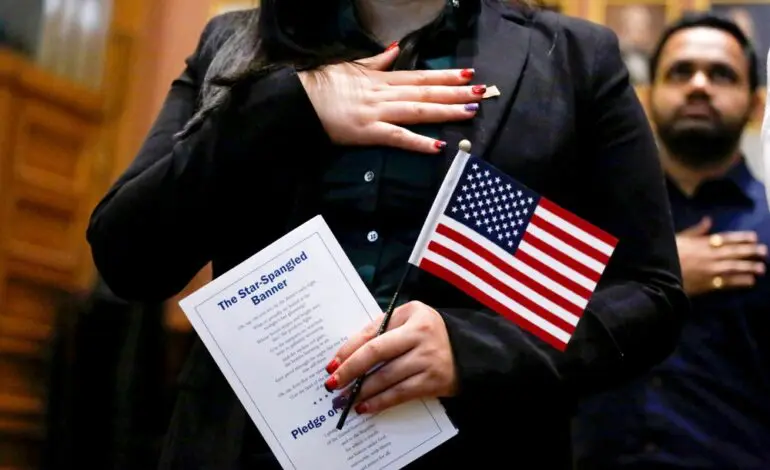
Citizenship represents something more than a legal status. It represents belonging. It represents security. It represents the moment when the country they chose finally chooses them in return.
The Department of Homeland Security has proposed increasing the filing fee for Form N-400, the Application for Naturalization, from $760 to approximately $1,330 for paper filings and from $710 to approximately $1,280 for online filings. The proposal would also eliminate most reduced-fee options and fee waivers that have historically helped lower-income immigrants pursue citizenship.
For many Arab American families, the proposal raises a simple but important question:
When did becoming an American become so expensive?
The answer reveals a significant shift in how the government views citizenship.
For decades, policymakers generally treated naturalization differently from many other immigration benefits. Citizenship was not viewed merely as a service provided to an applicant. It was viewed as a public good.
New citizens vote. They serve on juries. They participate more fully in civic life. They become permanent stakeholders in their communities and in the future of the nation.
Government policy reflected that understanding.
In the mid-1980s, the naturalization filing fee was approximately $35. During the 1990s, it rose to roughly $95. Over time, the fee increased gradually as administrative costs increased. Even then, policymakers generally accepted that citizenship applications would not necessarily cover the government’s full cost of processing them.
The goal was not merely recovering expenses.
The goal was encouraging citizenship.
The new proposal reflects a different philosophy.
DHS has made clear that previous administrations intentionally kept naturalization fees below actual processing costs and that the agency now seeks to recover the full cost of adjudicating citizenship applications. Citizenship is increasingly being treated as a service that should pay for itself.
A naturalization fee of roughly $35 reflected a government that viewed citizenship as something worth encouraging. A fee exceeding $1,300 reflects a government increasingly focused on cost recovery.
That shift is not merely financial. It reflects a changing philosophy about who should bear the cost of becoming an American.
For generations, America’s immigration story has not ended with a visa or even a green card. It has ended with citizenship.
For many Arab American families, citizenship is rarely the first immigration expense.
It is often the last.
By the time immigrants become eligible for naturalization, they have already invested thousands of dollars — and often years of emotional energy — into the immigration process.
There were student visas, employment petitions, family sponsorships, adjustment-of-status applications, medical examinations, biometrics appointments, travel documents and filing fees along the way. Many families have also paid attorney fees, translation expenses, document procurement costs and international travel expenses over the course of their immigration journey.
For some, the process has taken years.
For others, decades.
Some Arab American families arrived fleeing war, political instability, economic collapse or religious persecution. Others came through employment opportunities, educational programs or family sponsorship. Their stories differ, but many share a common experience: years of sacrifice before finally reaching the threshold of citizenship.
Citizenship represents the moment when much of that uncertainty ends.
It means no more immigration renewals.
It means the ability to vote.
It means the security of a U.S. passport.
Most importantly, it means knowing that the place where a family has built its life is unquestionably and permanently home.
That is why the proposed increase feels different from other filing fees. It arrives not at the beginning of the journey but at the very end, after years of patience, sacrifice and investment.
The United States currently has nearly nine million lawful permanent residents who are already eligible to become citizens.
Collectively, they represent one of the largest pools of future citizens in American history. No recruitment campaign could create such an opportunity. These future Americans are already here.
The question is whether public policy will encourage them to take the final step or place additional obstacles in their path.
Supporters of the proposal argue that government services cost money and that applicants should bear the costs of adjudication. That is a legitimate policy position.
But it is also reasonable to ask whether citizenship should be viewed differently.
After all, the benefits of naturalization extend beyond the individual applicant. New citizens strengthen communities, deepen civic engagement, start businesses, buy homes, volunteer, serve on juries and participate more fully in democratic life.
For generations, America encouraged immigrants to become citizens because policymakers believed those outcomes benefited the country itself.
Naturalization has long been one of the most successful integration tools in American history. It transforms newcomers into stakeholders. It turns residents into voters. It strengthens neighborhoods, communities and democracy itself.
The proposed increase would be easier to understand if applicants were seeing dramatic improvements in service.
Yet many immigrants report the opposite experience. Reaching a live officer is increasingly difficult. Automated systems often replace human interaction. Processing times can be unpredictable. If citizenship applicants are being asked to pay substantially more, it is reasonable to ask what improvements they can expect in return.
The question is whether America still wants to encourage immigrants to take that final step.
The proposed rule remains subject to public comment and further review before becoming final. If adopted, immigrants could face dramatically higher naturalization costs as early as late 2026 or early 2027.
For generations, America’s immigration story has not ended with a visa or even a green card. It has ended with citizenship — the moment when someone who chose America is fully welcomed into its civic life.
That tradition helped transform millions of newcomers into voters, homeowners, entrepreneurs, community leaders and proud Americans.
Today, millions of lawful permanent residents stand at that threshold.
For them, the question is not whether citizenship is worth pursuing. After years of sacrifice, investment and commitment, they have already answered that question.
The question is whether America still wants to encourage them to take that final step.
For families who have spent years navigating visas, renewals, government paperwork and immigration uncertainty, citizenship represents something more than a legal status. It represents belonging. It represents security. It represents the moment when the country they chose finally chooses them in return.
Whether America makes that final step easier or more expensive will reveal something important about how the nation views citizenship itself — not merely as a government service, but as an investment in people who have already invested so much in America.
– Richard T. Herman is an immigration attorney, entrepreneur and co-author of Immigrant, Inc.: Why Immigrant Entrepreneurs Are Driving the New Economy. For more than three decades, he has represented immigrants, founders, researchers, physicians, investors and families navigating U.S. immigration law and has spoken nationally on immigration, economic development, entrepreneurship and demographic renewal.



Leave a Reply