



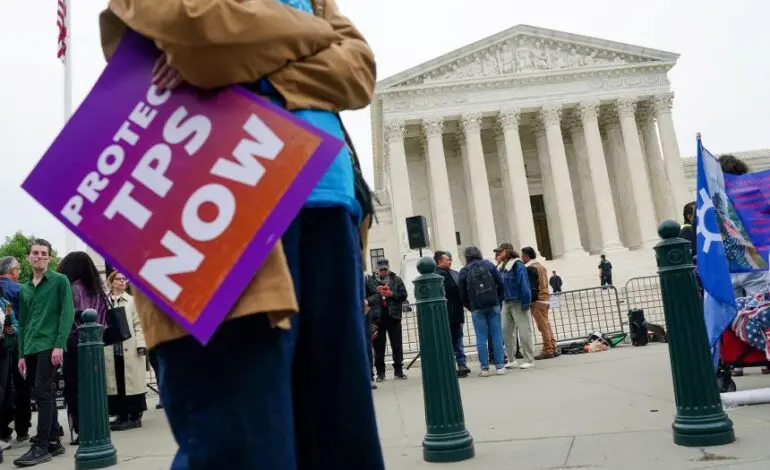

WASHINGTON, D.C. — The U.S. Supreme Court has cleared the way for the Trump administration to terminate Temporary Protected Status (TPS) for approximately 350,000 Haitians and 6,000 Syrians, a decision that could have far-reaching consequences for nearly 1.3 million immigrants from 17 countries currently living and working legally in the United States under the humanitarian program.
The ruling allows the Department of Homeland Security (DHS) to move forward with ending TPS for Haitians and Syrians while legal challenges continue in lower courts. Immigration attorneys say the decision is likely to influence dozens of pending lawsuits challenging the administration’s broader effort to dismantle TPS protections for immigrants from multiple countries.
Humanitarian protections at risk
Congress created the Temporary Protected Status program in 1990 to shield foreign nationals from deportation when conditions in their home countries make it unsafe to return because of war, armed conflict, natural disasters or other extraordinary circumstances. The program also grants recipients authorization to work legally in the United States.
Many TPS recipients have lived in the United States for decades, own homes and businesses, pay taxes and have children who are U.S. citizens.
When Trump returned to office, Venezuelans represented the largest group of TPS beneficiaries, followed by Haitians and Salvadorans.
Trump administration expanding rollback
The Trump administration has argued that the Biden administration dramatically expanded TPS protections without adequate vetting and maintains that conditions in several countries have improved enough to allow migrants to return safely.
Since taking office, the administration has moved to terminate TPS protections for nearly 1 million immigrants from 13 countries, including approximately 650,000 Venezuelans and 50,000 Hondurans. Decisions are also pending for roughly 200,000 Salvadorans and 100,000 Ukrainians, whose protections are scheduled to expire in the coming months.
Other countries with TPS beneficiaries include Afghanistan, Cameroon, Ethiopia, Lebanon, Myanmar, Nepal, Nicaragua, Somalia, South Sudan and Yemen.
Court sides with the administration
In its 6-3 decision, the Supreme Court’s conservative majority agreed with the administration’s argument that the Department of Homeland Security — not federal judges — has primary authority to determine when TPS protections should end.
The ruling represents a significant setback for immigrant advocacy organizations, which had argued that the administration failed to follow legal requirements by not fully evaluating current conditions in Haiti and Syria or consulting other federal agencies before terminating the protections.
“This decision is definitely bad news,” said Ahilan Arulanantham, co-director of the Center for Immigration Law and Policy at the University of California, Los Angeles, and one of the attorneys representing Syrian TPS holders. He warned that the ruling could undermine many of the remaining legal challenges to the administration’s efforts to end TPS.
Work permits could expire by late July
Immigration attorneys say the ruling is expected to take effect in approximately 32 days, meaning Haitian and Syrian TPS holders could begin losing their employment authorization by late July unless they qualify for another legal immigration status.
Advocates are urging beneficiaries to immediately explore alternative forms of relief, including asylum applications, family-based petitions or employment visas, although many acknowledge those pathways have become increasingly difficult under current immigration policies.
Without another legal status, affected immigrants could face detention, deportation proceedings, loss of employment and possible separation from their families, including children who are U.S. citizens.
Advocates say home countries remain unsafe
Immigration lawyers continue to argue that neither Haiti nor Syria is safe for large-scale returns.
Haiti first received TPS designation following the catastrophic 2010 earthquake, and protections have been repeatedly extended because of worsening gang violence, political instability and the collapse of public institutions.
Syrians were first granted TPS in 2012 after the outbreak of the country’s civil war. Although Syria’s government changed in late 2024, attorneys argue that years of conflict have left the country unstable and unable to safely receive returning refugees.
Advocates are now urging Congress to enact legislation providing permanent legal status for longtime TPS holders, arguing that many have built their lives in the United States and continue to contribute to their communities and the nation’s economy.



Leave a Reply