


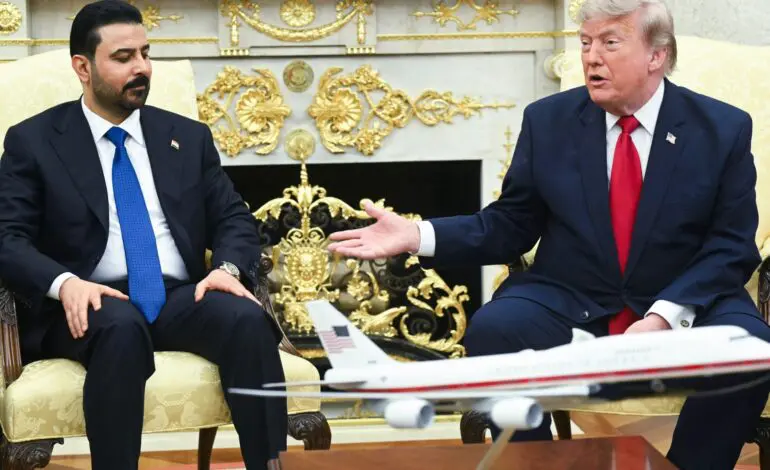

WASHINGTON, D.C. — Just two months after taking office as Iraq’s prime minister, Ali al-Zaidi received one of the strongest endorsements yet from President Trump during a White House meeting Tuesday, underscoring Washington’s growing investment in Iraq’s new leadership as it seeks to reduce Tehran’s influence over Baghdad.
Trump, who publicly supported Zaidi during Iraq’s recent government formation process, praised the first-time politician in front of reporters in the Oval Office.
“I put a very strong endorsement out because I was very unhappy with the man that was supposed to win the election,” Trump said. “This great gentleman, I think he’s going to end up being a great leader.”
The president also described Zaidi as “a great fan of America” before joking about the Iraqi leader’s youth and appearance.
The meeting, however, extended far beyond diplomatic pleasantries. It served as a clear signal that the Trump administration expects Iraq’s new government to move decisively against Iran-backed armed groups operating under the umbrella of the Popular Mobilization Forces (PMF).
Deadline to disarm armed factions
Following the meeting, Zaidi reaffirmed that his government intends to enforce a September 30 deadline requiring armed factions to surrender their weapons.
“Whoever surrenders his weapons, we will cooperate with them,” Zaidi said through an interpreter, emphasizing that armed groups should no longer function as permanent political or military institutions.
The demand reflects one of Washington’s principal objectives in Iraq: restoring the Iraqi state’s monopoly over the use of force while limiting Tehran’s influence over Iraqi security institutions.
Economic pressure helped shape Baghdad’s transition
The White House’s approach toward Iraq has combined diplomatic engagement with economic leverage.
Earlier this year, during heightened tensions between Washington and Tehran, the United States froze dollar shipments to Iraq and suspended portions of its security cooperation with Baghdad. Those restrictions were lifted shortly after Zaidi emerged as Iraq’s new prime minister.
Since the 2003 U.S.-led invasion, Iraq’s oil revenues — representing roughly 90 percent of government income — have largely flowed through the Federal Reserve Bank of New York, giving Washington significant influence over Iraq’s financial system.
Zaidi, whose professional background is in banking, has sought to portray his administration as committed to economic reform, foreign investment and anti-corruption efforts.
His government has launched one of Iraq’s most aggressive anti-corruption campaigns in years, leading to the arrests of two former oil ministers and dozens of senior officials while recovering millions of dollars in cash and gold.
Balancing sovereignty with outside influence
Despite the reform campaign, analysts continue to question how much independence Baghdad can realistically exercise while remaining financially dependent on Washington and politically constrained by Tehran.
Former U.S. Ambassador to Iraq Stuart Jones argued that Iraq possesses enormous economic potential but continues to struggle because of outside interference and inadequate infrastructure.
He said Iraq’s wealth could rival that of Gulf states such as Saudi Arabia and Qatar if Baghdad were able to make independent economic decisions free from external pressure.
Regional instability complicates reform
While Washington has framed Iran as the principal obstacle to Iraqi sovereignty, regional analysts argue that this year’s U.S.-Iran confrontation also inflicted significant damage on Iraq.
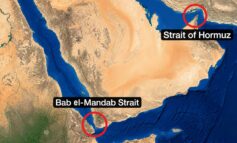
The temporary disruption of shipping through the Strait of Hormuz severely affected Iraq’s oil-dependent economy, costing Baghdad billions of dollars in lost revenue.
Earlier during the conflict, reports suggesting possible U.S. support for Kurdish operations against Iran also raised concerns inside Iraq that the country could once again become a battlefield for regional rivalries.
“Iraq seems to be a victim of the chaos in the region,” Gulf State Analytics CEO Giorgio Cafiero observed.
Trump rejected that characterization, insisting the Middle East has become more stable following U.S. military operations against Iran.
“We are getting rid of the bully of the Middle East,” Trump said. “Iran was the bully of the Middle East. They bullied Iraq. They bullied every country.”
Iran has rejected U.S. claims that its military capabilities have been significantly weakened and has shown no indication that it intends to encourage allied Iraqi factions to disarm.
Cafiero also expressed skepticism that Baghdad would be able to fully dismantle the Iran-backed armed groups in the near future, arguing that the Iraqi state still lacks sufficient authority to impose complete control over them.
Business ties emerge as cornerstone of new relationship
Despite the security challenges, both governments appear eager to expand economic cooperation.
Zaidi’s visit includes meetings with executives in Houston’s energy sector, where Iraqi officials are expected to discuss major investment opportunities, including a proposed Chevron pipeline project aimed at strengthening Iraq’s energy infrastructure and export capacity.
The Iraqi prime minister is also scheduled to meet members of the Iraqi-American Chamber of Commerce before concluding his first official visit to the United States.
For Washington, Zaidi represents an opportunity to deepen economic partnerships while encouraging Iraq to strengthen state institutions and reduce the influence of armed groups aligned with Tehran.
Whether Baghdad can accomplish those goals without provoking internal political instability remains one of the central questions facing Iraq’s new government.
Leave a Reply