




Regime Change is a devastating new book from two New York Times reporters; an extraordinary account of American chaos and decline at the hands of a madman and his enablers. Read it and weep.
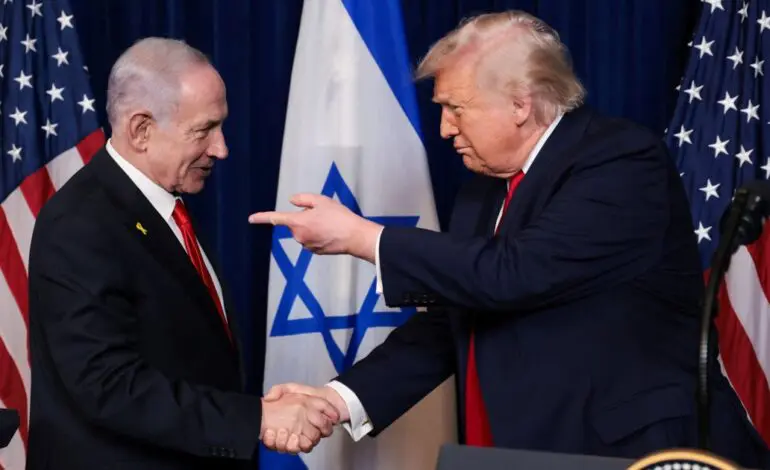
There are shocking headlines to be drawn from Regime Change, the new blockbuster by New York Times reporters Maggie Haberman and Jonathan Swan, when it comes to Donald Trump and Israel. Of course there are. It’s an astonishing feat of reporting. Every page seems to contain something appalling about Trump’s second lunatic term.
Early on, Trump is shown meeting in the Oval Office with Tucker Carlson and Elon Musk. Musk is distracted, the then-billionaire man-child “transfixed” by a golden pager given by Israeli Prime Minister Benjamin Netanyahu, “staring at it intently, silently working it between his fingers like a Rubik’s Cube.”
“‘Don’t push the button,” Trump joked.
It was February 2025. The president’s “joke” emerged from his fascination with Israel’s attack on Hezbollah leaders in Lebanon the previous September, using exploding pagers: an operation that killed at least 32, maimed more than 3,200 and was widely condemned as a war crime. Never mind pesky things like morality. As described by Haberman and Swan:
Trump then “regaled” his guests with horror stories of the destruction that the explosions had wrought. He had seen pictures, he said. Mutilated genitals and missing hands. He was horrified by the injuries, but fascinated as well, lingering on the scenes and the details. One survivor, he said, “looked like a great white came and just took a chunk out of him. It was like a shark bite. It was horrible.” He grew voluble, repeating, “It’s horrible, horrible!”
If you were paying attention in season one, you may recall Trump’s view of sharks according to Stormy Daniels – “He is obsessed with sharks… Terrified of sharks… ‘I hope all the sharks die’” – and you may laugh. But this is season two, altogether darker. The scene continues:
And there was something else that captivated him. Many of the devices had detonated in public, and it was hard to know who was holding a pager when it exploded. The indiscriminate nature of the killing and maiming had shocked Trump, and while he was taken by the ingenuity, he showed a measure of disbelief at its recklessness. He seemed at once enthralled and horrified.
This man is president. And yet the book has many more worrying places to go.
Carlson’s Oval Office visit also produces an exchange in which he tells Trump, Israel wants him “to go to war with Iran.” Trump says, “We’re not doing that.” Carlson replies: “Good, because the only thing that can blow up your administration is if you get into a war with Iran.”
Prescient words, for a Fox host turned testicle-tanning far-right podcaster who claims to have been attacked in bed by a demon. Granted, words recalled after the event, presenting their speaker in his best (testicle-tanning) light. Still, score one for Tucker.
As Regime Change is published, the Iran war Trump started on Israel’s say-so is lurching to a close. Or not. Lumbered with negotiations, Vice President JD Vance also has Trump’s promise of blame if he fails. With meticulous reporting including from inside the Situation Room, Haberman and Swan show how Netanyahu guided Trump into this hell and will do so again if he chooses, Vance just one more hapless lackey. Whatever the Israeli PM is, he is not an idiot. And he knows one when he sees one.
Reading Regime Change, it’s more than mildly disturbing to find one’s self experiencing the slightest, briefest, creeping, fragile hint of appreciation for the diplomatic efforts of Jared Kushner. Trump’s son-in-law has no official role in government or in attempts for Middle East peace. It’s clear he’s primarily in the game for his own obscene profit. His vision for a “New Gaza” is ridiculous, his version of peace not one that contains a scintilla of justice for the Palestinian people. But at least – at the very least – he’s tried to stop the killing. Compare him to Trump, and the Big Lebowski occurs: “Say what you like about Jared Kushner, at least he has an ethos.”
Then again, maybe not. Kushner, Trump’s real-estate pal turned haplessly overstretched envoy, Steve Witkoff, and their ally Tony Blair, a former prime minister who knows a lot about war, having built a good case to be indicted for war crimes, deserve every humiliation they get. And as Haberman and Swan show, under Trump they sure do get them.
Trump came up with a brilliant idea for how to save Gaza: “What if we own it? That’s a good idea, right? We’ll just own Gaza.” Mike Waltz, then national security adviser, and communications director Steven Cheung are among the profiles in courage shown kowtowing on that one. Unchecked, the mad emperor went out and spewed to the press.
“Legitimately nutso,” one senior aide said later. “But very on brand.”
It’s also very on brand only to voice such an opinion later, anonymously, to a couple of New York Times reporters with a book deal. But that’s the world we live in.
The U.S. does not own Gaza. Talks with Iran drag on. Israel keeps on killing, deaths from its airstrikes, drones, tanks and guns past 73,000, a dreadful feat in less than three years. Amid such obscenity, the best response to reading Haberman and Swan’s meticulous account of Trump’s Israel “policy” – a term used only as a catch-all, language not having caught up with the horror – is anger. Often as I read Regime Change I recalled my thoughts on reading Truss at 10, Anthony Seldon and Jonathan Meakin’s 2024 account of Britain’s own mad (thankfully former) leader, Liz Truss: Who the fuck are these people, and what the fuck do they think they’re doing with our countries?
Trump’s power and danger is fueled by his truly incredible ignorance. In scenes from summer 2025, Swan and Haberman show Kushner and Blair “at work on a postwar rebuilding plan for Gaza… jointly present[ing] their ideas to Trump on how to handle Gaza, with its millions of Palestinian refugees, in a meeting at the White House. When Trump looked over the plan, he offered a predictable comment about the prospects for building a Trump-branded hotel in Gaza – a remark an advisor quickly insisted was made in jest.”
No, again, it wasn’t. Nor is it remotely funny that a growing sense of optimism was punctured dramatically, Swan and Haberman write, “about 12 hours later, when Israel fired missiles at a site in Doha, Qatar, targeting a meeting of Hamas negotiators focused on a possible end to the war [in Gaza]… a stunning airborne attack on the capital of a U.S. ally whose leaders could help broker the very deals Trump was hoping for.”
Kushner and Witkoff were “enraged.” They can’t have been surprised.
According to Swan and Haberman, that September, Trump told Netanyahu: “Everybody’s sick of you, Bibi. All the Jews are sick of you. Even the two Jews on this call are sick of you.” The two men have had more clashes since. But Trump is consistent in nothing except his inconsistency. Netanyahu will always be able to bend the president’s ear.
There’s much more in Regime Change, about every aspect of Trump’s chaotic presidency, including a fuller version of an excerpt published by the Times in April, headlined “How Trump Took the U.S. to War With Iran,” which like other episodes features the sort of Situation Room reporting that reportedly has the White House worried about leaks. Such reports, usually in Axios, are of course constructed of anonymous quotes to reporters by aides professing to be concerned about anonymous quotes to reporters. The parlor game of working out who leaked what to Swan and Haberman is fun – hint: In the Situation Room, where recording isn’t allowed, some principals dialed in – but it’s ultimately pointless. As Zeteo has reported, the administration’s internal leak hunt hasn’t gone well, because everyone leaked. In the end, Washington’s gonna Washington, reporters gonna report.
It’s just as well that reporters as prodigiously talented, if now by their own accounts extremely tired, as Haberman and Swan will stay on the beat and the case. It’s also just as well that Regime Change contains clear indications the authors do not see themselves as holier-than-thou Times types, above the fray, claiming “objectivity”, reporting for posterity. Their tone is measured, on the page and in interviews too, but horror at what Trump has wrought runs through their work like a vein.
A sit-down interview finishes the book, Haberman and Swan on the other side of the Resolute Desk from their subject. What transpires is “legitimately nutso,” Trump delightedly comparing himself to Hitler, Mao, Napoleon and other leading maniacs, citing a “historian” who turns out to be Gary Player’s caddy. Swan and Haberman don’t like comparisons to Woodward and Bernstein but they can’t avoid them. Nixon in his final days, drinking and ranting at the tapes in the walls, was just a warm-up for Mad King Donald.
“We gathered our things and walked out,” the authors write, in their final lines, set in mid-March this year. “The rain had eased, though a heavy gray still hung over the capital.”
As Regime Change comes out, it is summer. In Washington, at sunset, the storm clouds are sometimes tinted orange.
Originally published by Zeteo. Edited for style.



Leave a Reply