



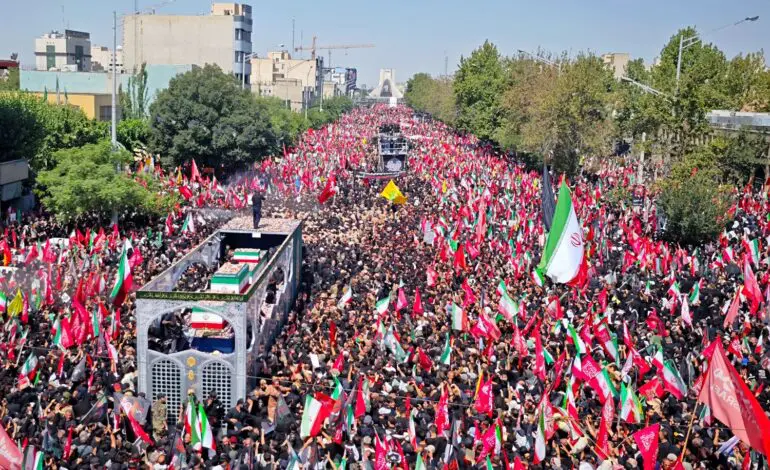

While millions of mourners participated in a six-day funeral procession honoring Iran’s late Supreme Leader Sayed Ayatollah Ali Khamenei, the U.S.-Iran memorandum of understanding signed last week came under immediate strain as Washington and Tehran exchanged new military strikes amid a growing dispute over the future control of the Strait of Hormuz and renewed Israeli calls for war.
Israeli Prime Minister Benjamin Netanyahu, who has been urging President Trump to continue military operations against Iran, declared that “the war is not over” and insisted that “Iran will never obtain nuclear weapons, with or without an agreement.”
Despite increasingly hostile rhetoric, including Israeli intelligence claims of an alleged Iranian plot to assassinate Trump, the limited exchange of strikes between the United States and Iran on Wednesday and Thursday suggested that neither side is seeking a full-scale war. Instead, analysts say both governments appear to be settling into a prolonged confrontation based on calibrated military pressure, economic coercion and strategic deterrence.
Washington appears to believe that continued military pressure combined with sanctions can force Tehran into further concessions. Iran, meanwhile, is relying increasingly on its geographic leverage over global energy supplies through the Strait of Hormuz, arguing that recent fighting demonstrated the limits of military force alone. Regional diplomatic efforts continue even as Israel prepares for the possibility of another round of strikes against Iran.
Khamenei laid to rest
Funeral ceremonies for Sayed Khamenei concluded Thursday in Mashhad, where he was buried near the shrine of Imam Reza, in accordance with his reported wishes. Iranian authorities organized massive public ceremonies throughout the city, with thousands waving Iranian flags and chanting anti-American slogans. Iranian officials estimated that as many as 15 million people participated in the burial ceremonies.
The funeral procession began in Tehran before traveling through Qom, Najaf and Karbala in Iraq, drawing large crowds and senior Iranian officials, including President Masoud Pezeshkian, Foreign Minister Abbas Araghchi and Quds Force Commander Esmail Qaani.
Khamenei and several members of his family were killed on Feb. 28 in a joint U.S.-Israeli strike on his residence in Tehran, according to the report. Iranian military leaders renewed vows during the funeral ceremonies to pursue those responsible for his assassination.
Military tensions rise again
The funeral coincided with renewed military escalation.
President Trump declared that the ceasefire reached with Iran on June 17 had effectively ended following attacks attributed to Iran against three commercial vessels in the Strait of Hormuz. He warned that any further attacks would trigger even stronger U.S. military action.
The United States subsequently expanded strikes against military sites, ports and facilities associated with threats to maritime navigation. U.S. Central Command (CENTCOM) said the operations were intended to reduce Iran’s ability to disrupt international shipping.
Iran reported that eight military personnel were killed in the latest U.S. attacks. According to Iran’s Health Ministry, strikes on July 8 and 9 targeted five provinces, killing 14 people and injuring 78 others.
The Islamic Revolutionary Guard Corps (IRGC) responded by announcing attacks on U.S. military facilities in Bahrain, Kuwait and Jordan, warning that additional American bases would become targets if military operations continue.
The IRGC also warned that any U.S. attempt to dictate navigation through the Strait of Hormuz would jeopardize the gradual reopening of the strategic waterway and threaten the interests of countries dependent on Gulf energy exports.
According to analyses published by the Financial Times, the Telegraph, the Guardian and Axios, the rapid deterioration of the memorandum of understanding reflects longstanding mistrust between Washington and Tehran, with both sides accusing the other of failing to honor their commitments.
Diplomacy competes with Israeli pressure
Even as military exchanges continued, diplomatic efforts intensified.
Regional mediation involving Pakistan, Qatar, Oman and Turkey continued in hopes of returning Washington and Tehran to negotiations.
According to the Telegraph, the Trump administration currently faces three strategic options: launch a broader war against Iran, continue limited military operations while maintaining economic pressure or return to negotiations under revised terms.
CNN reported that Pakistan and Qatar are actively attempting to revive direct talks between the United States and Iran.
Foreign Minister Abbas Araghchi also held telephone discussions with Pakistani Army Chief Gen. Asim Munir, Saudi Foreign Minister Prince Faisal bin Farhan, Qatari Prime Minister and Foreign Minister Sheikh Mohammed bin Abdulrahman Al Thani, Omani Foreign Minister Sayyid Badr bin Hamad Al Busaidi and Turkish Foreign Minister Hakan Fidan. Araghchi accused Washington of violating the memorandum of understanding and warned against further military escalation.
Israel, meanwhile, has continued urging a renewed military campaign.
Netanyahu reiterated that “the war is not over”, while Defense Minister Israel Katz said Israel is prepared for a “third round” of fighting with Iran. Israeli military Chief of Staff Lt. Gen. Eyal Zamir said Israel remains closely monitoring developments in both Iran and Lebanon and is prepared to act immediately if necessary.
Israeli media reported that Jerusalem is seeking Trump’s approval before participating directly in any renewed military campaign against Iran. American officials told CNN they have not independently verified Israeli intelligence alleging an Iranian assassination plot against Trump and suggested the report may have been intended to encourage further escalation.
Trump and Netanyahu also spoke by telephone Thursday regarding recent developments in the Gulf. According to Netanyahu’s office, they reaffirmed continued U.S.-Israeli coordination while discussing regional security and Israeli concerns regarding recent statements by Turkish President Recep Tayyip Erdoğan.
The conversation came amid reports of growing tension between Washington and Netanyahu over the memorandum with Iran. Trump recently remarked that Netanyahu “knows who the leader is” in reference to the U.S.-Israeli relationship. Israeli media reported that Netanyahu hopes to leverage an expected meeting with Trump as part of his upcoming election campaign.
Lebanon remains tied to regional negotiations
Renewed U.S.-Iran tensions have also affected Lebanon’s political landscape.
Lebanese authorities continue moving toward implementation of a framework agreement addressing the future of Hezbollah’s weapons while preparing for meetings in Rome on July 15-16 involving Lebanese and Israeli delegations under U.S. sponsorship. Lebanese President Joseph Aoun is also expected to travel to Washington on July 21 for talks with Trump.
Supporters of Aoun argue that Hezbollah has been significantly weakened and no longer possesses the political leverage to block implementation of the proposed framework agreement. Observers say the Lebanese government has delayed submitting the agreement to the Cabinet to avoid internal political divisions before broader negotiations are finalized.
Amid speculation regarding discussions between Trump and Syrian President Ahmad al-Sharaa about Hezbollah, Lebanese Parliament Speaker Nabih Berri dismissed suggestions that Syria intends to play such a role, telling the newspaper Al-Akhbar that the issue had been discussed candidly during his recent meeting with Syrian Foreign Minister Asaad al-Shaibani.
Berri added that, ultimately, Lebanon’s future remains closely linked to the U.S.-Iran memorandum of understanding currently under negotiation through regional mediation efforts that began in Islamabad.


Leave a Reply