



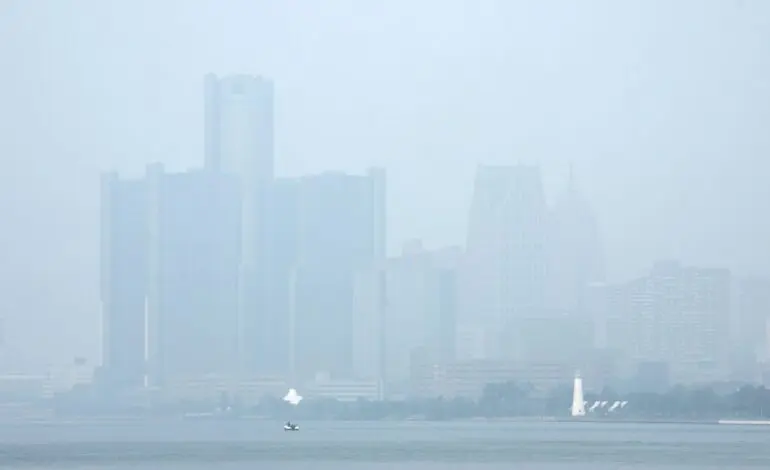

DETROIT — After enduring days of near-100-degree temperatures, Metro Detroit residents were hit with another wave of extreme weather this week as thick smoke from massive wildfires in Canada and northern Minnesota blanketed Southeast Michigan, creating hazardous air conditions, disrupting daily life and prompting health officials to issue emergency warnings.
Smoke from the wildfires drifted hundreds of miles across Ontario and northern Minnesota before settling over the Detroit area on Thursday and Friday, reducing visibility and creating a dense haze across much of Southeast Michigan.
Health officials said air quality in southern Michigan deteriorated Thursday morning to hazardous levels, prompting environmental authorities to classify the situation as an air quality emergency. Officials warned that the smoke posed a serious health risk, particularly for children, older adults and people suffering from asthma, heart disease or other respiratory conditions.
The dense smoke forced the cancellation of numerous outdoor activities throughout Southeast Michigan and even affected the judicial system. The Wayne County Circuit Court, Michigan’s largest trial court, suspended all court proceedings on Thursday and Friday because of the dangerous air conditions.
Highlighting the severity of the event, air quality monitoring website IQAir ranked Detroit as the city with the worst air quality among major cities worldwide on Thursday, recording an Air Quality Index (AQI) of 426. Detroit ranked ahead of Toronto (360), Minneapolis (349), Kinshasa, Democratic Republic of the Congo (161), Chicago (155) and Delhi, India (146).
As pollution levels reached what officials described as the worst ever recorded in the region, several businesses and entertainment venues temporarily closed. Public swimming pools in several suburbs were shut down, while businesses with outdoor attractions suspended operations. The annual Ann Arbor Art Fair also closed to visitors because of the dense smoke.
Residents received emergency alerts on their mobile phones advising them to stay indoors, keep doors and windows closed and set air conditioning systems to recirculate indoor air to prevent smoke from entering their homes.
The alerts also urged residents to wear protective masks if they had to be outdoors and advised children, seniors and individuals with respiratory illnesses to exercise extreme caution.
Meteorologists with the Michigan Department of Environment, Great Lakes, and Energy (EGLE) said the smoke episode was expected to last about 48 hours, with forecasted weekend rainfall likely to help clear the air and improve environmental conditions.
Air quality emergency
Smoke from the northern wildfires began reaching southern Michigan on Wednesday, prompting EGLE to issue a statewide air quality advisory warning of elevated concentrations of fine particulate matter capable of causing serious health problems when inhaled.
The agency said Michigan’s Upper Peninsula was the first area affected before the smoke spread into the northern Lower Peninsula and eventually reached Metro Detroit.
By Thursday, pollution levels in southern Michigan had climbed so high that state and federal environmental officials classified the situation as an environmental emergency.
Conditions were even worse in northern Michigan. Brian Hommel, emergency management coordinator for Marquette County in the Upper Peninsula, said ash was literally falling from the sky.
“It snowed ash on Wednesday and Thursday,” Hommel told The Detroit News. “When I left home for work, I found a layer of ash covering my car. I’ve never seen anything like it.”
Health officials urge precautions
Public health experts said the safest response during hazardous smoke events is to remain indoors with windows and doors closed whenever possible.
Officials also recommended using air conditioners and indoor air purifiers. Anyone who must spend time outdoors was advised to wear a high-quality respirator, such as an N95 mask.
People with asthma and other chronic respiratory illnesses face the greatest risk because wildfire smoke can inflame and narrow airways while allowing dangerous gases and microscopic particles to enter the lungs and bloodstream.
Relief expected
The smoke crisis marked the latest in a series of extreme weather events that have disrupted summer across Metro Detroit since late June.
Residents have already endured two major heat waves separated by severe thunderstorms that caused widespread power outages. The arrival of wildfire smoke further limited opportunities to enjoy parks, beaches and other outdoor attractions during what is typically one of Michigan’s busiest recreation seasons.
Forecasters expect rain moving into the region over the weekend to help disperse the smoke, improve air quality and bring cooler temperatures. Highs are expected to fall into the low 80s beginning Monday, offering residents a return to more typical summer weather after weeks of extreme conditions.


Leave a Reply