



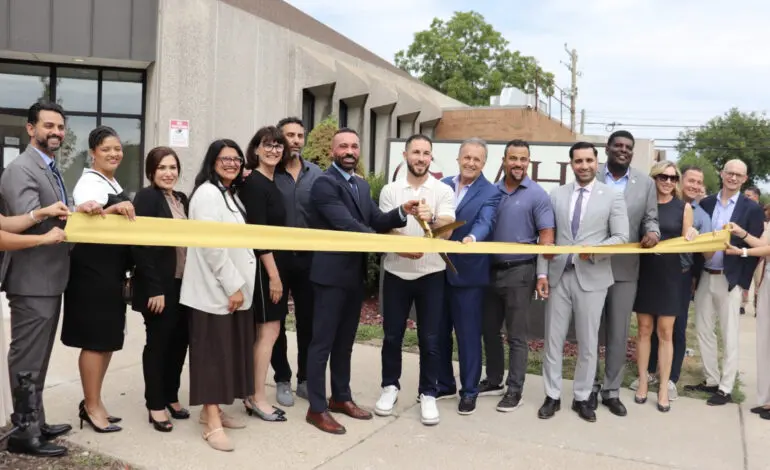

DEARBORN – Leaders Advancing and Helping Communities, the nonprofit formerly known as the Lebanese American Heritage Club, has opened a new behavioral health, education and workforce development center in Dearborn following a construction investment exceeding $3 million.
The new 6,500-square-foot facility is an extension of LAHC’s headquarters on Kenilworth Street in East Dearborn, where the organization relocated in 2022.
Completed after nine months of construction, the integrated center will expand LAHC’s mental and behavioral health, education, professional training and employment services at a time when the organization’s figures show growing demand for its programs.
In 2025 alone, LAHC officials said they served more than 80,000 people across its programs. That included 5,570 people who received mental and behavioral health services and 4,727 who participated in education and workforce development programs.
Once the center reaches full operating capacity, LAHC expects to serve approximately 20,000 additional people annually, according to organization officials.
LAHC President and CEO Wassim Mahfouz told The Arab American News that the decision to create an integrated 6,500-square-foot facility came after the organization’s experience demonstrated that the psychological, social and economic challenges facing families rarely exist in isolation.
A person struggling to secure stable employment may simultaneously experience anxiety, depression, financial stress, language barriers or difficulty accessing available resources, he said.
We wanted to create one welcoming place where a person can take care of their mental health, build their skills, prepare for employment and access other resources that can help their family become more stable and self-sufficient. — Wassim Mahfouz, LAHC president and CEO
Likewise, someone seeking behavioral health support or treatment for substance use or gambling addiction may also need help finding a job or improving digital skills.
According to Mahfouz, LAHC’s 2025 figures demonstrated a “tremendous need” for a more integrated service model.
The new center, which includes classrooms and computer-equipped training spaces, was built around a simple principle: People should not have to navigate multiple organizations and systems to receive the help they need.
“We wanted to create one welcoming place where a person can take care of their mental health, build their skills, prepare for employment and access other resources that can help their family become more stable and self-sufficient,” Mahfouz said.
Funding the project
The project relied on partnerships and financial support from several government entities.
Mahfouz said the principal capital funding included $1.5 million from the Michigan Department of Labor and Economic Opportunity and $1.35 million from Wayne County.
The project also received $500,000 in federal funding from the U.S. Department of Housing and Urban Development secured with the support of U.S. Rep. Rashida Tlaib.
Completing construction, however, was only the first step, Mahfouz said. Beginning with the planning phase, LAHC developed mechanisms intended to sustain its programs and services over the long term.
The organization uses a diversified funding model that includes government contracts, nonprofit foundation and corporate grants, charitable contributions and partnerships supporting workforce development services. Some eligible behavioral health services can also be covered through health insurance.
Mahfouz said LAHC now accepts several Medicaid plans for eligible behavioral health services. That will expand access to specialized mental health care while establishing a reimbursement model that can help sustain therapeutic services.
LAHC recognizes that government funding levels can change, Mahfouz added. The organization therefore continues to strengthen private-sector donations and develop a range of partnerships rather than depending on a limited number of funding sources.
Twenty thousand additional clients
Mahfouz said the projected 20,000 additional clients represent the anticipated annual increase across LAHC’s behavioral health, education and workforce development programs once the center reaches full capacity.
LAHC expects particularly strong demand for mental and behavioral health care, career counseling, job-placement assistance, digital skills, financial literacy, English-language education and workforce-readiness training.
The center will also provide services for people with intellectual and developmental disabilities and autism spectrum disorder.
Mahfouz said that demand is already becoming apparent. LAHC has expanded its behavioral health team to include licensed social workers and certified recreational therapists.
The expansion is part of a strategy to provide more therapy at LAHC’s facility while building stronger partnerships with local schools and community organizations.
The stigma surrounding mental health care
Mental and behavioral health services carry particular importance in the Dearborn area, where social and cultural barriers may discourage some Arab American and immigrant community members from seeking help.
“The stigma is still real,” Mahfouz said, explaining that discussions about mental health remain difficult within many Arab American and immigrant families.
Some people may feel comfortable saying that they are experiencing stress, exhaustion or sleeplessness, he said, but may feel less comfortable discussing depression, anxiety or the need to see a therapist.
Addressing the problem begins with normalizing conversations about mental health and recognizing it as an integral part of overall health, Mahfouz said. Mental health treatment should not be viewed differently from medical care for physical conditions.
Trust is also essential, particularly because LAHC has served the community for more than four decades.
Other cultural barriers include generational differences, fear of judgment from relatives or the broader community, limited understanding of behavioral health treatment and language difficulties.
Providing services through an organization and staff who understand a client’s language, culture, family dynamics and life experiences can make it easier to take the first step and ask for help, Mahfouz said.
The center’s behavioral health services include professional assessments, individual and family therapy, treatment planning and recreational therapy, as well as specialized services for people with disabilities.
LAHC’s new model does not follow a single path to care. A person may enter the center seeking employment, only for an initial conversation to reveal additional barriers that other LAHC programs can help address.
Most of the organization’s programs are offered free of charge or for a nominal fee because of grant funding and partnerships. Some behavioral health services may be covered by Medicaid, depending on the client’s eligibility and health plan.
For uninsured individuals, Mahfouz said LAHC will work to identify available programs, funding sources, referrals and other resources.
The goal, he said, is to ensure that financial circumstances do not prevent anyone from taking the first step and seeking help.
An integrated center
Combining behavioral health, education and workforce development in one location reflects LAHC’s belief that these challenges are interconnected and that families frequently experience several of them simultaneously.
“Life does not happen in separate silos, so our services should not operate in separate silos either,” Mahfouz said.
Mental health affects a person’s ability to work, while unemployment and financial instability can affect mental health.
Limited English proficiency can restrict someone’s ability to secure employment or navigate the healthcare system. Weak digital skills can prevent a person from applying for a job, accessing public benefits or even completing an online application.
The new center was designed to address multiple aspects of clients’ lives. Mahfouz said the approach represents the direction community services should take: Treating the whole person rather than focusing on only one problem or its visible symptoms.
“We cannot simply treat the symptoms,” Mahfouz said. “We have to address the social, economic, educational and behavioral health factors that affect a family’s ability to thrive.”
The project’s goal, he added, is to “create a place where people can walk through one door and find multiple pathways to opportunity, stability and hope.”
For more information about LAHC and its programs, visit lahc.org.


Leave a Reply