



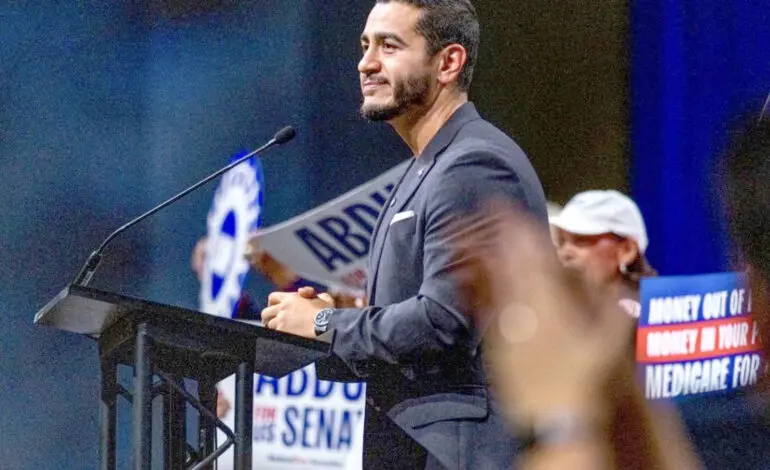

In an effort to unite Democrats ahead of November’s election, Michigan Democratic U.S. Senate nominee Abdul El-Sayed apologized to the Jewish American community for previous remarks he made concerning the March attack on Temple Israel in West Bloomfield Township.
Despite delivering the public apology twice at separate events within two days, some Jewish Democrats remain clearly hesitant to support the Arab, Muslim and progressive candidate. They include Michigan Attorney General Dana Nessel and Democratic congressional nominee Jeremy Moss, who currently serves in the State Senate.
El-Sayed’s apology comes as Michigan Democrats face an internal challenge in trying to bridge divisions between the party’s progressive wing and its traditional establishment. Jewish voters remain hesitant about supporting him because of his positions on Israel, previous statements and political associations, while Democratic leaders warn that continued division could benefit Republicans just weeks before absentee voting begins.
Tense atmosphere
A visibly tense atmosphere surrounded the Michigan Democratic Party convention in Lansing last Saturday, despite El-Sayed offering a formal and direct apology to the Michigan Democratic Jewish Caucus.
In one of the most notable indications of the divisions at the convention, El-Sayed did not share the stage with Democratic gubernatorial nominee Jocelyn Benson. Although both candidates delivered remarks, neither mentioned the other by name, highlighting the continuing tensions between the party’s progressive and establishment wings.
As Benson faces a concentrated Republican advertising campaign attempting to link her to El-Sayed’s progressive agenda, the Democratic Senate nominee is trying to mend relations with Jewish Democrats after a bitter primary campaign in which he criticized the influence of the pro-Israel lobby in American politics and highlighted the record funding his opponent, Haley Stevens, received from groups connected to the American Israel Public Affairs Committee, or AIPAC.
Throughout the campaign, El-Sayed has repeatedly criticized Israel and its brutal attacks on Gaza and Lebanon, as well as U.S. support for Israel. His positions have led pro-Israel advocates to accuse him of fueling antisemitism and prompted many prominent Jewish Democrats to withhold their endorsements of the party’s nominee.
El-Sayed’s apology
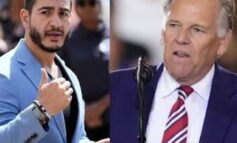
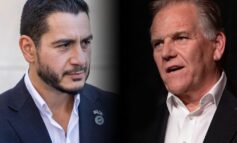
In an intensive effort to contain the growing divisions before facing Republican Mike Rogers in November, El-Sayed apologized to the Michigan Democratic Jewish Caucus on the sidelines of the party convention. He stressed that his remarks concerning the March attack on Temple Israel were never intended to justify what he called a “terrorist attack” in any way.
The explicit apology followed months of controversy over El-Sayed’s response to the attack, in which he said, “Hurt people hurt people”, while discussing the attacker’s motivations and the reported loss of members of his family in an Israeli airstrike in Lebanon.
The remark angered some Jewish Democrats, who believed it could be interpreted as justifying the attack, in which the assailant was killed. El-Sayed, however, had condemned the violence.
During his meeting with the Jewish caucus at the convention, El-Sayed acknowledged that his previous remarks were a mistake. He said he had attempted to provide context for the attack but later realized that doing so was inappropriate at a moment when the focus should have been on condemning the violence and recognizing the pain experienced by the victims and the Jewish community.
“I made a mistake,” El-Sayed said, stressing that he had never intended to justify violence or terrorism.
He added that his initial statement should have been limited to an unequivocal condemnation of the attack, emphasizing that “no one deserves to have their pain ignored or minimized.”
El-Sayed’s efforts were not limited to the apology. Before the convention, he intensified his conversations and meetings with Jewish Democratic leaders and community members across Michigan in an attempt to ease concerns about his positions on Israel and antisemitism, which have become major points of contention in his campaign.
In recent weeks, El-Sayed has also sought to soften some of his previous criticism of Israel in his campaign rhetoric and distance his campaign from Hasan Piker, the left-wing political commentator who endorsed him and appeared at campaign events during the primary. Piker’s statements concerning Israel and American Jews have drawn widespread criticism within the Democratic Party.
Nevertheless, El-Sayed’s positions on Israel and his previous association with Piker remained sources of tension during the party convention. That prompted El-Sayed to renew his apology the following day when he attended the Jewish caucus’ annual Summer Simcha gathering in Birmingham.
No explicit endorsement
Although she stopped short of explicitly endorsing El-Sayed, Michigan Attorney General Dana Nessel suggested in remarks delivered while she was being honored at the Birmingham event that Jewish Democrats may have to sacrifice their personal comfort and safety for what she described as an “opportunity to save the rest of humanity” from the threat posed by Republicans under President Trump.
The media was barred from attending the gathering, but a video recording showed Nessel speaking at length about the tension Jewish voters feel amid the anti-Israel rhetoric of some Democratic candidates. She did not mention El-Sayed by name, although he was present.
In recordings released through the media, El-Sayed repeated his apology at the Birmingham gathering.
“So I’m asking for forgiveness and a moment of grace,” he said. “I made a mistake.”
Despite emphasizing Democratic unity, Nessel refrained from explicitly endorsing El-Sayed.
“Come November, do what your Jewish values tell you to do,” she told those attending.
Nessel, who did not attend the party convention in Lansing because of concerns about her personal safety, said it is “very easy to hate people right now, especially other Democrats who seem to have abandoned us and let us down, despite the contributions we have made to our party throughout our lives.”
She said some people argue that Zionism is synonymous with racism or fascism, describing them as people whose understanding of Jewish and Israeli history extends no further than “a 47-second TikTok video produced by Qatar or Iran.”
Nessel invoked the story of Queen Esther, who risked her life to save the Jewish people. She said Jewish Democrats have “a moral imperative to place the needs of the world above even our own self-interest.”
“It is perhaps up to us now to follow in her path and sacrifice the comfort, safety and security, and even the very future of our own people, in exchange for the opportunity to save the rest of humanity,” Nessel said.
She added that many Jewish Democrats today feel “forced to choose between their faith and their party” amid the rise of anti-Israel rhetoric.
“What good is defending the historic homeland of our ancestors and demanding that candidates acknowledge its right to exist if the planet upon which it rests is no longer inhabitable?” Nessel asked.
Nessel sharply criticized Republicans for rallying behind Trump and raised concerns about climate change, wealth inequality and artificial intelligence.
“I see their embrace of selfishness and blind obedience to the biggest and most dangerous fool in the world as a direct abandonment of our responsibilities as Jews,” she said. “Our tradition imposes upon us a profound obligation to the world and the need to act compassionately toward others.”
“The Republican Party wants to convince you that the greatest issue facing our nation is transgender girls playing on junior varsity volleyball teams,” Nessel added. “How I wish it were that simple.”
Leave a Reply