



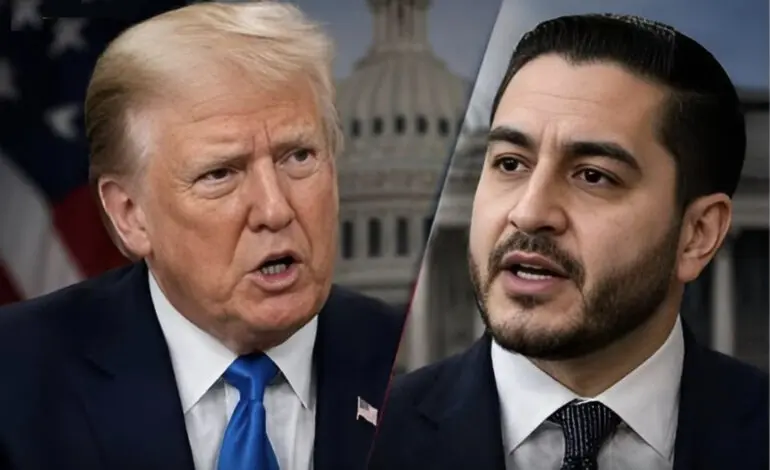

Over the past two months, I have been troubled by the political commentary I have encountered online and on television portraying Abdul El-Sayed, a physician with a Ph.D. in public health, as a potential threat simply because he is Muslim. What I find particularly striking is that some of these same voices passionately defend Donald Trump despite his criminal conviction, civil liability and long history of controversy. Why does one man’s religion provoke suspicion before his ideas are even considered, while another man’s documented conduct seems to do little to diminish the loyalty of his supporters?
This is not an argument that El-Sayed should be immune from criticism. Every candidate deserves scrutiny. Voters should examine his qualifications, policies, judgment, and positions on matters affecting the country. But that examination should be based on evidence, not religious identity. The same standards must apply to everyone seeking public office.
In 2024, Trump was convicted in New York on 34 felony counts of falsifying business records. A civil jury held him liable for the sexual abuse and defamation of writer E. Jean Carroll and a subsequent jury ordered him to pay additional damages for further defamation. His name has also received considerable attention in connection with the Epstein files. Further, his business career has been marked by multiple corporate bankruptcies and allegations from contractors and business partners that they were not paid fully or at all. His presidency has also drawn criticism over the handling of federal institutions, democratic norms, immigration enforcement, aid to vulnerable families, military actions and the growing national debt.
These matters deserve scrutiny and accountability. Yet some of Trump’s most devoted supporters appear more troubled by a candidate’s Muslim identity than by the controversies surrounding the president they admire. Somehow, the Muslim candidate must prove he is not a threat, while the president’s admirers find reasons to excuse his own record. That is the double standard worth examining.
Somehow, the Muslim candidate must prove he is not a threat, while the president’s admirers find reasons to excuse his own record.
A Muslim candidate may be unfairly held responsible for the actions of foreign governments, extremist groups or individuals simply because they share his religious faith, despite having no association with them. His faith becomes a political liability, and he may be asked repeatedly to demonstrate that his religion does not make him dangerous. Meanwhile, a politician with a substantial record of personal, legal and political controversies may receive the benefit of every doubt from supporters who consider him their champion. Why should the burden of proof be so different?
There is nothing unreasonable about questioning a candidate’s views on religious liberty, constitutional principles, civil rights, foreign policy or the separation of religion and government. Those are legitimate subjects for public debate. Voters should examine what candidates believe, what policies they propose and how they intend to govern. But assuming that someone is dangerous simply because he is Muslim is not political scrutiny. It is prejudice masquerading as prudence.
A person’s Muslim faith does not make them a threat to American democracy, just as being Christian does not guarantee honesty, compassion or a commitment to upholding the Constitution. Religious belief is neither a guarantee of moral character nor a reason to question someone’s integrity. The relevant questions are straightforward: What has this person done? What does he propose to do? What evidence supports our judgment of him?
The same questions must apply to political accountability. If honesty matters, it must matter regardless of party. If respect for the law is essential, it cannot become optional when a favored politician faces legal consequences. If protecting children, supporting vulnerable families and defending democratic institutions are genuine priorities, those concerns should not disappear when a political leader’s decisions conflict with them.
If respect for the law is essential, it cannot become optional when a favored politician faces legal consequences.
Political loyalty is not inherently wrong. People support candidates whose policies reflect their values. But loyalty becomes troubling when it prevents honest evaluation, turns every criticism into an attack to be dismissed and encourages people to judge opponents by standards they refuse to apply to their own side.
None of this requires anyone to support El-Sayed. Voters may disagree with his positions, question his proposals or prefer another candidate. That is their right. But those conclusions should follow an examination of his actual qualifications, policies and conduct — not assumptions about his faith.
Likewise, Americans who support Trump should be able to acknowledge legitimate concerns about his record without feeling that doing so betrays their political identity. Accountability should not be a weapon reserved for opponents. It should be a principle that applies to everyone. Ultimately, this is about more than two men or one political controversy. It is about the standards by which we judge people and the political culture we are willing to accept.
I believe character matters. Honesty matters. Integrity matters. How a person treats others and exercises power matters. These principles should carry more weight than religious stereotypes or unconditional political allegiance. If you are more disturbed by one man’s religious faith than by another man’s documented misconduct, perhaps it’s time to reconsider the principles and standards you use to judge others.
What I find most disturbing is the possibility that some people have become so focused on finding danger in another person’s faith that they have stopped asking difficult questions about the conduct of their own political heroes. America’s strength depends on equal treatment under the law, freedom of conscience and the principle that people should be judged as individuals. Those principles mean little if we abandon them whenever prejudice or political loyalty becomes more convenient.
We cannot demand integrity from one candidate while excusing another’s misconduct. When religion becomes a disqualification, but misconduct gets a pass, the double standard is hypocrisy. Faith does not define character, and political loyalty must never place anyone above accountability.
– Jamal I. Bittar is a university professor and opinion writer focused on Middle East politics and U.S. foreign policy. He is based in Toledo, Ohio. The views expressed are solely his own and do not represent those of any institution with which he is affiliated.


Leave a Reply